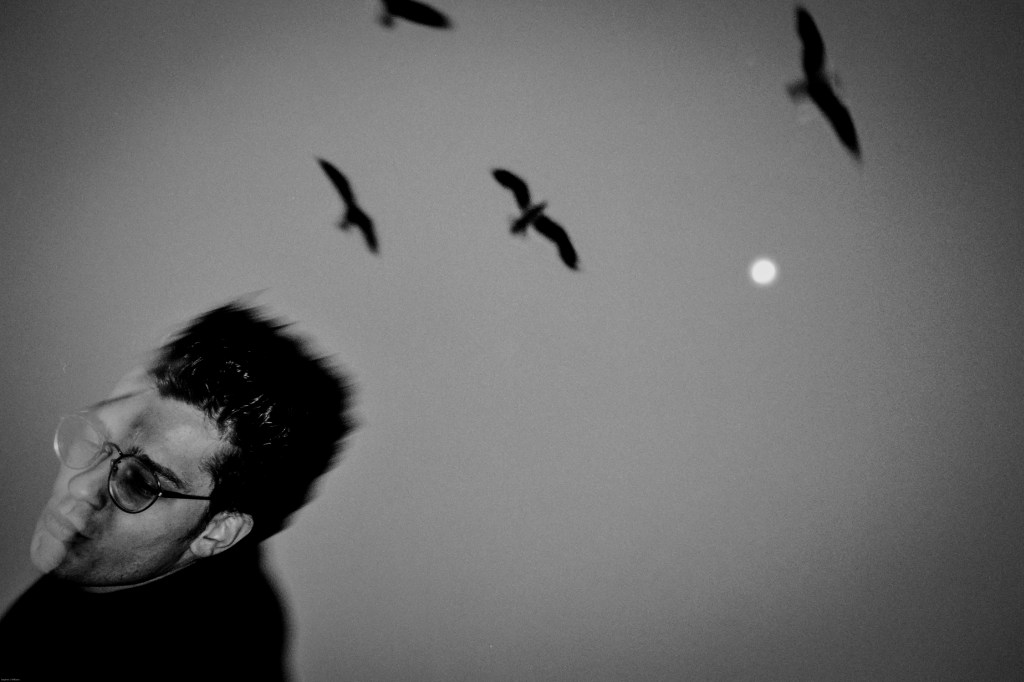
Someone I know has sent me to pick up a book. However, when I arrive at the shop I realise that the book is being designed, written and created as I wait for it, and that it has not been paid for. I am not happy about this, at first, but the book-creation process is very interesting… As soon as I arrived a camera mounted in a wall display took a picture of me and began to analyse and display a version of it on a screen. Sheets of paper begin to shoot out of a printer in the centre of the room. There are chapters relating to fashions in clothing containing many drawings about the development and materials all of which has been very neatly laid out. The machine continues to generate more details based on my name, age, physical condition, and so on, showing different versions of me, none of them actually me but, rather, versions of how I may have turned out under different circumstances or having made different choices. The printing machine at the centre of the room sometimes prints very large sheets, folds them, cuts them and re-folds them into elaborate paper models and packaging. Every new component is being stacked on a growing pile of fictional data amounting to many thousands of words, diagrams, and photographs. The stack includes a drawing of an ideal person I could be, and paper templates of suits and other things that could be made for me.
Author: Stephen J. Williams
-
‘The future’
I am in the future again. This time I am I being dragged around ‘the sights’ by a guide who it not very communicative. In fact, he doesn’t tell me anything at all, doesn’t answer any of my questions. Nevertheless I do appear to have complete access to his house and life. He is always around. There are always other people—all of whom are equally unhelpful. I wonder why. There is no doubt they still go out in the same way that people used to go out for a good time, except that that it doesn’t look like they are having a very good time these days. For a start, everyone is wearing white. Not only is everyone dressed in white, the dominant color choice for decor is also white. In the absence of talking and laughter, there does not seem to be much point in drinking or eating. The meeting places are lounges with long tables and sofas where people sit together for hours on end. It is not really clear to me what they are exchanging, if not words or conversation, but there is little talking being done. One afternoon, my guide is working on some papers at his computer. He hands me a pair of glasses, like a band of metal. At one end there are the letters “GLASS REC JON:” which is followed by a string of letters and numbers. I put the glasses on my head and, after a little while trying to adjust it, the image on the glasses has cut off what I would normally see through my eyes, and I can hear a drum beat through little speakers near my ears. Most troubling, though, is that I am thinking thoughts that are not mine and I know they are not mine. The disembodied thought seems to take me by the hand and drag me impatiently down the street. When I look into the cafés and clubs now I can see what it is that people are actually doing with each other: they are talking and sharing impressions and recordings that they have made. They are doing this with these devices attached to their heads. It doesn’t seem like a very good idea, but I can see why it’s popular. For a start, there are no awkward spaces or silences; they have been edited out. We are walking along a small street where the outer wall of a garden surround a house or business has little planting boxes in it. My guide sends me a recording through the glasses, like a memory, that shows how one night he had pissed in all the plant boxes. “It wasn’t very nice of me, pissing on all their strawberries.” Later, everyone in the house is surprised to hear I think it is obvious their failure to communicate directly is the main reason they are so unhappy. “Are we unhappy?” “I didn’t know… That’s horrible.” Several of them leave the lounge room to get coffee. Later, while I am recording a message through the glasses I notice that the image of myself is not quite right, perhaps because it has been made from the ‘inside-out’. In any case, I decide to compare the image of myself with my real self and to do this by opening my eyes. I open my eyes. I expect to see myself like I would see myself in a mirror, but there is no mirror. All I can see is [a cupboard and a part of the ceiling in my room.] I close my eyes and see the image of myself in the recording. I open my eyes again, and again nothing, except that in my mind is a flash of recognition that my real body is several shades lighter in color and heavier in weight than the one in my dreams.
-
‘The Bullet’
It is the future again. I am in a large skyscraper where some renovations are being done to the elevators. Some of the elevators are still in use, some surrounded by high fencing. Queues are growing around the elevators and people start to remove some of the fencing that protects the elevators that are not working properly. I decide not to go in them. I find, instead, a moving walkway, like those used in airports, and that this new service has just been opened. It is called ‘The Bullet’. I step onto the walkway and it immediately begins to gather speed. I am surprised that it does not remain horizontal. It is taking me down the side and outside the building at tremendous speed and there seems to be no way to get off it. Other people on the walkway move to different lanes with ease while the walkway appears to compensate its speed allowing them step between the lanes without falling over. I give it a try and it works. When I am outside, however, the walkway continues to move me out of the city into areas I have not seen before. It is a wholly new city, really. Have I really been away this long? Could it have changed so much that I am a stranger in my own hometown? The walkway is speeding me further into unknown territory. There are cars, but the ‘walkers’, if that’s what they could be called, are moving just as quickly. I step off the walkway at an intersection where there appears to be some maps and travel information. None of it makes any sense to me. I ask for help from a young man who is handing out printed information at a stand that prints all newspapers and book as they are requested. It is a bookshop, the centrepiece of which is a machine for making books, maps and newspapers. The young man prints out a docket that has a long series of stops and directions on it, telling me where I have to get on and off different modes of transport that will take me home. It looks very complicated. “Is there any way I could get a taxi around here?” I must look very weak. Maybe I am close to tears. “It’s all right, Sir. I am finishing here, soon. I’ll take you there.”
-

‘Flying lessons’
I am giving flying lessons. Not flying lessons in any kind of aircraft, but the kind of flying people do using their arms and wind currents. It occurs to me straight off that it’s a bit odd that I am giving this lesson to someone who appears not to be present with me. That is to say, I am the only one who is doing the flying. However, this problem doesn’t engage me for very long because there is flying to do and if I worry about those other things too much I am going to lose elevation. It seems right to remark early on that people new to flying find it difficult to control the flight path, but a little practice is all that is needed and the early difficulties usually disappear quickly. Now that I appear to have established a smooth gliding pattern, I remark that subtle adjustments can be made by the position of the feet, using them as rudders. Under normal conditions the toes should remain pointed. Yaw and pitch are controlled with various parts of the body—feet, ankles, hands, and wrists—being adjusted carefully. At this moment—I still have not achieved much altitude and I am flying across a broad and shallow river—I am suddenly swept up in a terrifying turbulence and there is very nearly a disaster. I look up to see that a large, passenger aircraft, taking off from a nearby airport, has very nearly sucked me into its enormous engines as it crossed my path. This dramatic incident reminds me that there is, as yet, no agreed system for controlling the flight paths of low-flying passenger planes and humans. I have gained some altitude now. I can see suburbs, parks and football fields below me. I feel a little tired and know that I will have to land soon. As I make my descent onto the football field I become entangled with a flock of birds. Some of the birds are attacking me. When I come down to the ground, with a thud, there is a great weight on my head, and I cannot see whatever it is that seems to be pressing my head down. I try to get it off, using my arms and hands without any effect. I’m not successful and have to wait for one of the footballers to come over and remove the thing from my head. I look up to see what caused my crash. “It’s an enormous duck!” I say. “He said it’s a duck. That’s funny!” the footballer shouts, as he tries to catch the flapping bird. He grabs it and encloses it in his arms as he runs off, followed by several other players. I imagine they are going to pluck it and try to figure out how to cook it.
-
‘The scene, the struggle, the after-party’
The scene is the area of Brunswick where my mother lives and where I lived from the age of fourteen. There are cafés that are familiar to me or to my dreams… I can’t remember whether they are real places. I am being attacked. Hopeless at fighting, all I can do is hold on tight. I manage to get the man, who my mother knows, into an arm-lock that effectively paralyses all attempts at escape. This is fine, except that I must hold him in this position forever if I am to escape being beaten up. So, I hold on tight. The struggle goes on a long time. We are able to move our legs. Slowly, the struggle moves from the doorway of one of the cafés to the footpath. And then from the footpath to the gutter. And then from the gutter to the road. We stop the oncoming traffic, the drivers looking from inside their cars at the peculiar way I am pressing his face into the bitumen. It seems necessary at this point to clear the road, so the struggle moves slowly back into the gutter, and then from the gutter back onto the footpath. At least an hour has gone by, maybe two hours. We are exhausted and the struggle must end somehow soon. When I let go, both of us are so weakened that neither attempts any further attack or defence. Instead I find myself slumped in a chair in what appears to be some kind of club. It is dark inside and the music very loud. I am surrounded by a crush of young people. Directly in front of the row of seats where I am is a large console, like an electronic juke box, with a touch screen a dozen feet wide and six feet high displaying the timeline of songs chosen by the people at the club and the thousands of other choices that can be made by anyone who has managed to make their way through the crowd to the screen. I feel out of place, until I realise that everyone is happy and no one seems to mind me being here. The only worrying thing about this place is that its mood seems to be chemically induced. A girl sitting next to me offers me something to take. “It won’t hurt you,” she says. It doesn’t look very nice, though. I take the smallest bite off it. It is chocolate on the outside and has the acidic taste of adrenaline on the inside. “Thank you,” I say, but I don’t take another bite.
-
‘Stolen bookshop’
A Dickensian curmudgeon is standing high up in the stacks of bookstore on stairs that wind around all its walls—up, down and across. The Dickensian curmudgeon talks to the three of us in increasingly haughty and threatening tones, but about what, exactly, it is difficult to say. The subject of his talk appears to be very specific and very useful, like the books in his bookshop, which are on subjects like ‘Production in 1878’ or ‘Conditions report—March to April’. We listen to him speak but don’t really know what he is talking about. We can hear a tapping sound in the background, though, that is getting louder and louder. At first, I believe he is making this noise with his hand on the railings of the stairs that wind around the book stacks. However, the sound has become unbearably loud. The sound is actually coming from somewhere else and the Dickensian curmudgeon is only keeping time with it. There’s no discussion and before I know what has happened the curmudgeon is dead. When the body is hidden and the laneway entrance to the bookshop bricked up so that there does not appear to be any shop there at all, we remember there was another way in. A new bookshop can be opened from the old one’s rear entrance. The others weakly attempt a celebration, dress up and sing verses of a comic opera—something where the rhymes are new but the music always sounds the same. It’s a total failure and not very comic. One of the others, far off, sings “We’re off to sleep now the old man’s dead.” I interrupt the black recital: “Oh, no, we’re not going off to bed… And that’s vaginal!”
-
Not a threepenny opera
“Why, if Mr and Mrs Been-to-La-Boheme-six-times can have their seats subsidised without filling out a form in triplicate, are the processes for writers’ grants so damned complicated and exhausting?”
Toner-gate, Victoria’s little arts scandal, revealed some interesting facts about government and administration of the arts. Firstly, public sector employees working in the arts believe that going to arts events is “a fundamental obligation of their professional life”. Penny Hutchinson, Director of Arts Victoria, rejects the idea that free tickets to arts events should be registered as gifts. The Ombudsman concluded, “a lack of management and auditing at Arts Victoria contributed to a culture that allowed the corrupt conduct to go undetected”.
Secondly, the Director of Arts Victoria told the Ombudsman that department employees keep a diary of their attendance at arts events. However, neither the Arts Victoria website nor the Department of Premier and Cabinet (DPC) annual reports of Arts Victoria’s activities contain statistical information gathered from employees or arts organisations about the numbers of tickets given away, for this or any other purpose. Detailed statistical information about attendance at arts events comes mainly from Australian Bureau of Statistics data from census interviews. The Arts Victoria website is an analytical wasteland. Sure, you can find out how much money the government spent and on what projects. When percentages and dollar figures are provided, they all point to the munificence of the public purse and the crucial role of the arts in the economy. They are statistics served up like comfort food to make the public sleep.
Third, though Toner-gate is trivial compared to other public sector governance problems (annual expenditure on ICT in Victoria is around $1.6 billion), the numbers are not trivial to artists themselves—especially artists, like writers and poets, who are not part of the ‘color and movement’ industry. Chris Flynn, who organises writers’ events in Melbourne, posted on Facebook the day the Toner-gate news broke, “Thank God I didn’t get those Arts Victoria grants after all—turns out they needed 80 grand to buy toner.” I suspect this reaction would be mild among writers.
The ABC’s comedy series ‘Angry Boys’ was viewed by “just” 569,000 viewers on Wednesday 15 June 2001, when it went head-to-head with broadcast of a state of origin rugby union match. Chris Lilley, the comedic artist in question, must think that such contests are a harsh proving ground.
Go the Melbourne Symphony Orchestra (MSO) website and look at the 2010 annual report and you will find that in 2010 the total audience for 2010 was 181,387. The total “paid attendance” was just 121,330. It’s not clear from the report whether any of these figures includes free concerts in the park (40,000 in attendance) or other outreach programs. Using the two available numbers, 33 per cent of seats at concerts are given away.
The Victorian Opera annual report includes the tantalising remark that audience figures are prepared according the standard Arts Victoria methodology. Gosh. Arts Victoria has a methodology for counting audience numbers? —Its annual report does not say what it is. Neither does its website. And this is strange because performing arts publications make so many remarks about audience numbers, it would be handy to know if there is a ‘special’ way of counting them.
The VO says that the total audience in 2010 was 41,799. This number includes dress rehearsals, educational and promotional events, and even 6,500 at free concert in The Bowl with the MSO. Leave all free seats in, and any others that may or may not be free, and divide it into the total of government grants (including a small sum from the federal funding body), and it appears that every single seat at an opera event is subsidised to the tune of $91. This figure is closer to $150 if you exclude seats given away for whatever reason; but, because we don’t know how many seats are filled by arts administrators for the purposes of “professional obligation”, there is no way of telling how high the figure goes. To be fair, the numbers should look better if one took into account that public funds also pay for modest administration, marketing and other expenses.
None of this even touches on the extraordinarily generous donations received by the operatic arts by various kinds of patrons, though it is interesting to note that the VO annual report has two not-quite-full pages of these donors’ names, some of whom gave over $20,000 and at least one (I wonder who?) who came up with $2.

The Threepenny Opera was one of the first musical films. Weil and Brecht filed lawsuits against the production company over its handling of the script and music; and both collected damages. The film was screened for the first time in February 1931. And the numbers were especially healthy in 2010 because of the spectacular success of Kurt Weil’s ‘Threepenny Opera.’ More than ten thousand people attended 22 performances, about two and half times more than the next most attended opera and about five times more than most.
Why is the writer beating up on the euterpean muse? (I didn’t even look at the statistics for the ballet. My pure heart would be too beaten up!)
Arts Victoria’s and DPC’s websites used to bulge with business plans and targets related to the ‘Creative Capacity +’ framework for arts development in Victoria, a document that, now, even Google can’t find in the Orwellian memory hole of documents published on the Internet.1 I used to look into them to wonder, as I do now after Toner-gate, how little light these numbers, goals and performance measures throw on the ironies of arts funding.
Why, if nearly a third of seats at some concerts are unpaid for, is there no detailed information about how the seats are filled?
Why, if public taxes pay for astonishingly expensive artistic productions, are these productions not televised?
Why, considering apparent waste and inefficiency, can no public funds be found to support a poetry recitation prize for Victorian secondary school students? And why, if Mr and Mrs Been-to-La-Boheme-six-times can have their seats subsidised without filling out a form in triplicate, are the processes for writers’ grants so damned complicated and exhausting?
Why, if arts administrators can have free tickets to attend arts events, can we not provide the same advantages to artists themselves? I could, within a week if asked, provide a list of several hundred creative writers whose artistic education would be enhanced by nights at the opera and in our concert halls and theatres, myself included.
Penny Hutchinson’s tortured responses to the Ombudsman’s report demonstrate, amongst many other things, that she has no imagination. Maybe that’s what it costs you when “professional obligation” takes you out for a night on the town.
- The document can still be found in Pandora, the government repository of stale, public websites: Creative Capacity +. ↩