-

Updated reading (and looking) lists
Links to artists, writers, and reading sites are being updated. You can read them here …
— Or at the pages in the top ‘Links’ menu.
You can write to me to suggest additions. (No promises.)
- alex cothren
- Alex Creece
- B. R. Dionysius
- Benjamin D. Muir
- Don Walker
- Ella Skilbeck-Porter
- Gayelene Carbis
- Gregory Woods
- Jack Callil
- James Walton
- Kelly Gardiner
- Martin Duwell – Australian Poetry Review
- Michael Farrell | Author | Giramondo Publishing
- Nigel Featherstone
- Philip Salom | Fiction & Poetry
- Robyn Rowland
- Steve Turtell
- Stuart Barnes
- The Other Adam Ford
- Thomas Mayo
- tim loveday
- Ursula K. Le Guin
- 3Elements Review || A Literary Journal
- 32 Poems Magazine | Poetry for the ear, the eye, and the ego.
- Since 2011, George David Clark has edited the journal, now based in Washington, Pennsylvania. In 2013, 32 Poems expanded to begin publishing regular prose features online. These reviews, essays, and interviews have themselves been reprinted in collections of essays and criticism and in such series as the Poetry Daily Prose Feature. The journal also partners with teachers of creative writing through a program called 32 Classrooms in which editors introduce students to the craft of literary editing, discuss work featured in recent issues, and invite student contributions to 32 Poems’ prose features.
- ABR Inglis Fellowship
- Abstract Mag TV – Contemporary Expressions
- Abstract is a Pushcart Prize-winning fine arts journal featuring a broad range of artistic works curated from an international group of exciting and innovative creative talent. Abstract seeks fine art in all forms that engages with both the crises and joys of our shared human condition. We seek art that engages the edge of now; we seek to explore a future forward zeitgeist with a respect for the gifts of the past. We are looking for both established and emerging artists across genres. Our criterion is quality.
- ACU Prize for Poetry
- Acumen Poetry | Poetry Prose Reviews
- Acumen is among the longest-running literary magazines today. Patricia Oxley started Acumen in 1985 armed with only an electric typewriter, and without subscribers or contributions. Since then it has grown to one of the country’s leading literary journals.
- Adelaide Literary Magazine — NY and Lisbon
- Adelaide Literary Magazine is an independent international monthly publication, based in New York and Lisbon. Founded by Stevan V. Nikolic and Adelaide Franco Nikolic in 2015, the magazine’s aim is to publish quality poetry, fiction, nonfiction, artwork, and photography, as well as interviews, articles, and book reviews, written in English and Portuguese. We seek to publish outstanding literary fiction, nonfiction, and poetry, and to promote the writers we publish, helping both new, emerging, and established authors reach a wider literary audience.
- Aeon | a world of ideas
- Aerogramme Writers' Studio
- Aesthetica Magazine – Aesthetica Art Prize
- Aesthetica Magazine – Creative Writing Award
- American Poetry Journal | publishing exceptional poetry
- American Poetry Review
- The American Poetry Review is dedicated to serving a worldwide audience excellent contemporary poetry and literary criticism. APR also aims to expand the audience for poetry, to provide poets with a far-reaching forum in which to present their work. The American Poetry Review has been in continuous publication since 1972 and has published the work of over 6,000 writers.
- ArtsHub (opportunities listing)
- ASAL | Association for the Study of Australian Literature
- asaustlit — Linktree
- Atrium
- Australia Reads — Literary Calendar
- Australian Writers' Centre
- BACKCHANNELS – FOR WRITERS, ARTISTS, AND READERS
- bæst
- Blackbox Manifold
- https://sites.google.com/sheffield.ac.uk/blackboxmanifold/home https://sites.google.com/sheffield.ac.uk/blackboxmanifold/submissions Blackbox Manifold is an online forum with a slant towards innovative poetry that has prose, narrative, or sequences in its sights. That said, we don’t hold allegiance to any one poetry school or group, and we’re happy to receive submissions from established and emerging poets alike. Our aim is to present new juxtapositions of voice while using the web’s fluid solidity to cast around for as wide and varied a readership as possible. The journal is continuingly archived by the British Library in its Web Archive. On occasion, a current topic or event will be the focus for an issue – in bringing together poems that warp current woofs our hope is that some news, at least, may be broken. Voices that record by trembling are always welcome. But to ensure that we don’t settle into familiar patterns, guest editors will also occasionally be invited to take charge of an issue and solicit new work. Calling on a range of poets for editorial advice is fundamental to our own collaborative approach.
- Brunswick Street Gallery
- Calls for submission, competitions, and opportunities in Australia – Australian Poetry
- Camberwell Art Show
- Chill Subs – The place for writers
- Coastlines Journal | A Journal of Good Writing
- Cordite Poetry Review
- Creative Australia
- Critical Inquiry
- Critical Inquiry – Facebook
- Current Affairs
- Eunoia Review
- Existential Comics
- Fellowships | Copyright Agency
- Flying Islands Pocket Poets
- Google Arts & Culture
- Griffin Poetry Prize
- Griffith Review
- https://www.griffithreview.com/for-writers/
- Hornsby Art Prize
- Hunter Writers Centre
- Newcastle Poetry Prize
Newcastle Poetry Prize
- Identity Theory
- Identity Theory is an online literary magazine and cultural hub that has been publishing original writing, interviews, and other forms of creative expression since July 2000.
- ISLAND — Australian Literary and Arts Magazine
- Jacaranda Journal
- Kleksograph
- La Mama Theatre – poetica
- lana turner journal
- Lazuli Literary Group | AZURE Journal
- Limina: A journal of historical and cultural studies
- A journal of historical and cultural studies, Limina, has been published at the University of Western Australia since 1995. The journal's editorial collective works with an international advisory board to publish two issues each year: a themed issue (linked to the Limina Annual Conference theme), at a minimum, a general issue.
- Liquid Amber Press
- https://www.facebook.com/LiquidAmberPress
- London Review of Books
- Matter
- Meanjin
- Melbourne Prize for Urban Sculpture 2026 | One of the most valuable arts prizes in Australia
- Monday Markets Archives – Erika Dreifus
- n+1
- Narratively | Substack
- Off Season
- Off Season is an independent quarterly literary magazine that celebrates the rough patches of a creative life. We exist as a respite from the rejection, writer’s block, and self-doubt that follows creatives, whether you are at the beginning of your career, or well established in the literary and artistic community. We aim to be a refuge for anyone trying to persevere as a writer, poet, or artist, and to help you find ways to pursue a long and fruitful career. We open for submissions twice a year and produce four online issues a year. All submitters to Off Season should not have received a literary journal acceptance in the last three months.
- OLGA MASTERS
- The Olga Masters Short Story Award accepts short story entries from writers of all ages residing in Australia.
- On This Date in Photography: by James Mcardle
- One Sentence Poems
- OutStanding
- Peter Porter Poetry Prize
- Poetry Foundation
- Poetry Ireland
- Poets' Directory — Facebook
- ProPublica — Investigative Journalism and News in the Public Interest
- Publishing … and Other Forms of Insanity
- Rattle Poetry
- https://rattle.com/page/about-us/
- Red Art Prize
- Red Room Poetry
- Rochford Street Review
- Seven Kitchens Press
- Launched in the fall of 2007, Seven Kitchens Press has published over 200 chapbooks through eight series: the Keystone Series (focusing on the work of poets with Pennsylvania roots), the Robin Becker Series (showcasing LGBTQIA poets), the ReBound Series (bringing well-deserving out-of-print chapbooks into new, updated editions), the Editor’s Series (soliciting manuscripts by invitation and “rescuing” worthy contenders which didn’t place in our other series), the Rane Arroyo Series (honoring the memory and work of the beloved writer and professor), the Summer Kitchen Series (featuring three to five limited-edition chapbooks published over the hot summer months), and, most recently, the A.V. Christie Series for women writers over the age of 50 and the Allison Joseph Series for BIPOC women writers.
- Southerly
- Southerly is Australia’s oldest literary journal. The journal of the English Association, Sydney, it was launched in 1939 with works by authors such as AD Hope and Kylie Tennant. It was, from the outset, dedicated to publishing new Australian literature of the highest standard, and of providing a link between the academy and the garret.
- SRB First Nations Critique Residency | Sydney Review of Books
- In 2023, Wiradjuri writer, scholar, and poet Jeanine Leane published her seminal essay, ‘Cultural Rigour: First Nations Critical Culture’ in the SRB. The essay identified some of the systemic issues stymieing the reception of First Nations writing, from a lack of familiarity with, or respect for, the communal context from which authors emerge, to a tendency towards either hollow praise or casual dismissal. This residency program aims to answer Leane’s call for cultural rigour and forms of critique responsive to the full range of ‘cultural perspectives, speaking positions, socio-cultural contexts, and intersections of identity’ present in Australian literature and art. It also joins in the efforts of recently established First Nations-led journals, such as Blue Art Journal and Sovereign Texts, to foreground critique as both a ‘cultural intervention’ and an assertion of sovereignty.
- StylusLit
- Submittable (photography)
- Sudo Journal
- Sydney Review of Books
- Tablet Magazine
- Tears in the Fence
- The Baffler Magazine
- The Baffler is America’s leading voice of incisive and unconventional left-wing political criticism, cultural analysis, short stories, poems, and art. Founded in 1988 by Thomas Frank and Keith White as “the journal that blunts the cutting edge,” the magazine is currently edited by Matthew Shen Goodman and headquartered in New York. It prints five print issues annually and publishes online nearly every day of the workweek.
- The Bangalore Review
- The Bangalore Review is a bi-monthly online magazine aimed at promoting literature, arts, culture, criticism, and philosophy at a deeper level. Conforming to our mission of giving back to society, the magazine will remain a non-profit venture and is currently managed by Spanning Minds, Inc. (USA).
- The Bruce Dawe National Poetry Prize 2026 | UniSQ
- The Cafe Review
- The Indianapolis Review
- The Manhattan Review
- Snail mail submissions. Old style.
- The New York Review of Books
- The Submission Grinder
- The Wheeler Centre
- Tom Collins Poetry Prize | Fellowship of Australian writers
- UNBORDER
- UNFURL
- University of Canberra Vice-Chancellor’s International Poetry Prize
- Uplift Poetry
- Verity La Journal
- Verity La Journal was established in 2010 as an online, transnational creative arts journal publishing fiction, poetry, nonfiction, visual art, reviews and interviews from Australia and around the world.
- Whitsundays Literary Heart Awards – Whitsundays Writers
- Writers SA (Australian literary journals)
- Writers Victoria
- https://writersvictoria.org.au/calendars/opportunities-competitions/
- Writers Victoria – Competitions, Prizes and Fellowships
- Writing Competitions & Opportunities
- A collection of writing competitions, prizes, awards and opportunities open for submissions throughout the year for adult writers residing in NSW, Australia.
- Ai Weiwei
- Andrew Moncrief
- Annie Vought
- ARTnatomy | ARTnatomía
- Boris Torres
- C Brown
- Christopher Kerley
- Emily Rogers
- Gloria Stern
- Harry Hay
- J. M. Culver | Contemporary Artist
- James Riches
- Jodie Wells
- JOHAN BARRIOS
- JON SETTER
- Jordan Sullivan
- KENNY PITTOCK
- Martin McEwen
- MICHELLE RAMIN
- Min-Woo Bang
- Penny Byrne
- Richard Tipping
- Shane Jones
- Steve Cox
- Steve Warburton
- Susan Wald
- alex cothren
-
“Resistance is futile”
—how the public service defends the indefensible
Text:
Stephen J. Williams
keyed.subnet.0s@icloud.comSecretariat
Members of the Not-for-profit Stewardship Group
nfpstewardshipgroup@ato.gov.au
and
Pete Robjent
Director, Not-for-profit Unit, The Treasury
charitiesconsultation@treasury.gov.auRef: MC26-004062
re: Administrative circumvention and
the subversion of regulatory integrityMr Robjent
Thank you for your correspondence of 27 March 2026. Your response, however, serves as a deeply troubling admission that the Australian Government has chosen to prioritise political patronage over the impartial application of the law.
Your central premise—that ‘prior ineligibility is the precondition’ for a specific listing—is a logical absurdity. It suggests that the findings of the Australian Charities and Not-for-profits Commission (ACNC), the Administrative Appeals Tribunal, and the Full Federal Court are merely optional hurdles that the executive may ignore at its discretion. If an organisation is found to be a ‘political lobby group’ rather than a ‘benevolent institution’ by every relevant judicial and regulatory body in the country, it is because that organisation does not warrant a taxpayer-funded subsidy. To treat this failure as a ‘precondition’ for a special legislative carve-out is to openly mock the rule of law.
If there were any possibility I might get a detailed explanation about this matter, I would ask you to explain the following points of failure in the logic of your reply:
Your department’s public guidelines state that specific listing is reserved for ‘exceptional circumstances.’ Given that Equality Australia’s own representatives have stated that there is ‘nothing unique or exceptional’ about their listing, by what objective metrics did the Treasury determine they met this threshold? In the absence of such metrics, the decision appears to be a clear case of ideological bias.
Your department’s internal Explanatory Materials for the Deductible Gift Recipient (DGR) reforms admit that the specific listing regime ‘lacks compliance infrastructure’ and has ‘a low level of regulatory oversight.’ Why has the government chosen to move a controversial advocacy group, already accused of ‘channelling’ donations through Thorne Harbour Health to bypass tax rules, into a category that is shielded from the ACNC’s routine audits?
The Full Federal Court ruled unanimously in 2024 that Equality Australia’s advocacy is ‘too far removed’ from traditional concepts of benevolence. By overriding this finding, is the Treasury now establishing a new policy where ‘political lobbying’ is considered a ‘community benefit’ equivalent to the direct relief of poverty or sickness? If so, when can other political lobby groups expect their specific listings?
DGR status is a public subsidy funded by all Australian taxpayers. The Treasury has facilitated a financial advantage for an organisation that actively campaigns against the legal protections of religious schools. This is a departure from the principle of state neutrality and represents the government ‘picking a winner’ in a contested social debate. (Further, and perhaps more important, the specific advocacy of Equality Australia includes support for medical treatments for minors that are currently being restricted in other jurisdictions. Critics have highlighted the closure of the Tavistock child gender clinic in the United Kingdom following the Cass Report as evidence that the treatments promoted by Equality Australia are a matter of intense medical and public debate. By subsidising an organisation that campaigns for these treatments at a time of global reassessment, the Australian Government is effectively taking a side in a global medical controversy using taxpayer funds. Your letter provides no evidence that the potential for ‘public harm’ or the ‘medical uncertainty’ of these treatments was considered during the DGR assessment process.)
The listing of Equality Australia within an ‘omnibus’ bill regarding superannuation and wine taxes was a transparent attempt to stifle debate and avoid the scrutiny that a standalone measure would attract. Does the Treasury consider it ‘good lawmaking’ to bundle controversial political payouts with uncontroversial industry support measures?
Your suggestion that concerns regarding conduct be raised with the ACNC is a vacuous deflection. The ACNC has already spoken ( https://archive.is/gpW5Y ) on this organisation’s fundamental nature and was ignored. The issue at hand is not Equality Australia’s conduct, but the Treasury’s decision to reward a legal failure with a legislative gift.
I look forward to a response that addresses these systemic failures in logic and integrity rather than one that relies on bureaucratic scripts.
Respectfully,
Stephen J. Williamscc. Members of the Not-for-profit Stewardship Group
-
Would-be oligarch falls to death from sky
“If only things had turned out differently,
this time,” he thinks, undone now by flying.
His mind’s archives change to melody. They
scream a vapid, sentimental song of
mayhem in the air that, from down here,
is just a smudge and smoky curlicue.
The old, Austrian seer foretold that death
is the subjunctive of our very being.
Our birdman, he grasps it now and succumbs
to that truth’s sting—his personal pain.
In chapels spanning every longitude
of its vast motherland, his public hear
the solemn knell that tolls his passing hour.Peasants, scholars, drivers on the roads begin
to capture his descent on mobile phones.
They see it for what it is … proof of life,
descending earthward, flames. They take a pause.
The savage boar and all his clan are dead.
These simple folk believe this life’s no more
than a trip to a zoo, where animals
root in the dirt and fling their shit about.
They thought there was no end to their decline,
no respite. Then, a man falls from the sky
into his grave, and proves the zoo is ours
to leave. And governments, disasters, wars,
simply, but sometimes by chance, always end.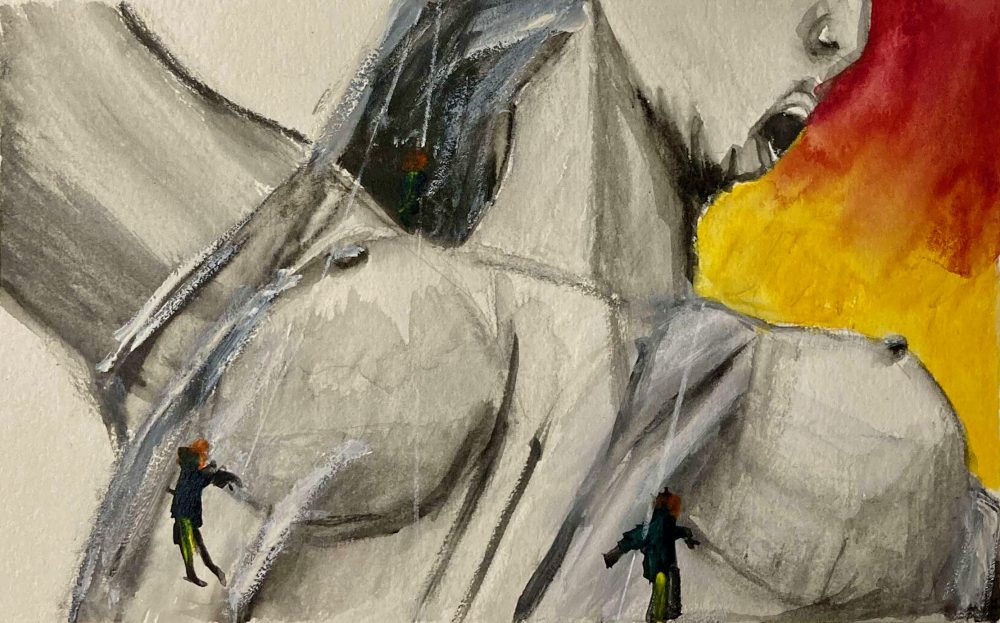
Firefighters in Russia (watercolor and acrylic on paper, 20230414) Stephen J. Williams -

The 193 member states
As the United Nations prepares to pontificate on how democracies defend themselves, it might be useful to remember that across the United Nations’ 193 member states, a substantial proportion are not democratic. According to the 2025 V-Dem report, about 90 states qualify as autocracies, either “electoral autocracies” or “closed autocracies.” Freedom House’s Freedom in the World 2025 survey classifies 59 countries as “Not Free,” meaning citizens lack basic political rights and civil liberties. The Economist Intelligence Unit’s Democracy Index 2024 offers a similar perspective, designating 59 of the 167 states it surveys as authoritarian. Although methodologies differ, these datasets all indicate that roughly one-third to nearly half of UN members fall outside democratic governance.
A handful of states are unambiguous theocracies. Iran and Afghanistan are clear examples, while Saudi Arabia is often described as a theocratic monarchy. Military juntas are rarer but currently in power in about eight UN members, including Myanmar, Mali, Burkina Faso, Niger, Guinea, Chad, Sudan, and Gabon.
Sources
V-Dem 2025 report: https://v-dem.net/documents/54/v-dem_dr_2025_lowres_v1.pdf
Freedom House 2025: https://freedomhouse.org/…/FITW_World2025digitalN.pdf
EIU Democracy Index 2024: https://www.eiu.com/n/democracy-index-2024/
Find out what the UN actually does
UN Watch: https://unwatch.org/
-
Subscribe
Subscribed
Have a WordPress.com account? Log in now.


You must be logged in to post a comment.