The Rent-a-Negro website link flew around the internet a while back, many people linking to it as a humorous site. Initially few people recognised that the site was, as well as being very funny and beautifully written, a ‘serious’ art project.
More recently, and more controversially, Tanja Ostojic’s poster of a reclining nude in blue briefs with the symbol of the European Union planted over the hidden entrance to an unknown woman’s vagina, caused outrage in Austria.
Other posters commissioned by 25PEACES were by Carlos Aires, a Spanish photographer, depicting international leaders (including the Queen of England) having sex.
What are we to make of these web sites and images? The Austrians, currently thinking hard about their relationship with Turkish immigrants and the possibility that Turkey might one day join the EU, were naturally sensitive to Ostojic’s image.
The 25PEACES commission of over a hundred works contained images that attempted to provoke debate about the relationships of global political leaders.
From this distance—and it is very difficult to judge reactions and emotions through the news and over the internet—what looks like public outrage may only be a storm in a teacup. In reports about the public outrage over art works, generated for the sake of news or not, there is almost never any real discussion of the ‘art’ in the art. Is it no longer relevant—because only ‘facts’ are reported in the news—what an artist’s other works are like?
Reporting (in Europe) about the controversy over the Ostojic image blends it seamlessly with reporting about the other posters and of people’s reactions. However, there are two facts it is useful to know…
1] The Ostojic image exactly reproduces Courbet’s famous painting in the Museé d’Orsay, ‘The Origin of the World’. The title of the reference painting, alone, should be enough to make us stop to think what might be going on here.
2] Ostojic’s art often focuses on issues where politics and women’s bodies collide. Look at this remarkable image of a woman in a camouflage burka …
To me, this is a much more powerful work than the 25PEACES commission, but I don’t expect to be bowled over by everything an artist does. Artistic works of this kind set out to dislodge our thinking from fixed positions.
Beginning with exactly the same methodology and materials, Carlos Aires’s contribution—global leaders fucking—seems thoroughly tame. Why? Possibly because the idea underpinning the images is weaker. Possibly because we sense, as viewers of the works, that Aires has strained too hard and with not enough effect after the outrage the work sought?
These are more typical Aires photographs. Confronting, in a dull way, but competently photographed and printed (on metallic paper: a trick from the advertising industry).
Part of the problem with Aires’s contribution to the 25PEACES commission may simply be that he has miscalculated the objects of his scorn. Why is Queen Elizabeth in the group at all?
The outrage over such art works is a good thing. Artists, old and new, sink or swim in the tidal flow of public perceptions. Commentators on art works behave as though this isn’t the case, and has not always been the case. The pathologies of our outrage, the process by which we become aware of what has moved us or left us cold, need to expand our peripheral vision beyond the images themselves while not losing focus on what it really is we are looking at.
Riccardo Angelo’s art seems very accessible when he paints identifiable figures and poses, but inaccessible when his private thoughts and knack for surrealism take over the imagery. The theory, popular amongst critics of literature, that ‘the author is dead’ means that we do not have access to the intentions of artists. It is an idea that attempts to dislodge artists from the centre of their own work. It may be an effect of that dislodgement that art dealers—auction houses and galleries—encourage us to think of artists as in or out of fashion and, themselves, engaged in a struggle to stand for a while at the head of an advance guard. It is to everyone’s advantage that some artists appear to be at the cutting edge of taste, where investments will show a good return, and it is also completely irrelevant to the artwork.
Art criticism has a long list of well-worn words that are useful support critical claims to seriousness, and often before such claims to seriousness are warranted. Artists learn at art school and sometimes remain in the habit of obscuring what they know with what they learned.
It is a curious thing that the art world, the public language of visual artists, is saturated with artistic “intentions”. “What I mean by this is…” “In this picture I was trying to achieve…” “This is a painting about…” “So-and-so is trying to…” We lap up the intentions of painters in a way that we would find intolerable with, say, novelists.
However, I can not reconcile this effect with the knowledge that no artist I know talks to me about their art that way. (This, I have to admit, may simply show how I made the world I live in!) The more closely I get to know an artist, the less the conversation is about the apparent content and motive of the work than about the struggle to make it—about techniques, methods, materials, errors, frustrations and experiments.
This all amounts to saying that the artist’s history of art is very different to the art critic’s history of art. This is a fact worth noting. To an artist, the history of art is principally the history of the mastery of techniques and the struggle with materials: what is passed on, what is forgotten, what remembered, what can be seen or inferred from the surface of a painting and what must be imagined, what is discovered and what has to be re-invented, what he can do and what he cannot do. No-one who has spent any time with artists, listened to their conversations, and shared their practical daily concerns about their work, could deny that this is a basic truth about being an artist.
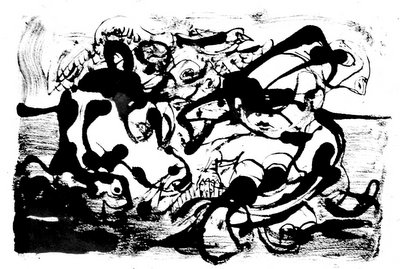
In this context, I think that Riccardo Angelo’s Nineteen monotypes exhibition was a litmus test of how to look at art, since its subject was not only the familiar figures that filled up the white space of the paper the monotypes are printed on, but also the technique itself. The nineteen monotypes were made specifically to draw attention to how they were made, and to the fact that the process of making them involved various, sometimes unexpected, stages of work.
The monotypes
Monotypes, as the name implies, should be one of a kind. Ink is applied to a plate that can be made of metal or glass, and may be flexible or rigid. The ink may be drawn on the plate; or painted on; or painted on, then rubbed and scratched off to make negative details. Plate and paper come together, sometimes, though not necessarily, in a press (a burnishing tool will suffice for some variations of the technique). The paper is peeled off the plate to reveal the image. The plate is wiped clean and the process starts again. Degas was a master maker of monotypes and he invented several distinctive variations of the technique, including making further images off the already used plate and hand-coloring the fainter second impressions. The beautifully luminous dancers’ tutus in Degas’ monotypes were made by first rubbing solid black ink on the plate and then rubbing away the ink with brushes and cloths to leave a blank area in the form of a white dress.
Riccardo Angelo’s nineteen monotypes were exhibited at a small, fine art gallery in Melbourne in September 2005. Angelo has made hundreds of these monotypes, usually in groups of about six to twenty. They are all organised by date. They do not have titles. The titles of the nineteen monotypes, taken randomly from superficially appropriate passages of the book of Genesis, were added to the monotypes at the request of the gallery director. The dates tell the viewer that some of the nineteen monotypes were made months before many of the others. Most, according to the dates, were made on a few days around the middle of December 2004.
First impressions: the meaning of ‘monotypes’
A monotype is one of a kind. However, the technique of making them encourages an artist to experiment with how the ink is applied and removed, repeating patterns, shapes and content in evolving sequences. Almost all monotypes are an instance of an evolving process and, of course, sometimes, failed prints are thrown away.
Many of the pictorial elements of the whole exhibition are in these first monotypes, made in August 2004. Birds. Wings. A squatting child. A snake. Two figures kissing. A figure kneeling, legs forming the shape of an inverted ‘V’.
In exhibition, the prints are not presented in any particular order. The first impression is confusing. Few viewers appear to spend more than seconds in front of each of the prints. You may look at the details of any print and become lost it its suggestiveness—the ‘drawing’ that forms the basis of the prints is apparently wild, undisciplined, free. Indeed, it is hard to imagine how it would be possible to control the materials to produce a fine effect: the viscous ink, brushes and glass are not ideal instruments with which to draw. Angelo is an excellent draftsman, but his abilities don’t appear, at first viewing, to be on show here.
It is only when viewing the prints from a distance and as a group that revealing patterns begin to appear.
Techniques and variations
Why do many of the monotypes present us with a figure that has fallen to its knees to form an inverted ‘V’ shape with its legs? Man, woman, dog, and creature—they are all the same—all reduced to the same pitiful position. The supplicant, bowed shapes of all living creatures in this world, Angelo seems to be saying, should tell us about something they all share. It is hard to pin down what he might be referring to. Most of the monotypes have some explicitly sexual content, but they are definitely not erotic. It is not even, really, a human theme. In the world of these drawings, man and dog suffer in the same way, men and women are equally exposed, and all nature becomes part of the muddled, expressive, psychological moment of the work and of the exhibition.
Then there are the groups of two or three monotypes that belie the individuality of the print process. It is clear from these prints that Angelo does not always clean the glass plate he uses before beginning work on the next impression. He reworks an image he has already made by making new layers of ink stick to the half-dried layers underneath, and he adds new details.
The monotype process produces unique prints, but Angelo has rediscovered something that Degas knew: the plate, whether flexible metal or inflexible glass (other materials can be used), becomes an anchor that keeps the work on theme. The plate remembers the structure and some of the details of the drawing, and always provides a useful departure point for the next drawing, if one is needed. The process itself is also telling us that the work is not random; not as random as we first thought.
These three prints demonstrate something different. Between one print and another the details may change dramatically, but the underlying structure of the picture can remain the same. On the right hand side of the three prints there is a group of trees, or a tree. On the left hand side: a much larger tree, a female figure (perhaps like a sphinx), and a child’s face with its mouth open, crying. Of course, there are birds, beaks, animals and snakes everywhere, making it difficult to see these figures. Look at the prints for a while and you begin to realise that deep patterns have repeated themselves.
The next two prints reveal another variation in the technique.
The second print is a reverse print of the first. This means that the second print must somehow have been printed from the first print, or the image reversed on the plate and re-printed.
What does it all mean?
One of the reasons I wanted to write about this exhibition, and why I wanted to publish a permanent record in print of these nineteen monotypes, is that it allows me to discuss an unresolved question about the relationship between artists and their critics. I include in ‘artists’ all kinds of artists, though I realise that, increasingly, it is used to refer only to visual artists.
So much of what one reads about art is shallow, ideological or self-serving. Is there an appropriate way to write about art at all? I’m not really sure. I would align myself with Susan Sontag, if anyone. I am not interested in producing another interpretation, but in what I see and in transmitting some of that excitement about what is visible.
This is, itself, a philosophical manoeuvre, of course. An ‘interpretation’ cannot avoid being, at some level, an attempt to master and comprehensively remake the art it is talking about. Interpretations come to stand for the works of art themselves. There is nothing intrinsically wrong about that. In fact, in life as in art, an interpreter is exactly what we need sometimes.
However, it is undeniable, I think, that certain critical ‘positions’ or theories seek to remove artists from a privileged relationship to their own work. The effect is strange. The public discussion of art is carried on as though art itself were an ‘effect’ or by-product of the history of ideas. Artists are made to line up while an -ism is pinned to their lapels. At some point the unreality of it may strike you as itself meaningful.
Riccardo Angelo’s Nineteen monotypes exhibition invited us to view ourselves in the act of looking, and to notice how many of the artist’s intentions and meanings could be traced from one moment to the next.
In the future the Archibald Prize has become such a big thing that it needs a special building to house all the paintings to be displayed. And the paintings themselves are very strange. I walk around the huge gallery thinking how horrible all the paintings are. One of them has huge sacks of paint hanging off it, a skin forming over the still liquid oil paint underneath. It has not had time to dry before the exhibit. The globs of paint are so large that viewers are encouraged to press the sacks of paint hanging off the painting with their hands, which I do, and it feels a little like sagging flesh. This would be fine if the painting were even a little bit realistic, but it’s not—in fact it’s a mess of abstraction, not really a portrait at all. And I also notice that the paintings are all huge. Doesn’t anyone make small paintings any more? I talk to someone at the exhibition who asks me if I’ve seen the good ones yet, and he points to some inner rooms where all the good paintings are on exhibit. When I go into the rooms all the paintings are still depressing, and even bigger than the ones in the surrounding part of the exhibition. I move quickly through all the rooms, just to be sure there isn’t anything good, and finally come to the biggest room of all—it’s the size of an aircraft hangar! There is only one ‘painting’ in it, a large triptych that occupies every inch of a gigantic wall. As I enter—through the wall on which it is hanging—I am dwarfed by it, and as I look up I see that there are threads or ropes hanging off it, as though it has been stitched together and somehow tied to the wall. This gigantic room isn’t empty. There are enormous ottomans, which seem to be at least thirty feet square and made of red leather, placed around the room so that whole families can jump on them, lie back and look at the big painting. I lie down on one of the ottomans, alone. Everyone one else is just wandering about the exhibition, confused, staring up at the big painting. This is really horrible. I have to get out of here. I leave through a corridor that leads me into a place that feels like a great stone bunker, but I recognise it instantly as the Vatican. I look through a door into a red room that has a small chapel set up in the corner opposite the door I have stuck my head through. A priest is performing mass and some little altar boys are singing their hearts out. I can’t see where the music is coming from but it’s very good. I notice that there aren’t many people in the red room, just a half a dozen or so, dotted here and there, and the mass appears to be for the benefit of the one person who is kneeling, with his back to me, as I enter and take a seat. He is getting up, and as he stands I notice that he is wearing a white cassock, and when he straightens up I see he has a white mitre on his head. Oh, it’s the pope—Benedict!—but he’s already looking very old. It is really the singing that is most beautiful and, as it stops, I’m overwhelmed by the beauty and strangeness of it. My head in my hands, I think about how awful modern art is, what a useless lot of rubbish. A piece of paper scrunched up and left lying on a windowsill. A pattern of bricks. Lead pipes trying to be portrait of someone. The pope is walking by and making his way to a nearby elevator, until he sees that I’m upset and comes over to me. He puts his hand under my chin. I am expected to say something, to explain. “I didn’t understand,” I say. “Religion is the art of belief.” He goes off and, with nothing left for me to do here, I have to go, too. It is easy to get out. In fact, I’m surprised that the exit leads directly outdoors, and that there’s a wire fence, with razor wire on top, very near by. Pasolini would be impressed… There must be poor suburbs just on the other side. I know exactly where I am, and can even picture in my mind where this strange, quick exit from the Vatican was located: St Peter’s hung like a horseshoe on the wall, its arms hanging downwards, the exit I emerged from was just on the right shoulder. It’s so desolate out here. Maybe I should just duck back in?
Published as ‘Four events while sleeping’, incorporating ‘Poetry is a small house’, ‘Religion is the art of belief’, ‘Martial art, sans art’ and ‘The program’, FIVE:2:ONE print edition, August 2017.
Drawing falls and folds of cloth has been a standard exercise for student artists in their teachers’ studios. Along with perspective, chiaroscuro, flesh, and hundreds more particular painterly ‘rules’, mastering this painting exercise is a foundation of depicting human reality. Without it, it would be impossible to present any image of a man or woman in his or her social reality. It is not only the depiction of our clothing that the painter has to master—the space in which it appears, the volume it contains, the sources of light playing on its infinitely varied surfaces. There are also beds, furniture, curtains, and all the rest.
Shane Jones was apprenticed to the depiction of reality in paintings for twenty years before his own peculiar ‘take’ on realism began to emerge in his work. Virtually all the early paintings—still lives, street scenes, rooms and objects—have been destroyed. It is strange, now, that everything he has learned about painting is pressed to the task of depicting a reality that none of us has ever seen: a realism that looks like pure psychology.
A man dressed in a gray suit and a woman in a long, deep red dress stand with their backs to us. Behind them is a white curtain which reaches from somewhere out of the top of the painting to the surface the figures are standing on. There are actually two curtains: one for each of the figures. We can see, in the middle of the painting, that the two falls of curtain meet and overlap—except at the very bottom, where a small, triangular, black space, tells us that there is nothing or something on the other side of the space in which the figures stand. If you knew the artist, you would immediately recognize the male figure as the artist himself. However, for the purpose of the picture, it is just a man. There is nothing very special about him at all. We cannot see his face. We do not know whether he is anxious or calm, handsome or ugly. His companion, the woman in the red dress, may not be his companion at all: the two figures have adopted the same pose before us, turned away from our gaze, but they are not standing together. Well, they are not necessarily standing together. She has no feet. The dress is just long enough—just the right length—for the feet to be hidden. She seems to hover on the stage. Is it a stage? If it is a stage, are we also part of the performance that is about to begin, or that has just ended? Should we feel relieved and happy that the drama is over, or apprehensive because it just about to begin? The curtain may not be the curtain of a stage at all—perhaps it is only a curtain, a white sheet hanging in a gallery, much like the room in which the picture itself is hanging.
For the past four years Shane Jones has been methodically emptying his paintings of unnecessary clutter. In 1996 he won the Norma Bull Prize for a self-portrait. He emptied the room in which he painted himself by lowering the point from which the viewer seems to look on him: only the ceiling and an empty wall are visible in the background.
In 1997 Shane Jones saw the paintings of Avigdor Arikha (1929-), in particular ‘Slippers and Undershirt’ [1979]. The discarded clothing in these paintings, arranged like abstractions, seem heavily laden with their absent human bodies and activities. Shane Jones began to paint articles of clothing and falls of cloth. But these paintings are not copies of the effects Arikha achieved, any more than Arikha’s ‘Self-Portrait in a Raincoat, Peering’ (1988) is a copy of Joshua Reynolds‘ ‘Self-Portrait’ (c. 1748-9). Jones emptied his paintings of any discernable background and, as well, of perspective: handkerchiefs and cloths were unfolded and flattened to reveal their commonplace designs. These objects, sometimes painted at ten or twenty times their natural size, sometimes at ‘actual size’, were presented as though emptied of their function. No longer useful or used objects, they became simply something to look at: reality magnified. Articles of clothing, male and female, were presented to us neatly, often actually on their hangers, but floating in black space. Dresses, shirts and jumpers are the ghosts of their owners.
Deborah Klein and Shane Jones.
An untitled painting of 1998 went so far as to show only what appeared to be a white sheet suspended in black space, the upper left-hand corner hinting at something that could not be seen—a hook or nail holding everything up. We are forced to acknowledge our first ideas are often wrong when we notice the white sheet is, in fact, full of color—pinks, mauves and greens.
Underneath the thin veils that now hide his subjects’ faces, Jones has painted a real portrait of himself, a model or a mannequin. There is a Japanese flavor in the spatial arrangements and blank interiors that owe much to James McNeill Whistler.
Asked about the meaning of his paintings, Jones sometimes quotes Benjamin Disraeli: “To be conscious that you are ignorant is a great step to knowledge.” Or, at other times, he will say: “When I was twenty I thought I knew everything; at forty I thought I didn’t know anything at all…” This is really Jones’s subject: the feeling that we do not know very much about other people or about ourselves: uncertainty and ignorance painted with pared-down, formalised and quasi-realistic effect: the suspicion that commonplace certainties might some day turn out to be doubtful knowledge.
“It’s about plastic surgery,” Walter van Beirendonck told me. I knew it wasn’t about fashion, or clothes, which is what I had a right to expect it would be about. After all, Van Beirendonck is a fashion designer, and he had just spent an hour or so with an enthusiastic young crowd at the RMIT Storey Hall auditorium, saying several times during the discussion on stage that he was not an artist.
To be an artist, if you are a fashion designer, I began to think, must be something like being branded impractical or noncommercial or incapable of designing wearable clothing.
Van Beirendonck’s recent designs, clothes that are much less commercial than the street wear and jeans for which he became well-known, can still be bought from his shop in Antwerp. Just the place to go if you want an haute couture, plastic, cherry-colored suit—available in all sizes.
Spring 2012 collection
The problem is that van Beirendonck is an artist, or is behaving like one. At a Paris show a few years ago he put his models on stilts (the kind that plasterers use to reach ceilings), covered their faces, turned on the spooky music and waited for a reaction. The resulting ‘performance’—it’s difficult to continue calling it a ‘fashion parade’ or anything else that implies display of goods—was tremendously affecting, presenting the audience with the unexpected vision of models who had distorted their bodies to achieve a sort of perfection and had, at the same time, erased their identities. It’s no wonder that van Beirendonck’s shows are popular.
Transplanted to a theatrical stage, cut loose from the delimiting response of an industry audience, some moments he devises could easily be mistaken for ones by Pina Bausch, the German dancer, choreographer and champion of modern dance.
These effects on the catwalk have not come easily or suddenly to van Beirendonck. It’s clear from the videos of him, when he began teaching fashion in Belgium in the mid-1980s, that he used to look and behave more like we imagine a fashion designer should.
These days, fortyish, he admits that a gradual change has overcome him, the result of a desire to be more himself. He’s gone through many changes, in fact.
Fashion is the commodification of change, n’est-ce-pas?
He used to say, “Fuck the past! (Kiss the future).” One of the audience at Storey Hall wanted to know why he hated history. He is adamant that he does not; it’s just that he does not want to be tied to it.
Now he says, “You are not alone.” In the last few seasons he has stripped his designs of all ornamentation and shown us a bland future; dressed his models in hokey cowboy street wear and made them boot-scoot; then presented them all in pale-colored, knitted, clingy frocks.
Walter van Beirendonck
In a way, it’s interesting: fashion as a vehicle for thought… Do you think it’s going to work? Van Beirendonck certainly gives it a go, but the problems are too obvious. One of his recent shows sported the title ‘Gender?’ It was not about gender at all. It wasn’t even about sex (which is what most people think ‘gender’ is). It was a display of androgynous models. There weren’t any women.
“It was a male collection!” van Beirendonck explains. Exactly. Why pretend to be thinking about gender at all?
The reason, I suppose, is that fashion is not about the clothes, and not about being an artist, and not about thinking, or performance, or even business and money. It’s about expressing yourself. So there.
cathedrals in their middle age
          sourly contemplate

the platitudes of worship
          (what longing made

the history of their long struggle
          and what prayers like smoke

stain the minds and hands
          of old men

): their structure is a torsion—
          pleasure and silence

twisted
          at invisible altitudes—

below, the dark
          icon of betrayal

above, a whispered light
          revealing nothing.

without ceremony
          no voice to read

a lesson
          or to preach

and no believers (especially
          if there are no believers)

at the end of worship
          silence is their business.

if I was such a man
          —my eyes removed

for safe-keeping
          through the wars

my memory buried
          in a field—

how could I then say
          what my body meant to say?
Originally published in Out of the Box: Contemporary Gay and Lesbian Poets, edited by Michael Farrell and Jill Jones, Puncher & Wattmann Poetry, 2009







 Stephen J. Williams
You must be logged in to post a comment.