At the circular quay huge wooden posts, formerly the trunks of great trees, have been drilled into the sea-bed. They support thick planks which, facing out to the bay from the shore-end of the dock, are supposed to protect the quay from boats or small ships that might ram into it. The planks serve another purpose: to still the water immediately beside the wharf. Pieces of paper, an orange peel and a can move about in one corner. Closer to me, there is a head floating on water.
Category: A crowd of voices
This book was published by Pariah Press (Melbourne) in 1985. Pariah Press was a coöperative publishing company and its books did not have commercial distribution.
-
X equals X
When I go into the garden the deck chair that X was sitting in is empty. A book is opened, face down, where her feet should be. I put the glass of water on the wrought-iron table. Light moving through the decorations on the glass and the small bubbles in the water is making an intricate pattern on the surface of the table. I look into the pool: a dark blur, probably X, is swimming – actually, making strange, wriggling movements – several feet under the surface of the water. I sit down and begin to read the book. The light reflected off the white page is very bright, which makes reading uncomfortable. I close my eyes and rest my head on the canvas strips that form the back support of the chair. Sunlight shines through my eyelids. X must have been wearing sunglasses when she was reading, but I didn’t notice them on the table. They could be under the chair.

Man underwater (charcoal, 20220331) Stephen J. Williams When I open my eyes X is still underwater. The surface of the water is now quite smooth, and the water itself very clean except for a leaf which is floating in the corner farthest from me. Barely discernible, small waves appear on the surface just above the spot where X is spreading her arms; but they quickly taper out to nothing before new ones appear.
X is wearing her new, dark blue bathing costume. When it is wet it looks almost black, just as it looks now from this side of the water. When she reaches the end of the pool X curls up her body into a ball and tumbles over without breaking the surface of the water, then her feet push her away as she starts another lap. Just at the point where she turned, where the pebbled surface of the pool’s edge is rounded and dips into the water, there is a large area of that pebbled surface which is wet. The pebbles and the brownish mortar are darker and shinier when there is water on them. There are footprints leading from that wet patch onto the concrete path which goes to the back of the house and the kitchen which has large windows facing out onto the garden and the pool. Whose footprints are they? They must be X’s footprints.
A few bubbles escape from X’s mouth, rise to the surface of the water and vanish so quickly it is impossible to say exactly how. They are gone.
Her body is rolling over at the bottom of the pool, like a cylinder would roll down a slight incline except that X is not actually going anywhere. Her arms are stretched out above her head as she lies suspended in the water parallel to the bottom of the pool, and by quick wriggling movements of her torso she manages to make her body turn around an imaginary axis which runs from her head to her feet.
The footprints on the concrete evaporate. The wet area of the pebbled surface near the pool is gradually getting smaller.
X bursts out of the water; she comes up out of the centre of the pool in one quick movement. The air escaping from her mouth makes a small exploding sound when the lips open, and the water that is falling down the front of her face and over the lips is suddenly forced outwards, forming hundreds of tiny drops that travel slowly in an arc from her mouth to the surface of the water. X’s long hair falls liquidly down the centre of her back.
X stands in the water, almost motionless, for a long time. The only movement is a slow heaving of her chest and shoulders as she takes deep breaths. After a while she moves to the edge of the pool and lifts herself out of the water. She seems to be waiting as she looks down at her feet where a large puddle of water is spreading across the pebbles and brownish mortar.
X turns and looks around the perimeter of the pool several times. She’s trying to locate something, perhaps the towel. It’s nowhere in sight.
She turns around, walks up the garden path and leaves a trail of footprints on the concrete as she goes.
The path makes two swerving movements, first left, then right, on its way to the back entrance of the house, and X follows the centre of the path precisely even though it would be easy to cut across the curves because there is only fresh, green grass on either side of it.
She stops just inside the doorway. Stepping out of the sunlight, she feels quite cold. There is a towel draped over the back of a chair in the centre of the room. She moves over to get it and then stands in front of the sink underneath the kitchen’s large windows. The bottom edge of these windows is lined, on the outside of the house, by a shelf that carries about six large pots of azaleas. Standing in the kitchen, looking out into the garden, the sight of these brilliant pink flowers resting at the bottom of what could almost be an artist’s picture, is always the most striking feature of the garden. The evergreen trees at the bottom of the yard. The pale blue water in the pool. The brownish mortar and small, shiny pebbles around the perimeter of the pool. The white, wrought-iron table and canvas chair. The pink azaleas.
X stands at the sink and stares out into the garden. Perhaps she is imagining that she is again walking up the path towards the house. The footprints leading away from the puddle of water beside the pool are still distinct.
X turns around suddenly. The telephone is ringing. It makes short, shrill bleeping sounds, not at all like the old-fashioned bell type.
She takes one end of the towel in each hand, swings it up and around her neck, then uses one end to wipe the small droplets of water from her face. With her other hand she picks up the receiver.
“Hello.… Oh, hi! Are you all right? … No. No, she’s not here.… She hasn’t been around for hours, thank god.… Well, yes. You could come over now, but I’ll be meeting you later won’t I? … I do think it’s better that you stay away for a while.… Good.… Well, I’ll see you later then.… Goodbye darling. See you then.”
X continues wiping herself as she stands in front of the sink underneath the kitchen’s large windows. She puts the towel down on the bench, turns on the cold water tap, and reaches up to a shelf on the wall to get a glass – one of the better glasses with a deeply engraved pattern on the exterior surface. She fills the glass with water and turns off the tap as she gazes into the blue pool.
Standing in the doorway she sees that the footprints closest to the kitchen door have completely disappeared. The others, closer to the edge of the pool, are still very clear. X turns around momentarily to pick up the glass of water off the bench, and then walks out into the garden.
She sits down on the deck chair after picking up a book which has been left lying face down on it, and rests her head on the canvas strips that form the back support.
It’s a hot, bright day. Oppressively hot. Light passing through the glass is making a striking pattern of faint violet and orange colors on the painted, white surface of the table. Small bubbles form in the water and cling to the side of the glass.
X opens her eyes quickly. The hot sun has made her drowsy. Her facial expression suggests some anxiety, as though she has suddenly remembered an important task which needs to be completed. -But then, just as suddenly, her expression is calm again.
She continues reading.
Hercule Poirot hands M. Bouc a piece of paper. At the top are written, in Poirot’s own hand, the words:
Things needing explanation.
Underneath is a list of ten questions. X reads through the questions carefully, then lifts her eyes and looks into the pool. The book is a long algebraic equation. Things begin to fall into place very slowly. There is someone swimming underwater. She can again feel her chest hardening with the strain of holding her breath and can remember how desperately she fought the urge to let that air out of her lungs. When was that? The body in the pool is tumbling slowly over, several feet under the surface of the water.
She continues reading, but the light reflected off the white page is very bright. She closes her eyes and tries to remember where she put her sun-glasses.
The leaf floating on the surface of the water, the piece of paper on which Poirot wrote his list of questions, a bright, blurry-edged yellow square, all float slowly away in a sea of red.
-
Days dressed in dream and black wire
for Frank Kavanagh, died 27 January 1984
In the heartland the hills move.
Roads shoot through the earth,
Turn, then disappear far off.
Our horizon circles leaving no escape;
We paint our family red on kitchen tables,
Uncertain children tracing questions in a mess.For thirty years he sat, the centre
Of our family’s compass: North, soft hills
Too steep for grazing, but pleasant enough
To look at; South, and the other side
Of a languid river, another property,
Larger and richer with level ground;Stretching East to West, his oblong piece,
Made more interesting by having at one point
Where the river turns, a steep fall to the waterline,
Large trees, and blackberry scrub which pricked
Our legs until they bled, driving us home
In an ancient truck, proud of the wounds.Today, his no-time friends and no-where relatives
Have their collars pinned and waistcoats
Tight around the grave; all the vegetables
Of green and ordered gardens, the photos
Of men with beer and women in frocks
Are spun into coarse rope.His pain like a nightmare stretched
Around the farm, fine as barbed wire
Fence, enclosing dreams a thousand years.
Outside the farmhouse, our breath
Spiralled steam-tubes in morning’s
Slow, grey colors of sky and hills:There, inside a shed—is his
Very private life of rust and disorder,
Where the sheep is hung by its forelegs
Still, and hot—where a knife draws
Lines in blotched skin, and it opens
Steaming like our breathSteaming through the still cold air
Of this city: clinical and truncated
As television murder: with no fire,
No blood, lifeless as geometry,
As pencilled lines like days of geometry
Dressed in dream and black wire. -
Our winter solstice
grandad was dying
and angry
i walked with him
between the trees
plunging sad steel
teeth into lifeless timberwe sweated remorse
for our labor
hacking at a
pale-skinned gum
only to find the core
greenevening closed
the farm gate
chained us to
the stump of
our pernicious
and untimely murder
thrust angry words
in our mouths
and brought us home
to a rain-washed roof
thundering till shattering
our obdurate despairso when light and warmth
rested in the soil of our farm
he did not dielearning never
to fell trees
in the winter solstice. -
Poems from psychoanalysis
I could be bounded in a nutshell and count myself a king of infinite space, were it not that I have bad dreams.
1 The Breach
Hide and seek is the game
we play, alternating
parts, clinging to walls
just beyond reach.
Who can live with me?
he says, mocking.
Come out. Come out.
Scar says hands on head,
to your knees. Scar says
shout, then says die.
Scar gives the lie to
harmless thoughts,
then settles down
in the dark house,
corrupt little animal
gnawing at the heart
and baring teeth
that cut up memory.
Sleeping and dreaming
he’s more alive,
feeds on each hurting
image, gorged and lying
safe beyond the breach.2 Self and Space
Science probes the atom
revealing matter
mostly emptiness.Congregations of memory
clutter darkness
at the heart of things.Going deeper you and I
search the self and fall
through infinite space.3 The Lesson of Eumenides
Client
“My father’s mother
loved her child’s only son
demonstrated the fact
holding the grandson’s head
against her wrinkled
milkless breast.“My father’s father
loved his child’s only son
demonstrated the fact
when he died bequeathing
fifty cent scraps
of each fortnight’s pension
to a trust of his grandson’s name.“My father’s parents
neither loved each each other
nor loved their son
demonstrated the fact
letting him grow fat
on careless marriage,
double portions, his and theirs.“My life repairs mistakes in others’ past
blood fighting for the line’s success in life.
It ends with me
hate’s puzzle knotting all that should make sense
and useless with anger.”Analyst
Ghost and Furies inhabit the temple
demanding justice
for horrors beyond speech.Orestes, the son,
runs a whole year
body dispirited by effort and fear.I promise protection
and equal judgment releases him.
—Athena left to placate Furies’unearthly rage, revenge-hot blood:
“My new city has difficult gods who
strike its people down with no warning.“Will you be the city’s warders?
turn your strength
to good works?”They accept
and in their dark world
tie death’s agents down;while in Argos, safe
and crowned with light,
a murderer is king.4 Confessional
Lonely are the gifts
I took with me
into this death
like absurd too many chairs
I can sit on only one of them
at a time.I have drawers and chests
hundreds of places
to stow parts of myself away
but you find them
a pick in your hand
and in my head
the case opens.Your father angers you
like a doctor
I have books
which I open sometimes
and do not understand
why the lock of my cell
is so difficult to open.In the cell is a horrible creature
with two heads
both of them ugly
both of them screaming.Your mother loves you
like a priest
I have words in my head
I never use
and places I
have never seen
gifts that were brought
I want to refuse.Gifts of rope and knives
dressed in striped boxes
and coloured ribbons.They expect me to answer
fulfil expectations
they speak to me in a language
I never learned
they never taught me
full of private symbols
drawn on my forehead
and on my back
everywhere I cannot see.5 Egg
Something about them
is difficult to touch
with their bloody insides
awesome and fragiletreat lovers delicately
their skin is strong
but thin
as they move from room to room
with their soft soft edges
like shadows
and internal affairs of eggsthat at the slightest jolt
display their dark insides
rich with confusion6 The King of Hate
Years the beast spends
dining on his own flesh,
inexhaustible passions
coming from who knows where
beyond the breach.
My arms outstretched
find a way through
glowing darkness back
to where the hate began
a life of forgetting,
bandaged head, a mask.
Come in. Come in.
He says, this dark house
is larger than love,
your heart unwired
will warm to knowledge
of superb pain,
will grow to fill
its infinite rooms.
He crowns me king
of beasts, winds me
in red fields and war,
promises all the void
will sing my name;
if only I would stay. -
The poetry of Wallace Stevens
for Joyce Lee
A voice is a solid thing
One hears as though it were built
Entirely of air. It is substantialYet it carves out song from nothing.
A voice is a real thing
We cannot move through, that livesSeparately, and uniquely sings
The air on which it moves.
A voice reminds us of our distance.A bad voice is all voice.
The good voice glows and lights
The air on which it throws out songAnd bites. electrically, the space
In which we stand to hear: it alone
Is real, and clearly moves between us.The perfect voice is in the mind
And never sings what can be heard;
It has a life its own that bringsThe sounds the mind has learned
To the moment of the keenest singing:
Its song is pure imagining. -
Mario Giacomelli’s Scanno
It’s 1962. Signor Giacomelli goes out with his camera,
His ‘avocation’. (Probably he had it with him by chance:
Who would want to take pictures at this hour?)The sun half up, he uses flash, for contrast
And to brighten faces, but it’s no good.
Two noses and four down cast eyes only faintly appear.What the matter? Are the women crying?
Has someone died? No. I think they’re always this unhappy.
After early mass somewhere in the Abruzzi district,Traditional black coats eclipse the frame
Then wander dimly off.
You’ve probably not seen this photograph thoughIt’s very famous. The title is either something innocent
Or implies a sacrifice. And it’s strange
That when you stare into the puzzle for a long timeThe little boy in long trousers
With his hands in his pockets, hair neatly combed,
And a face that shines specially,Head cocked slightly right on top a crisp, white shirt,
Descends so nonchalantly on his own
Light pathway into this misery.What is he
Here for?
What will he do?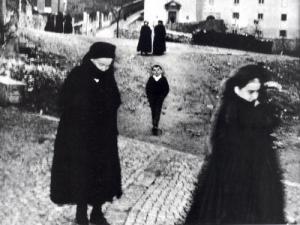
Mario Giacomelli’s ‘Scanno’ (1957).
 Stephen J. Williams
You must be logged in to post a comment.