Among the people who have tried to arrive in Australia by boat in the last few decades were probably many, whatever their religion, who knew all the details of this story already, and knew its lessons …
Krishna reveals his universal form to Arjuna.
Every Friday night Sebastian comes around for dinner and drinks. Last Friday he asked if he could invite Arjun to call in, late, and join us. I had not met Arjun before. I thought for a moment, trying to recall the name in the Bhagavad Gita. It has been a long time since I read it. A very long time. “Yes… Is it as in ‘Arjuna’?”
Sebastian sent the agreed-upon text message to Arjun’s phone… “Park the elephant anywhere. I’ll come out to show you in.” —As though anyone with a modern Hindu name would turn up for drinks on an elephant.
Arjun arrived later than expected. He had been to an exhibition and the art was ‘experimental’. “I went with an artist who tried to explain it to me. Apparently it starts off being a painting, and then it gets turned into a print, and then it’s projected. There were videos, too.” So, we talked about art.
Every long friendship is a secret place, a bolthole that is also a hall of mirrors where language, laughter and identity reflect on each other. We tell politically incorrect jokes about gays, women, blacks, politics, and then quickly straighten ourselves, pretending to worry that someone might be listening at the window or that there is a microphone hidden under the table. These jokes, to be fair, are often at our own expense. No-one gets out alive.
Blacks call each other ‘nigger’. Gays take back ownership of ‘queer’ and ‘faggot’. But in our colonial outpost at the end of Asia, surrounded on all sides by water, Muslims, Hindus, Maoris and ice, people who look and speak like ‘foreigners’—non-Anglo, non-Euro foreigners—are still having a gruesome time.
It is not difficult to perceive a shrill panic in Australian language in 2015. Online newspapers are stuffed full of (mostly) anonymous complaints about fake refugees. “Surely everyone knows that the countries refugees want to live in are white countries.” “The refugee convention does not guarantee that refugees can only be resettled in the wealthy country of their choosing. Yet, many refugees seem to want only to come to Australia and reject safe harbor in other countries.” And so on. Genuinely racist urges are easily camouflaged with concern that we should not allow refugees to drown at sea.
Australia has developed a heap of festering prejudices. “Why do these people have to come here.” “They’ve spoiled their own countries,” “ruined their own cultures with religious wars.” “We don’t want that sort of thing here.” “There are Muslim countries they can go to. Why don’t they go there?” “The Indian student who faked an attack on himself.” “Oh, God, they’ve taken over the Seven-Eleven stores…” “Asians. I think they’re aliens. I mean really aliens. From outer space.”
I like to think I know a thing or two about art, but the truth is I do not know very much at all. Asian art, for example, is a mystery to me. I think I am not alone. All the Catholic and Christian stuff I have down pat, rehearsing it since childhood. To my deeply prejudicial frame of mind, Muslim art is easy: they don’t like images. What’s next? Ah, the Hindus: statues with many heads and way too many arms. I have no idea what it means.
What does it mean? I acknowledge it simply as a symbol of exotic excess. Those asian artists, you know, they just do not know when to stop. And there appear to be different versions of the same thing: one is a Krishna, the other a Shiva; some of them are dancing and some not. It’s all just too complicated—and alien.
Properly motivated, it does not take long to find out what it means.
…
With apologies to Hindus who may be offended by a clumsy contraction of several million words into these few paragraphs…
Hindus, like Catholics, believe in a god who transcends everything in time and space. Brahma is the supreme god of creation (alongside Vishnu the preserver and Shiva the destroyer—making the Hindu trinity). It is Brahma who is the father of Manu, from whom all human beings descend.
The central, though not by a long way the oldest, texts of Hinduism are the Mahabharata and Ramayana. Composition of both began around 400 BCE, and the texts finalised around 400 CE. The Mahabharata is the great story of the ‘Bharata’ dynasty—a history of the contest for accession between the Pandava princes and the Kaurava princes. At the core of the story is the recounting of the Kurukshetra war in which the armies of the branches of the dynasty fight each other. (In this and all the other Hindu texts, the ‘story’ is accompanied by much philosophical and devotional material.)
The Mahabharata is the longest verse epic in world literature. While the centrepiece of the poem is the description of the eighteen day battle, the Mahabharata also contains, just before the battle begins, one of the key texts of Hinduism—the Bhagavad Gita.
Arjuna, the Pandava prince, arrives in a chariot to the place where the Kurukshetra war is to start. Krishna, in human form (he is the eighth incarnation of Vishnu), is Arjuna’s charioteer. Arjuna looks at the army opposing him and is paralysed by the thought that many of the people there are beloved members of his family and his teachers.
Arjuna asks Krishna for his advice. Krishna does not hold back. He tells Arjuna his duty and reminds him that there is no point delaying taking action. The fate of the Kaurava princes is already determined—by Krishna himself.
To prove his point, Krishna reveals his universal form to Arjuna. This is the moment (chapter 11, verses 10 and 11) we see depicted in the paintings of the (often blue) deity with many heads and many arms. Krishna sees everywhere, and his hands guide everything in the universe.
Arjuna’s dialogue with Krishna is crucially important to Hindus—personally, culturally and politically. It is a narrative about fate, courage, the necessity for action, and the role of heroism in personal and social life. Its influence runs deep in Hindu culture. Political leaders, past and present, including Mohandas Gandhi, interpreted the narrative of the Bhagavad Gita to clarify their own ideas and actions.
Careful readers will have noted that Arjuna does not arrive on an elephant.
I understand there are many Australians who believe there is an imperative to preserve life; to keep straight the lines and the lengthening queues of people wanting to come here; and perhaps even to sort through those queues for the kinds of people we would prefer.
Australia is filling up with believers who are concerned to do the right thing.
Speaking only for myself, I have decided that it is not necessary to pretend to judge whether someone is actually a refugee. I do not believe we should pretend it is moral to punish someone who seeks a better life with alienation, abuse and rape; and to promise it will be punishment without relief.
I cannot promise it will make any sense to you because I hardly understand it myself: the story of Arjuna is about how to act, and the need to act, even though we are quite certain that no matter what we do we will cause suffering. These ideas are permanent and universal. They were the same in Asia two thousand years ago as they are now in Greece or Italy.
At around the same time that the Mahabharata was being composed, on the other side of the world, a bronze statue of a boxer was being created. This statue was unearthed on the Quirinal Hill in Rome in 1885 by the archaeologist Rodolfo Lanciani. The bronze has copper inlays that make the flesh of the boxer look bruised. When the figure was cast the sculptor took a chisel to his work and gouged scars in its face.
The creators of the Mahabharata and the statue of the seated boxer were both trying to tell us something about human suffering and heroic action.
Statue of a seated boxer, 3rd century BCE, Palazzo Massimo. Photograph by F Tronchin (2007).
My father had a secret stash of Shirley Bassey records. There was a record-player in the house. Mine. It was not a very good record-player. I was eleven and I did not know what hi-fi was. I was into noise, and catchy tunes and syncopations. I had no idea what a ‘Shirley Bassey’ was either, except that it was obviously extremely glamorous and sparkly, could be photographed with its mouth open and got hidden in my father’s bedroom closet—where there was no record-player to play it.
‘Melodica’—sucky instrument one blows into to produce windy notes.
Many years later I learned my father lived most of his life in another house, an apartment he kept in Collingwood, an inner suburb of Melbourne, while I reconnoitred the border of ‘Forest Hill’ and ‘Nunawading.’ His Shirley Bassey records got played—if they were played at all, I never heard them—in Collingwood.
I compensated for the lack of a musical education, from my parents or anyone else, by trying to figure out how musical scales worked with the aid of books and a strange, little keyboard called a ‘Melodica’ (which sucked, even though I had to blow in it). This ‘instrument’ emitted horrifyingly weedy, windy sounds that were supposed to be musical notes.
Children are lucky if their parents have the good sense to force them to learn a musical instrument. Even if the knowledge does not stick or the child has no talent, there are important ideas and impressions that are planted in the mind by a musical education.
Children are lucky if their parents have the good sense to force them to learn a musical instrument. Even if the knowledge does not stick or the child has no talent, there are important ideas and impressions that are planted in the mind by a musical education. Exactly what these ideas and impressions are is difficult to say.
One of them, for example, might have something to do with scales. Leave aside the discipline and patience needed to practice them: every distinct culture has a distinct musical scale that is a framework upon which all its music is built. There is a Chinese scale, an Arabic scale, a Greek scale, an Indian scale, scales that are equally tempered and scales that are not. Discovering these facts through musical exploration changes a person’s understanding of what culture is and how culture shapes perception.
I listened to Mozart, and graduated to Bach. I had no idea what a Sex Pistol was, or a Clash; David Bowie, The Ramones, The Osmonds and The Bay City Rollers were all just words.
One of the popular boys in high school, who seemed to know things the unpopular boys did not know, started to mock me and gave me the nickname “Stevie Wonder”. His mockery was so gentle and, I see in retrospect, so complimentary that I wonder now whether he might have fancied me. Whatever his motive, my new nickname introduced me to the artist who convinced me that contemporary music was worth listening to. Motown. It was fresh air.
Wonder was twenty-three when he made the live studio promotional video for a new album and recorded ‘All in love is fair’. What a voice he had! Conversational and easy-going when singing quietly, it could suddenly unleash tremendous emotion. Wonder’s version of his own song is a study of contrasts between beautiful vibrato, playful melisma, and striking crescendos.
Shirley Bassey singing ‘All in love is Fair’.
Other singers, mainly women, took up this song very quickly, and made it their own. Shirley Bassey renders it in a sassy, wise-ass style in which her jaw really looks as though life is punching it crooked as she sings. Barbra Streisand performs it straighter, as though whispering a lesson in life and love right in your ear. Carmen McRae’s version is jazzier, seeming to plumb darker notes, but all the while keeping the melodic line under tight control. Dionne Warwick’s is the saddest version and, just by a little, the slowest.
These other artists are not merely channeling Wonder’s song. Each version seems like something completely original that is made out of the singer’s own life.
The great French cellist Paul Tortelier said of musicians, “We are fortunate. We know about happiness.” Note, though, that he does not say they are happy. And that is another mystery music teaches us, and which it is best not to explain.
In each great hall an exhausted tourist or a lover of art
whose life has come to this fine point, standing still as a sign,
is troubled to learn the truth of his companion’s mind, and
cannot calculate how far he’s come to know so little.
He knows the museums of beautiful art are full,
as much with pain as love; and all the masters, old and new,
knew just what we go to them to do… At every other corner
a blood-soaked scene, vengeful, pitiable, famous or obscure,
is excessive proof—with martyrs, slaughtered innocents, rapes,
betrayals—the world was shaved by a drunken barber; and,
at the next corner, the beautiful starvation of youth, which, like a theory
facts have not yet spoiled, reminds us of all longing unfulfilled.
It’s true, as we’ve been told, every dreadful martyrdom must run its course. Paris, if he is not in love, is just a city
full of old stuff, unhelpful, jaded waiters, and dog shit.
Fall flat on your face in Rue Saint Denis, and Parisians laugh.
On such a day—beyond where Veronese’s butcher-cook hacks
away just above Christ’s head; and, following the signs, in the hall
past the spot where Leonardo’s Mona Lisa woodenly endures
the tourist crush—one more painting waits for him…
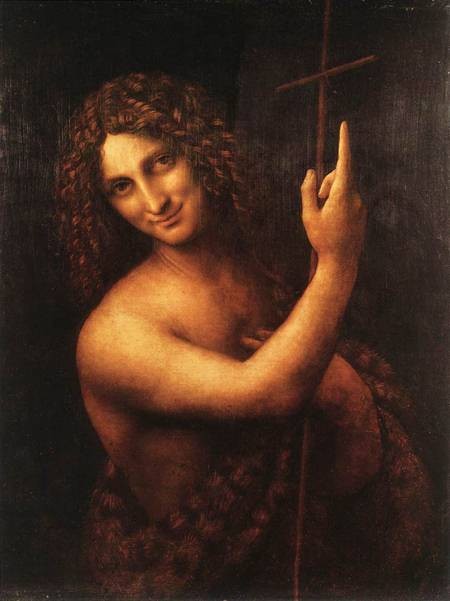
Saint John, the Baptist. From within the black world where nature
and hope have disappeared, the saint’s left hand rests upon his heart;
and his right arm, pointedly, shows the way to another world.
He steps into the traveller’s light and, with a kind word and gesture
to offer, smiling, says, “I know that you, too, suffer.”
Meanings that will not bring words to a traveller’s mouth,
the wounds he spoke of to himself at night, are recognised,
fixed forever, in the master’s art and the smiles of artless saints.
Originally published in Out of the Box: Contemporary Gay and Lesbian Poets, edited by Michael Farrell and Jill Jones, Puncher & Wattmann Poetry, 2009.
Anyway, the word from the poor author, who’s writing this because he doesn’t have a ‘real’ job, is that he wants to know what’s going on behind those eyes, why we behave as though we still believe in fairy tales when it’s obvious that the world’s fucked. I’m thirty-something, so you’d think I’d have figured it out already; but that’s just the way it is. I’ve got plenty of time, though, if my heart holds out.
I met an author at a book launch recently and we talked about the painter Francis Bacon. An interview with Bacon called ‘The Brutality of Fact’ begins with the admission that Bacon harboured a sexual desire for his father. The author I was talking to thought this was shocking, impressively honest, very promising; but he was sure that Bacon was concealing something else with this honesty. Well, I’m not so sure about that. I’m mentioning this because I remember now what I was thinking while we were talking about Francis Bacon.
I was thinking that when I was a young boy I was fascinated by my father’s sexuality. I loved his body, his big dick and his hairy chest. For years, for most of my adult life, I have maintained the conviction, and touted it publicly, that I hated my father. At my twenty-first birthday party I called him an “elephant’s arsehole”. (Not very nice; but, then, we hated each other secretly: he ‘hated’ me for leaving him; and I ‘hated’ him for treating me so badly when I left.) When I come to think of it, these were almost the last words he ever heard come out of my mouth. Everybody laughed.
Kids are supposed to hate their fathers because they’re the competition in a boy’s love for his mother. Did you ever hear such a stinking lie? This conviction I have maintained, stylishly elaborating it for my small part of the world to hear, is, of course, a load of crap—a load of crap straight out of the elephant’s arsehole, so to speak. The truth is, I loved my father. When I remember him now, in the moments that he touched me, when, for any reason, his arms wrapped around me, I was in heaven. But, even when I was just eleven years old, I knew the boundaries of this feeling, without knowing how I knew them, knew that there were things that could not be done or said, and knew this prohibition was real without ever having heard it spoken.
The point is—to answer the question before it is asked—that Francis Bacon was not concealing something else with his honesty. No, that’s not it. I know what Francis was trying to conceal. In a little while (when I’ve worked out how to say it) I’ll tell you what it was.
It’s hard to say what the truth of ‘style’ is, or with what ‘style’ the truth can be written. I know that I am impatient. I know that poets cannot be trusted. And you know you cannot trust me. You do not know whether I am lying or telling the truth. If those bastards in their ivory towers have their way, no one will know whether this pronoun I am tossing around is the thing that stands for me or is something else. I’ll tell you honestly: it is something else, something that even people who are writers do not know, and people who are readers know even less.
All the most personal writing I have reserved for poems; an idea, a feeling, a gripe with the world, some angry moment or pleasant surprise hunches in a cool, dark place for years, confident that, because it belongs to a writer, no one will arrive with a ‘Use by’ stamp. In a poem, and in some kinds of prose, these moments can be gathered irrationally, bunched like flowers and achieve, without too much thought—apart from concentrating now and then on ‘music’, the need to avoid cliché, and the necessary test of truth—an aesthetic effect. My first poems were not, in any way, personal, except in the safest and most abstract way; they expressed my feelings, but in a way that safely detached these feelings from my person. Perhaps this is the reason, years later, when I read these poems, I’m surprised and grudgingly recognise myself as their author. A few weeks ago, when a Sydney fiction editor wrote to ask if I had any prose suitable for publication in a gay magazine, I was surprised, again, to discover I responded, apologetically, that I write on gay themes only by accident, as though two aspects of my self might collide at an intersection. There are several stories, I explained in my letter, on appropriate themes, but they are all too long and none of them is finished. But, even as I wrote my excuse, I knew that it was not quite true and that I might, some time in the future, have to recant. There are, indeed, long, unfinished stories. It is no accident that they are unfinished. Something has obstructed their completion. There is the story of a man of letters and his boyhood relationship with one of Australia’s greatest painters; a ‘true story’ of which so little detail is available to me that it must be reconstructed from almost nothing: it is like trying to imagine a body from a pile of bones. There is the story of a relationship between a middle-aged man with HIV and a young, straight, drug-addicted prostitute. This is the story from which my last book takes its name: ‘The Ninth Satire’. It is strange, isn’t it, that a book built on the foundation of a particular story should have been published without the very story that prompted it? I like the irony of it. For hundreds of years Decimus Junius Juvenalis’s ‘Satire IX’ was excluded from collections of his satires because it dealt with subject matter which many editors thought unprintable. The relationship of Juvenal to the interlocutor of his ninth satire, Naevolus, has always disturbed me. I cannot fathom Juvenal’s cruelty. And Naevolus is both crudely attractive and repulsive. It is difficult to write about what you do not understand. There is another story, also unfinished, about a young girl who becomes pregnant when she is fucked by a man she later discovers is bi-sexual. This story is about disillusionment, abortion, and feelings of revulsion. These stories have something in common apart from being unfinished. They are all, in some way, stories about my unfinished self, ideas that are waiting for the completion of the person who could be their author.
People like a story that moves forward briskly, sweeps them up in a whirlwind of plausibility and delivers them, not more than a little bruised, to unexpected, credible conclusions: something with a beginning, middle and end. —But life is not like that; at least, none of the lives I know are like that. A story may be composed entirely of things left unsaid, where one thing is not properly related to anything else; and it may move forward only by changing direction. This is a story of that kind. Its author is a character a little like myself; that is, only in the sense that he is also an author.
You see, that’s the problem—Francis Bacon’s problem, one of them—you start out trying to tell the truth and, as soon as you open your mouth, your relationship to it has changed: it is no longer the truth, but something that obstructs something else.
What does it mean when someone writes ‘I’? Geofroy Tory, the typographer and student of Albrecht Dürer and Leonardo da Vinci, once wrote, “I cannot pass here without pointing out that our said letters were devised through divine inspiration. Homer, King of the Greek poets, states at the beginning of Book VIII of his Iliad that Jupiter once said he could, if he so wished, draw to himself by means of a golden chain all the other gods, and even the earth and the sea as well.” Tory imagines this chain, hanging from heaven to where we stand, “well proportioned in length and breadth, suited to the symmetry of our proportional letter ‘I’.”1 Victor Hugo, on the other hand, believed that “ ‘I’ is a war machine launching its projectile…”2 Can you imagine two more divergent explanations of the same thing? The upright letter. Tory draws his letter over the figure of a naked man. Anything could hide behind such a monument of typography, an ‘I’ that stretches from its author to the supreme god. Hugo’s letter is a cannon. It shoots its meaning into the heart of a reader, and it does not even have to be aimed very carefully to tear him apart.3
Now we understand each other. Now, as the story of this unfinished self goes on, you’ll understand this ‘I’ is both a monument of fiction (the obstruction itself) and the means by which the obstruction is removed. A typographer’s eye is another matter.
Mistake leads to interpretation. A proof-reader’s eye can unleash reverberations in a reader’s mind. Hans Gabler’s ‘definitive’ edition of Ulysses repeated the minor error of Clive Driver’s ‘definitive’ edition of Ulysses by deciding that Joyce had meant to write “lumps of coral and copper snow” at the beginning of chapter 15.4 The French translation of Ulysses5 says the phrase is “des couches d’une neige de charbon et de cuivre”—that is, “coal”, not “coral”. Joyce is preparing us for a descent into the underworld, not a sightseeing cruise to a coral reef. While we can imagine that Joyce would have cared greatly to give the correct impression here, the same cannot be said of all writers. It is Proust who interests me; the thousands of pages of digression, one tied to the other, so that a reader becomes lost in purely sensuous wandering, through a garden, along a path, the taste of a little cake dipped in lime-flower tea, the eye stopping for a moment on a young girl’s face. Proust did not seem to care about errors of typesetting. What he cared about was creating yet another digression, and when he received his proofs he added more writing to the galleys instead of reading them.6
“I gazed at her, at first with that gaze which is not merely a messenger from the eyes, in whose window all the senses assemble and lean out, petrified and anxious, that gaze which would fain reach, touch, capture, bear off in triumph the body at which it is aimed, and the soul with the body”, Proust writes, with a typographer’s eye, in the ‘Combray’ chapter of Swann’s Way, “then (so frightened was I lest at any moment my grandfather and father, catching sight of the girl, might tear me away from her, by making me run on in front of them) with another, an unconsciously appealing look, whose object was to force her to pay attention to me, to see, to know me.”7
The eyes are, perhaps, more important than anything—at least, to a person who has the use of them—and there is as much about them in our languages, poetry and morality, as any other part of the body, including the heart. Gray’s Anatomy describes the heart in less than ten pages (leaving aside all the things connected to it) and provides only two illustrations. The eye, however, has at least fourteen pages and five illustrations (not counting the Meibomian glands or the Lachrymal apparatus). The eye is in every aspect of our personality. While we keep the heart and mind separate, all minds have an eye—‘the mind’s eye’—to see things our other eyes cannot. This eye may be green, if we are jealous. And, as we know from the Psalms, having eyes is no guarantee that we will be able to see.8 Understanding is not only a matter for the eyes—‘an eye-opener’—but the speed with which it happens is measured in the eyes: “In a moment, in the twinkling of an eye, at the last trump: for the trumpet shall sound, and the dead shall be raised incorruptible, and we shall be changed.”9 There is an “inward eye”, according to Wordsworth, “Which is the bliss of solitude.” And, as we wander lonely as a cloud, like William, who knows, we might see Mr Dodgson through the looking-glass with our “dreaming eyes of wonder”. But it is all in the eye of the beholder. Some eyes have apples in them; some are jaundiced, some lacklustre; others have bags underneath. Many eyes are found in months—“men’s eyes in April / are quicker than their brains”10 —and there are a thousand, at least, in every night. Are there more eyes in Shakespeare than in the sky, than in the night sky, plus one, “the great eye of heaven”? “Alas, how is’t with you / That you do bend your eye on vacancy / And with the incorporal air do hold discourse?” Why are there so many eyes in Hamlet? “In my mind’s eye, Horatio.” “… Foul deeds will rise, / Though all the earth o’erwhelm them, to men’s eyes.” “The courtier’s, soldier’s, scholar’s, eye, tongue, sword.” “… Make thy two eyes, like stars, start from their spheres …” The eyes are the site of our most intractable prejudices. Black and white. “Appearances contribute to reality”, John F. Kennedy said. We know that there is something else, but our eyes tell us what we believe will be the truth. Our eyes connect us, by their immediate reaction, to what we know is viscerally, instinctively beautiful or horrible. Magnetic. Attractive. Insatiable. Repulsive. Ugly. An eye is a key that unlocks pornography. And while it is true that they can be closed, unlike our ears, which are always open (and, so to speak, ‘watchful’), even when closed the imagination keeps them alight. Memories stoke the fire. When we are asleep our eyes follow our dreams. The eyes hardly ever sleep. All of our desire is in them, and all desire’s sadness. The eyes are full of themselves and with everything else. It is with our eyes that we measure the world and first recognise ourselves in it. Sight, as Plato wrote in The Republic, stating the obvious, is the eyes’ “proper excellence”.11 —If only it were true. It is through them that we measure the visible world, and imagine the extent of everything that is hidden. First in the catalogue of human fear is the ‘unknown’, whose most compelling sign is darkness. The eyes are a list of suffering and joy. All of a person’s character may be in their eyes, as Gustave Flaubert knew.12 —And none of it. The eyes of the paranoiac imagine there is more in the eyes that follow him than there actually is. Why? It is because the content of eyes is very often ambiguous. We hope for love and fear rejection, and never know everything that is behind another’s eyes. A ‘visionary’ is one who saw things we did not, and so is a madman. Visionary and madman are measured by what our own eyes see, or don’t see, as the case may be. (Madness, as the mad will tell you, if you ask them, is mostly in the ears. Thoughts are ‘heard’. The mind is a noisy place. But, after the ears, the eyes are the next to go. Light and dark angels appear where voices were.) And, as Michel Foucault has shown, modern medicine was born in the eyes: “The gaze will be fulfilled in its own truth and will have access to the truth of things if it rests on them in silence, if everything keeps silent around what it sees.”13 Two eyes are needed to appreciate perspectives. A mystic is helpless without the third. A banker may not have a heart but he keeps at least one eye on the bottom line. Some people “only have eyes for you”, which is a somewhat unlikely compliment. To have eyes like these is, in short, to be human. Even Jews have them! “I am a Jew. Hath not a Jew eyes?”14 And niggers, queers, perverts, socialists, women, Liberals and child-molesters have them, too.
Are you following me? Good. Then let’s go to New York—city of many niggers, Jews, Koreans in self-serve salad bars, and millions of eyes. The contrasts are surprising. Times Square is said to have more ‘language’ hanging in the air than any other place on earth; a vortex of signs and speech, a typographer’s dream. Wall Street, on the other hand, where language has been replaced by ‘data’, is a cold, almost signless, windy canyon that, I was surprised to find, has a dark and eerily beautiful graveyard, beside Trinity Church, at its entrance. I walked back from Wall Street to my room on West 48th Street by wandering up West Broadway through Soho and Tribeca (in Spring Street there is an old building now dubbed ‘Poet’s House’—it’s in the NY phone book—where a monthly calendar of literary events and readings is published), the Village and, on the other side of Washington Square, Chelsea, up Eighth Avenue past the General Post Office (“NEITHER SNOW NOR RAIN NOR HEAT NOR GLOOM OF NIGHT STAYS THESE COURIERS FROM THE SWIFT COMPLETION OF THEIR APPOINTED ROUNDS”); a walk that, with occasional stops and small detours, can take a couple of hours. The 40s streets on Eighth could be avoided at night, if you are so inclined: they are full of visionaries, madmen, typographers and tourists. A typographer, I kept my eyes open, of course. There is so much to see. I walked into a salad bar where you can fill a small plastic container with whatever you like and pay, according to the weight of what you’ve chosen, only a couple of dollars for dinner. A tall, white red-neck in the queue in front of me was having an argument with the small Korean woman who weighed the meals. I had seen her here several times before, at all times of day, and concluded that she never slept. The red-neck had had enough of something. Maybe there are just too many people with yellow-brown skin in Manhattan these days. He exploded angrily, made some offensive remark, threw coins on the counter, and exited with his plastic container. The Korean woman said something to me that I didn’t understand, and then she laughed. I smiled quizzically. I was becoming accustomed to having conversations in which less than half of what was said could be understood. The previous night a cab driver had stuck his head out of his car and asked a black woman on the street, “Where is two-thoity-sex?” “Two-forty-what?” the black woman had replied in a well-educated tone of voice. I imagined these two people had spent most of their lives growing up together, one from Brooklyn, the other from the Lower East Side and, with only the East River between them, at this one, chance meeting, effective communication seemed impossible. I picked up my plastic container, which the tireless Korean woman had put in a little bag for me, and continued on my way. My eyes were still open. “Hey! Baldy!” I turned around. I realise, now, that this was a mistake. I should have kept my ears closed but, as I’ve already warned you, the ears are ever watchful and cannot be closed. A little Jewish man with long, messy hair, and dressed in a long, dirty, black coat, was hobbling behind me. He looked, in the moment that I saw him, like a mad and visionary Rabbi—not someone to be messed with. “Wha’do you want, baldy?!” Under no circumstances was I going to stop for this man. He had seen something, I don’t know what, leaning out of my eye as I walked along Eighth Avenue toward my room. Desire, perhaps. Whatever it was, he didn’t like it, and he was going to get me. “Hey, baldy! Wha’do you want, eh, baldy? Bald man!! Stop! Wha’da ya looking here for, bald boy?” he cried angrily. This guy was getting on my nerves. I walked a little faster, consoled myself that West 48th Street was only around the next corner and this nightmare would soon be over. But I was also angry. I was, after all, innocent of everything, except having eyes; and in New York there are millions of those. A moment later I realised that this caustic Jew and I had become a spectacle: ‘AVENGING RABBI CHASES GENTILE FROM PIT OF INIQUITY’. —This is what the German tourists have come to New York to see. What business was it of his where I looked, what my eyes saw? And this ‘baldy’ thing—it was very embarrassing. Had my corner not arrived just in time to save me, I would have turned on him and given him the slanging match he so richly deserved. My trump card was 2 Kings 2: 23-24. A Jewish nightmare, I thought, is a Gentile who knows the Old Testament. “And he went up from thence to Bethel: and as he was going up by the way, there came forth little children out of the city, and mocked him, and said unto him, Go up, thou bald head; go up, thou bald head. And he turned back, and looked on them, and cursed them in the name of the LORD. And there came forth two she bears out of the wood, and tare forty and two children of them.” I was shocked to look with my ‘inner eye’, in what should have been the “bliss of solitude”, on great reserves of hatred. Visionaries and bigots—the only way to cure them is to pluck their eyes out. This place, I thought, must be Hell in summer.
It is the same everywhere… In Melbourne, at a friendly Fourth of July gathering of expatriate family and lesbian acquaintances, a woman makes the remark, about a young girl who has just left, “She’s a very pretty young woman. And she’ll go far, if she fixes up her teeth.” The discussion bubbles for half an hour and then erupts. What kind of desire, mingled with business-like cruelty, had looked out of those eyes? In the 1930s, in Queensland, a young boy was receiving advice about life from his father. He recalls, nearly sixty years later, “My father told me there is no God. He was a sensible man. He told me I should not waste my time yearning for the Absolute, that I should be careful with money and that I should never feel guilty about sex. But the most important thing of all for a young man, he said, was to be careful not to get a young girl pregnant. If this happened I would be responsible for the baby before that responsibility was wanted, and it would ruin my life.” Between advice and recollection was a remarkable life, guiltless sex and, I assume, no babies. Once or twice, at the moment when stories haltingly begin, he refers to a self-imposed restraint on how his eyes might wander longingly over a beautiful face because, if it were noticed, some danger that is probably only recognition might present itself. Walk along a busy street, anywhere, behind a beautiful girl or boy, and you can see, in the faces of men and women alike who pass you going the opposite way, how their eyes suck light into an abysmal prison of need, with “that gaze which would fain reach, touch, capture, bear off in triumph the body at which it is aimed, and the soul with the body”. “He stared at the snake, and the snake at him”, just at the moment before his painful transformation, one body sucked into the other, and both of them transformed.15 It begins with a stare. Young girls are tarted up so effectively before their images are glued to billboards, you’d think they were old enough to consent. We are in Hell, and all this is perfectly natural here.
My own characters stare out at me like they would stare at the snake. Something prevents me from finishing them off. I slide around them, hissing, for months or, sometimes, years. —An unwillingness to change. That, you see, is how Dante finishes Canto XXV of Inferno: with the change and transmutation of creatures in the eighth circle of Hell, where fraudulent thieves are kept. (So, poets are among them, of course.) Dante’s eyes, he says, are “somewhat confused”, and his mind bewildered.
The eyes have always been the most sexual of organs. Legislators, moral guardians and civil libertarians argue more about what we may and may not see than anything else. The freedom to speak is, just as often as not, the freedom to write and, by implication, the freedom to read; and we live with elaborate administrative systems regulating what may be seen and, every now and then, the rules change. But some things never change and cannot be regulated. At the very beginning of (the first) Francis Bacon’s Advancement of Learning, the author was careful to note that in his own mind he represented the King “not with an inquisitive eye of presumption … but with the observant eye of duty and admiration”.16 The seventeenth century version of “you were always on my mind”, this was, of course, a lie, and it is clear he was attempting to cover up his ‘original sin’. Eyes are not like that. For both God and man, creation, knowledge and everything begins in the eyes: “God saw the light, that it was good … the woman saw that the tree was good for food, and that it was pleasant to the eyes … and the eyes of them both were opened, and they knew that they were naked …”17
So, when Francis Bacon—the painter—said he harboured a sexual desire for his father, was he concealing something else with this giant truth?
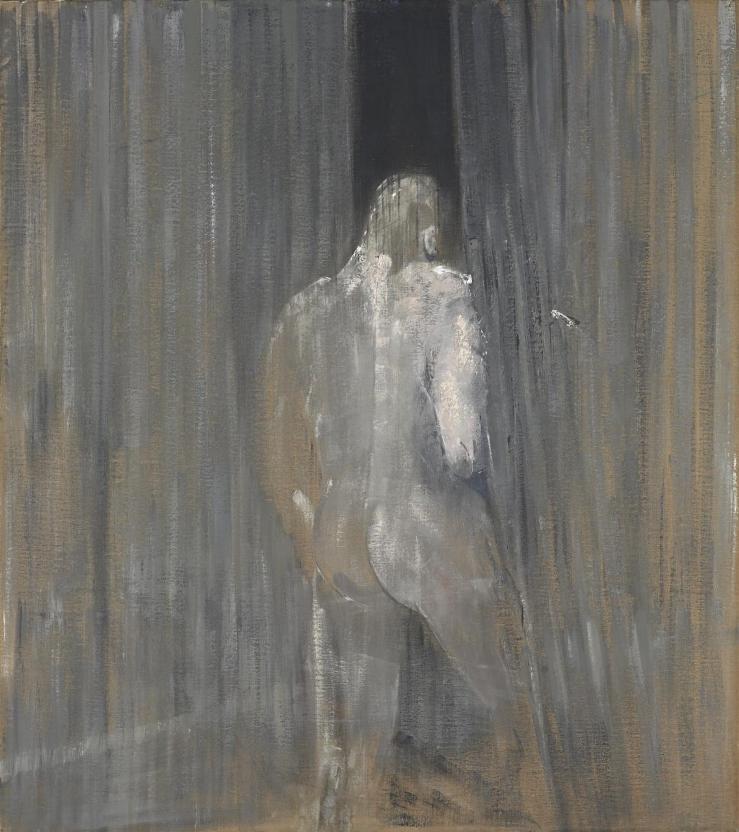
The National Gallery of Victoria has an early Bacon painting, Study from the Human Body (1949). Many of Bacon’s paintings depict bodies of this type. The naked male figure moves through a veil or curtain, steps into a dark space behind the painting, from the visible world into the invisible world, from consciousness into the unconscious, from life into death. His right leg and right arm quietly push the veil aside. His head bends forward into the dark. Two falls of curtain divide the painting—left and right—and the figure is in the centre. The man’s calves have been chopped off at the bottom edge of the frame. We cannot see his feet. The left fall of curtain hangs straight. The more central folds of the right fall of curtain slope gently toward the right. Above the man’s head, between the falls of curtain, is solid grey. The whole picture is composed of sandy-yellows, greys and white paint. The back, right shoulder and right arm of the figure are mostly bare, white paint. We cannot see his eyes, which must be looking down to where a little yellow-grey light is slipping along the floor from where we are to where he is going. Unlike many of Francis Bacon’s paintings, the figure is not distorted or deformed. He is a lover leaving the bedroom. A father disappearing into the past. You can stare into the painting a long time without noticing something else, a small detail that may not be very important: there is a safety pin fastened to the right fall of curtain, helping to hold the veil open. If the figure were absent, if no one had decided to pass through here, or if he had already gone, the gap in the veil would remain open, the safety pin holding it there so we could peer into the dark. In a moment he will be gone. The figure in this painting looks like my father. We want to call him back, tell him not to go in there. We would only need to say something, anything. We would only need to say something else. We do not know what this something else is. No one knows.
Study for Nude (1949), by Francis Bacon
This story comes to you courtesy of the Great World between Fact and Fiction, Inc., the eighth circle of Hell, pit of thieves and poets; where everything is changed into everything else; where, Dante reports, thank God for small mercies, smoking is not only permitted but absolutely essential; where poor Mr Bacon and I stare at the snake and wait, with terror, to be changed. Later, in the eighth circle, you will meet fraudulent counsellors and all kinds of falsifiers (generally speaking, the post-modernists). —Have a nice day.
This short story was originally published in Going Down Swinging Number 15, 1995.
Tory and Hugo do not always disagree. To Tory, for example, ‘H’ is “the body of a house” and to Hugo it is “the façade of a building with its two towers”. ↩
The 1960 Bodley Head edition of Ulysses prints it correctly as “They grab wafers between which are wedged lumps of coal and copper snow”, p. 562. ↩
By Auguste Morel and Stuart Gilbert, in collaboration with James Joyce, 1929. ↩
Guy Davenport discusses the examples in this paragraph at length in his book Every Force Evolves a Form, Secker and Warburg, London, 1989. ↩
Marcel Proust, Remembrance of Things Past, Volume 1, Swann’s Way Part One [1913], trans. by C. K. Scott Moncrieff, Chatto & Windus, London, 1976, pp. 192-193. ↩
The first thing I want to say is that everything I’m going to write down here is true. Obviously I’m going to lie a little here and there because you can’t tell everything you know about someone unless you’re trying to hurt them and I don’t want to do that. But as far as all the things that matter are concerned I’m going to tell the truth.
The notebook’s first page is a collection of titles. Most of them are crossed out lightly, or struck through; some have been obliterated by several layers of ink. Two of the titles are written in an unusually neat hand. They were the first and last choices. One of these two has been rejected because of its coincidental reference to a novel by Patrick White. Throughout the notebook the titles are repeated above versions of the same story or different parts of the same story. Everything in the notebook is unfinished.
There are two versions of the beginning: the first is a half-hearted claim to write nothing but the truth, and the second, in the middle of the notebook, is an attempt to begin at the beginning. He has decided this second attempt to open the story was too important to take the place it would naturally have in the record of a person’s life, and therefore adds the note, End—explanation?
The story is there, in the notebook, but, as it stands, it is little more than a record of the author’s failure to write it. “Story”, though, doesn’t describe it properly: some parts are like a diary, some actually a diary, some nothing more than notes on conversations. How much of it is true, how much fiction, doesn’t seem to matter.
I’ve been reading bits and pieces of The Norton Anthology of Modern Poetry. —For years. I have to admit I don’t like Ezra Pound. There are others I don’t like, which is only natural, but with Pound I feel like I should apologise, like it’s a sin. Father, forgive me my sins. It has been years since my last confession, father, and these are my sins: I don’t like Ezra Pound. It’s nothing about the writing. I think it’s something personal. Something to do with the ‘hieratic head’, the arrogance of it. Something about the way his poems are treated like holy relics. But now I’m not so sure, because there’s this ‘Portrait d’une Femme’, and it makes me cry. I slobber over it. It’s not a terribly sad poem — at least, I don’t think it’s supposed to be.
“Your mind and you are our Sargasso Sea.” No need to look at the note to understand what it means. My aunt is my family’s sea, beautiful and dangerous. So much depends on her.
Her life stinks and, unlike Job, she hates god for it. There’s no point in thinking that god might not exist—someone has to be responsible. Her bravery in cursing him during thunderstorms frightens friends who happen to be visiting.
All references to religion have been deleted, except a kind of prayer which I will show later.
In the next passage, not really part of the story, there is the reason for the writing.
More than a year ago my aunt left her home and moved into a flat to live by herself. She left her husband and son. Everyone in my family was shocked by this and couldn’t understand it at all. I include myself, of course. I heard about it second hand, from my mother when she visited me one day, hunting for clues. She didn’t tell me the whole story because she didn’t know it all herself. She didn’t say, for example, that some people in my family had been saying my aunt was a lesbian. “That’s the reason she’s done it. It couldn’t be anything else.” All I knew was my own disbelief.
When mum kicked me out of her house because she wanted to get on with her life, I left quite happily because I wanted to get on with mine. Kids run away just because they’re growing up, or because they think they’re growing up, which is the same thing. It’s about independence. A year ago independence was the only reason I could find for my aunt’s flight. I’d forgotten—not even thought, because it had never been necessary for me—it could also be about survival. Women know this other explanation deeply. Men don’t seem able to think it.
After the titles are four photographs, one to a page, pasted to the lined paper with art cement. The aunt is first. She is cutting a cake (a birthday cake?) and there is a Christmas tree in the background. The uncle is second. He is holding up a glass of beer in the gesture of ‘Skoal!’ and grinning broadly. Grandparents are third. It is a portrait taken with a diffusing lens-filter. A window off to the left of the couple throws light into a dark room. The tan on the face of the sun-loving husband and the flowers on the wife’s dress look painted. I am the fourth. My appearance, as a photograph in the notebook, is puzzling: the only other reference to me I can find is the letter “M” underneath the picture. It would have been more appropriate to include a photograph of the cousin, Robby.
Then there are two pages of scribbling. Two addresses, doodles, and a figuring of dates which arrives at the answer “1953?” The best, but still inadequate, version of this year is written like a report; the rest are only notes.
When she was thirteen everyone called her a tomboy. She used to box with a boy who lived down the street where she lived in Richmond. His name was Johnny Famechon and he went on to make a living beating young men to a pulp in the ring. When he was a kid, though, he used to come out second best against my aunt. In the same year, 1953 I think, there was a hot December night and nothing very important was happening. Anyone who was moving was moving slowly. Maybe half the women in the street were sitting out on their patios drinking beer. One of my aunt’s cousins, older than her but not by much, started talking about sex. It was a subject my aunt had not given much thought to. What was said—something crude and, in fact, a lie about my aunt’s mother—doesn’t matter in the long run. I’ve no intention of bringing it to life by repeating it here. It’s more important to tell how I was told of it.
My aunt was trying to remember how she felt. She said very clearly, very directly, “I hated her.” As she said this I remember seeing this hate as though all the years which separated her present self from that former one were suddenly transparent and irrelevant, and I could see the core of what she was that night her cousin told her the lie. Now I don’t know whether she was referring to her cousin, her mother, or both of them.
That hate lasted eleven years, from the night in December, 1953, to the day she gave birth to her baby. What happened during these eleven years is difficult to explain, and I don’t pretend to understand it at all. She says that this hateful “thing” which had formed inside her was alive, but also silent, like a place where light and sound could enter but not leave, a listening, lizardy thing, cold-blooded, not human. She became ill, and refused to carry on conversations even with people she had known for years. There was going to be a place no one else would know about, where she could be alone; and since there was no place in the real world she could make that happen, she created a place inside herself for that purpose. This place could be infinitely large, insatiably hungry.
There are more lies in here than are necessary to protect the people the writing refers to.
That first rule, Write about what you know, is not very helpful tonight. What I know tonight is that I have forgotten a great deal it would be useful to remember. There are only threads of conversations and stories left, which I pick up, trying to put them together. So, they’re together. How many lies will make a pattern visible?
My aunt used to listen to doctors, friends, and family talking to her, asking her what was wrong, and it would seem she wasn’t listening at all. Nothing seemed to get through. That was a mistake. In fact, she heard everything and let everything in. In her secret place she would be listening and speaking all the time, saying things like, “You’re all idiots! You’re never going to get in here!” Doctors can be idiots, too, of course. “It’s stupid to claim you know something when you don’t”, is her explanation of the work of psychiatrists. She does admit that one of her doctors came close to her.
He gave her paints and clean, white paper to work with. She liked painting, and still does, though she never paints people because she believes there is too much in people which can’t be seen. She paints only landscapes and houses. In Mont Park, the mental hospital, she painted what she saw and used only two of the colors in her set of paints, black and red. The whole surface of the white paper she’d been given would be covered with black, except for a thin, rectangular sliver of white right in the middle. At the end of this white sliver she put a red dot.
It was a cigarette. My aunt was certain that no one “in the whole world” would understand what it meant, but the doctor who’d given her the paints looked at it and said, “Well, there’s some hope for you yet. I’m glad you think there’s still some white to look at. It’s a window, yes?”
Less subtle, not-so-clever psychiatrists had already tried electric shocks to relieve her depression. The idea is that, if you shoot a certain number of volts through someone’s brain, the poor bugger’s going to feel as though he’s died, first, and then feel like he’s been born again, which gives him a new start in life. It certainly gives him a start. It wasn’t electricity which shocked my aunt out of her private place but the desire for light and the surprise of a real birth.
The notebook, its leaning toward an always incomplete story, seems to skirt the issue of a scandal in the family, providing the motive to write, but surfacing only in phrases delaying its appearance—“until recently … ”.
By 1959 my aunt had already married. I don’t have the foggiest idea how this happened. The details of this part of her life have never interested me very much, but now that I get around to this part they seem important and I’m pissed off that I can’t record it properly. I do know that her husband is a good man and loves her. I know that most of the time they sleep in separate beds. I know that until recently her marriage was the happiest in my whole family. I know there was a baby, my cousin.
After a few years she was still not considered to be really well or, at least, “normal”, and there was a lot of talk about whether she would be able to cope with a baby. For a while into the pregnancy her doctors continued to ask questions, mainly about sex. Neither my aunt nor her husband seemed to be very comfortable with it, but then you could say that about a lot of people, including most of the doctors, I suppose. She got fat. It was the first time in her life she looked like her bulging, robust sisters, and she thought it was wonderful. It was wonderful being fat; she wasn’t yet sure about the baby. If you could see her grand, muscular son now when he stands beside his tiny mother you’d probably laugh at the miracle of it. At some point she discovered the baby was protecting her. The doctors stopped asking questions. Occasionally she heard people say things like “It could go either way”, which she supposed was a comment on her mental state. She got fatter. She became two people. And then one afternoon, after complaining to the nurses of the women’s hospital for more than an hour, her son’s leg “popped out.”
I think it was a leg but it might have been his arm. She remembers travelling in an elevator with one or other of the baby’s limbs sticking out from between her legs and a nurse saying “You’re not being very helpful” as she wheeled my aunt’s bed into the delivery room.
After that there was nothing real, only a dream.
There are two dreams in the notebook: one recording a birth and the other a death.
Over the next few days the same dream kept coming back. She was being beaten cruelly by people who wanted to get inside her, and the baby wasn’t safe. Every night she had to fight these people off until her baby emerged with bruises on its face. The staff at the hospital and all the visitors recited a prepared speech when my aunt asked them why she could not see her baby. “Everything is all right. You must rest a few more days.” Robby did have bruises on his head, caused by the large clamp which had been used to assist his appearance in the world.
He has tried to assess Ezra Pound’s poem against his aunt’s life. There are lines in the poem which made him think of her, but others apparently did not sit comfortably with his ideas about her. Two pages of the notebook are devoted to this strange assessment, most of it unintelligible, referring to things and events not appearing elsewhere.
“No! there is nothing! In the whole world and all, nothing
that’s quite yr own.”
Anyone? What rubbish!
These are the only three parts of the poem clearly connected with parts of the notebook text.
It’s now about thirty years since the first time my aunt died. I’ve promised her the next time she dies, which will probably be from lung cancer at the rate she smokes, I will arrange for her favorite pillow, cigarettes and a box of matches to be buried with her. She says these are the only things she couldn’t bear to live without—or die without, depending on how you look at it.
After Robby was born my aunt started pulling things apart to find out what was wrong with them. Wherever she’s lived she’s become famous (locally) for being able to pull broken things apart and put them back together again fixed. Neighbors bring toasters, radios, tape-recorders, hair-dryers and children’s toys and puzzles for my aunt to work her magic. This is the way my aunt set about trying to repair the world and understand it, one thing at a time. Watches and clocks are her speciality.
One afternoon I went to visit her there were tiny pieces of metal scattered in what might have been an orderly fashion all over the kitchen table. She asked me whether I thought time was inside or outside a clock and I had to admit I didn’t have the faintest idea; so we just had another cup of tea while she put the clock back together again.
The meaning of the word ‘Body’ in the group “Oddments of all things” is not clear. The implication may be that the aunt’s peculiar mechanical abilities, her desire to “pull things apart”, were a substitute for a deeper interest in the workings of human bodies.
How can only three people be afflicted with so many unpronounceable names? ‘Von Recklinghausen.’ ‘Dupuytren.’ And so on. I imagine there are many like her, who live among the rest of us without ever telling us their special knowledge because they do not understand themselves it is something worth knowing. I imagine they have special powers given to them by their experience. And I imagine their numbers are growing.
I wish I were one of those know all authors who write stories where everything just falls into place, who make their characters do things like it was obvious what was going to happen all along.
In all the years I have known him I can only remember my uncle saying about a dozen things to me. Sometimes a few will come in combination: “Hi, how are you?” “It’s been a long time.” “What have you been doing?” I have a photo of him, glass of beer in his left hand and his mouth stretched to form an astonishing smile. It is really a picture of the mouth.
And then, the same thing over again …
Another Christmas has been accomplished. My aunt, her husband and son were absent this year. If they had said nothing, which would not be unusual, the rest of the family could easily have thought the three of them were staging a protest. It was not a protest. They went to meet Ken’s father halfway between the present and the past.
My aunt’s family seems to spend a lot of time not speaking. That’s not quite right: they speak, but do not tell. In all the years I have known him, before the last year, I can remember Ken saying only about a dozen things to me. Sometimes a few would come in combination: “Hi, how are you?” “It’s been a long time”, and, “What have you been doing?” I have a photo of him, glass of beer in his left hand, and his mouth stretched to form an astonishing smile. It is really a picture of a mouth. The mouth that doesn’t talk, at least not to me. It’s no less a friendly mouth just because few words come out of it.
I called her today to find out what had been going on. She didn’t come to Christmas lunch this year because she, Ken and Robby went up to the mountains to see Ken’s father. It’s been forty-four years. Father and son sat on the grass up there for hours, crying and talking, talking and crying, while the others, eating cold chicken, watched from a distance. My aunt couldn’t hear what was going on because her hearing aid was pointing into the wind. All she got was a roaring hiss. On the phone she kept calling the whole thing “pathetic”—“It was so sad, pathetic.”
He is relieved, at last, of the burden of having no past. Now, he looks there, seeing something solid, a grey face, old, not very impressive as far as faces go—but a face, life in its contours, a real death and loss in its future, something to know, touch, and kiss, or to hate and to blame. With this relief there will also be change. That must happen.
But, as for me, I am unchanged. The photographs prove it. I stare into the lens, my lips closed tight, not in the pose of a man who will not tell, but like one who has nothing to say. The one photograph which is most telling shows me clothed in black, in a solidly dark room. A light to one side of my face half lights me, and appears to freeze me in a world without its own features. The other half is completely black, and this is the place where I dream, and where, I suppose, my aunt lived. Who knows if there is any change or life there, or whether it is just a slow accumulation of junk and memory, where we might, if we were brave enough, go to find all our other selves, and write.
O God, who made us, who knows us, who knows our future
Who causes all our pain, and leaves us bewildered and helpless,
And free to die, and without hope, I know you are the God
Who is not God, who is our unfeeling, unthinking emptiness—
I know you are the God my aunt married, the dull, cold-blooded,
Blue-blooded lizard, and the dark, sticky resin where memory
Is planted, and where our feet stick. I know that I must fear You
As I fear the grave, and fear madness, because that is what you are.
I know that I must have you in my house and in everything I do
Because you are the living God who is dead in everyone,
Who sleeps and dreams with us, who arrives at breakfast
Stoney-faced, formal, in a black suit, like forgetting, and
Whose cruel, unbroken years of silence waits to break us.
Last night I dreamt I had fallen to the ground. I could see faces coming toward me, the familiar faces of the people I work with coming toward me. Arms reach out to touch me. Just at this moment I realise I am about to die. There is nothing these people can do to help. Someone calls for an ambulance. Since there is nothing I can do I watch my self dissolve; the faces looking at me disappear as I might seem to be disappearing to them. Then I am in a deep darkness. There is no sound and I can feel nothing. My mind is alive inside a black box. At this point—it has only taken a few seconds—I understand I have dreamt my own death, or I have actually died and that I understand nothing. What do I do now?
“What is there left for me to do? My first death left me with a choice I could not avoid, to live forever in that black cave I made, with my own voice, or … I remember the moment Robby was born, as though he were punching his way free of the place where he had been confined with me. I knew then that I was not alone, and never had been. This small thing had been with me all along, even from before I was married. He had been with me for as long as I have been here. I emerged, too, along with my boy, and found the other place outside not much worth living in. Every now and then I discover some thing, or a small area to live in, flooded with light, things or places where nothing is hidden from anyone who cares to look. —A clock or a watch, for example, inside which nothing can be secret, and where, because of that, there can be no real darkness or misunderstanding. The closed box of a jigsaw puzzle, too, is a place always containing some perfect picture; it only needs opening and patience. On the other hand, people are completely mysterious, and hopelessly dark. It is impossible to paint them. They are all odd numbers. My husband, whom I love, I have lived with all these years and I still do not understand him. I cannot explain the bad time we went through. The bruises, the drink, everything obvious about that time … I know I have not been the easiest person to get along with. He saved me once. I think it must have been he who saved me. At some point I can no longer remember I must have willingly come out of my madness and loved him. This must be true. I am here, after all. And we have survived all this. We are no longer alone together, but together. Something deeper has saved us all, and continues to save us. When I was young, very young, my parents already knew I was to be the odd one out, and odd even among all the odd in the world. I was the last of four sisters. My father was going to the War, taking a ship to the Middle East. It would be a struggle with four kids at home. The wartime censors pretended to keep secret where the men had gone. I still have a letter which dad sent home that has a square in the top right hand corner neatly removed. But there is also a yellow-brown postcard with the word JERUSALEM boldly printed at the bottom. On the docks, before he left, mum told me later, was where I was conceived, in the last ten minutes before all those years of silence. I can’t imagine where they found a quiet place to make me, or if they were worried about that. It was a quick job, but one well done, mum says. They never loved each other more than in that moment just before leaving, which was a kind of death, and never hoped more for the life that was promised after death. That is the reason I am here, and the meaning of everything that has happened to me …”







 Stephen J. Williams
You must be logged in to post a comment.