Category: Writing

Writing posts.

  • Welcome, Arjun! (Park the elephant anywhere.)

    Among the people who have tried to arrive in Australia by boat in the last few decades were probably many, whatever their religion, who knew all the details of this story already, and knew its lessons …


    Krishna reveals his universal form to Arjuna.
    Krishna reveals his universal form to Arjuna.

    Every Friday night Sebastian comes around for dinner and drinks. Last Friday he asked if he could invite Arjun to call in, late, and join us. I had not met Arjun before. I thought for a moment, trying to recall the name in the Bhagavad Gita. It has been a long time since I read it. A very long time. “Yes… Is it as in ‘Arjuna’?”

    Sebastian sent the agreed-upon text message to Arjun’s phone… “Park the elephant anywhere. I’ll come out to show you in.” —As though anyone with a modern Hindu name would turn up for drinks on an elephant.

    Arjun arrived later than expected. He had been to an exhibition and the art was ‘experimental’. “I went with an artist who tried to explain it to me. Apparently it starts off being a painting, and then it gets turned into a print, and then it’s projected. There were videos, too.” So, we talked about art.

    Every long friendship is a secret place, a bolthole that is also a hall of mirrors where language, laughter and identity reflect on each other. We tell politically incorrect jokes about gays, women, blacks, politics, and then quickly straighten ourselves, pretending to worry that someone might be listening at the window or that there is a microphone hidden under the table. These jokes, to be fair, are often at our own expense. No-one gets out alive.

    Blacks call each other ‘nigger’. Gays take back ownership of ‘queer’ and ‘faggot’. But in our colonial outpost at the end of Asia, surrounded on all sides by water, Muslims, Hindus, Maoris and ice, people who look and speak like ‘foreigners’—non-Anglo, non-Euro foreigners—are still having a gruesome time.

    It is not difficult to perceive a shrill panic in Australian language in 2015. Online newspapers are stuffed full of (mostly) anonymous complaints about fake refugees. “Surely everyone knows that the countries refugees want to live in are white countries.” “The refugee convention does not guarantee that refugees can only be resettled in the wealthy country of their choosing. Yet, many refugees seem to want only to come to Australia and reject safe harbor in other countries.” And so on. Genuinely racist urges are easily camouflaged with concern that we should not allow refugees to drown at sea.

    Australia has developed a heap of festering prejudices. “Why do these people have to come here.” “They’ve spoiled their own countries,” “ruined their own cultures with religious wars.” “We don’t want that sort of thing here.” “There are Muslim countries they can go to. Why don’t they go there?” “The Indian student who faked an attack on himself.” “Oh, God, they’ve taken over the Seven-Eleven stores…” “Asians. I think they’re aliens. I mean really aliens. From outer space.” 

    I like to think I know a thing or two about art, but the truth is I do not know very much at all. Asian art, for example, is a mystery to me. I think I am not alone. All the Catholic and Christian stuff I have down pat, rehearsing it since childhood. To my deeply prejudicial frame of mind, Muslim art is easy: they don’t like images. What’s next? Ah, the Hindus: statues with many heads and way too many arms. I have no idea what it means.

    What does it mean? I acknowledge it simply as a symbol of exotic excess. Those asian artists, you know, they just do not know when to stop. And there appear to be different versions of the same thing: one is a Krishna, the other a Shiva; some of them are dancing and some not. It’s all just too complicated—and alien.

    Properly motivated, it does not take long to find out what it means.

    With apologies to Hindus who may be offended by a clumsy contraction of several million words into these few paragraphs…

    Hindus, like Catholics, believe in a god who transcends everything in time and space. Brahma is the supreme god of creation (alongside Vishnu the preserver and Shiva the destroyer—making the Hindu trinity). It is Brahma who is the father of Manu, from whom all human beings descend.

    The central, though not by a long way the oldest, texts of Hinduism are the Mahabharata and Ramayana. Composition of both began around 400 BCE, and the texts finalised around 400 CE. The Mahabharata is the great story of the ‘Bharata’ dynasty—a history of the contest for accession between the Pandava princes and the Kaurava princes. At the core of the story is the recounting of the Kurukshetra war in which the armies of the branches of the dynasty fight each other. (In this and all the other Hindu texts, the ‘story’ is accompanied by much philosophical and devotional material.)

    The Mahabharata is the longest verse epic in world literature. While the centrepiece of the poem is the description of the eighteen day battle, the Mahabharata also contains, just before the battle begins, one of the key texts of Hinduism—the Bhagavad Gita.

    Arjuna, the Pandava prince, arrives in a chariot to the place where the Kurukshetra war is to start. Krishna, in human form (he is the eighth incarnation of Vishnu), is Arjuna’s charioteer. Arjuna looks at the army opposing him and is paralysed by the thought that many of the people there are beloved members of his family and his teachers.

    Arjuna asks Krishna for his advice. Krishna does not hold back. He tells Arjuna his duty and reminds him that there is no point delaying taking action. The fate of the Kaurava princes is already determined—by Krishna himself.

    To prove his point, Krishna reveals his universal form to Arjuna. This is the moment (chapter 11, verses 10 and 11) we see depicted in the paintings of the (often blue) deity with many heads and many arms. Krishna sees everywhere, and his hands guide everything in the universe.

    Arjuna’s dialogue with Krishna is crucially important to Hindus—personally, culturally and politically. It is a narrative about fate, courage, the necessity for action, and the role of heroism in personal and social life. Its influence runs deep in Hindu culture. Political leaders, past and present, including Mohandas Gandhi, interpreted the narrative of the Bhagavad Gita to clarify their own ideas and actions.

    Careful readers will have noted that Arjuna does not arrive on an elephant.

    Among the people who have tried to arrive in Australia by boat in the last few decades were probably many, whatever their religion, who knew all the details of this story already, and knew its lessons. It takes some courage to get into a wooden boat and try to cross hundreds of miles of ocean, does it not?

    I understand there are many Australians who believe there is an imperative to preserve life; to keep straight the lines and the lengthening queues of people wanting to come here; and perhaps even to sort through those queues for the kinds of people we would prefer.

    Australia is filling up with believers who are concerned to do the right thing.

    Speaking only for myself, I have decided that it is not necessary to pretend to judge whether someone is actually a refugee. I do not believe we should pretend it is moral to punish someone who seeks a better life with alienation, abuse and rape; and to promise it will be punishment without relief.

    I cannot promise it will make any sense to you because I hardly understand it myself: the story of Arjuna is about how to act, and the need to act, even though we are quite certain that no matter what we do we will cause suffering. These ideas are permanent and universal. They were the same in Asia two thousand years ago as they are now in Greece or Italy.

    At around the same time that the Mahabharata was being composed, on the other side of the world, a bronze statue of a boxer was being created. This statue was unearthed on the Quirinal Hill in Rome in 1885 by the archaeologist Rodolfo Lanciani. The bronze has copper inlays that make the flesh of the boxer look bruised. When the figure was cast the sculptor took a chisel to his work and gouged scars in its face.

    The creators of the Mahabharata and the statue of the seated boxer were both trying to tell us something about human suffering and heroic action.

    Statue of a seated boxer, 3rd century BCE, Palazzo Massimo. Photograph by F Tronchin (2007).
    Statue of a seated boxer, 3rd century BCE, Palazzo Massimo. Photograph by F Tronchin (2007).


    Asylum Seeker Resource Centre

    More information about refugees (links)

  • Melisma variations

    My father had a secret stash of Shirley Bassey records. There was a record-player in the house. Mine. It was not a very good record-player. I was eleven and I did not know what hi-fi was. I was into noise, and catchy tunes and syncopations. I had no idea what a ‘Shirley Bassey’ was either, except that it was obviously extremely glamorous and sparkly, could be photographed with its mouth open and got hidden in my father’s bedroom closet—where there was no record-player to play it.

    'Melodica'—sucky instrument one blows into to produce windy notes.
    ‘Melodica’—sucky instrument one blows into to produce windy notes.

    Many years later I learned my father lived most of his life in another house, an apartment he kept in Collingwood, an inner suburb of Melbourne, while I reconnoitred the border of ‘Forest Hill’ and ‘Nunawading.’ His Shirley Bassey records got played—if they were played at all, I never heard them—in Collingwood.

    I compensated for the lack of a musical education, from my parents or anyone else, by trying to figure out how musical scales worked with the aid of books and a strange, little keyboard called a ‘Melodica’ (which sucked, even though I had to blow in it). This ‘instrument’ emitted horrifyingly weedy, windy sounds that were supposed to be musical notes.

    Children are lucky if their parents have the good sense to force them to learn a musical instrument. Even if the knowledge does not stick or the child has no talent, there are important ideas and impressions that are planted in the mind by a musical education.

    Children are lucky if their parents have the good sense to force them to learn a musical instrument. Even if the knowledge does not stick or the child has no talent, there are important ideas and impressions that are planted in the mind by a musical education. Exactly what these ideas and impressions are is difficult to say.

    One of them, for example, might have something to do with scales. Leave aside the discipline and patience needed to practice them: every distinct culture has a distinct musical scale that is a framework upon which all its music is built. There is a Chinese scale, an Arabic scale, a Greek scale, an Indian scale, scales that are equally tempered and scales that are not. Discovering these facts through musical exploration changes a person’s understanding of what culture is and how culture shapes perception.

    I listened to Mozart, and graduated to Bach. I had no idea what a Sex Pistol was, or a Clash; David Bowie, The Ramones, The Osmonds and The Bay City Rollers were all just words.

    One of the popular boys in high school, who seemed to know things the unpopular boys did not know, started to mock me and gave me the nickname “Stevie Wonder”. His mockery was so gentle and, I see in retrospect, so complimentary that I wonder now whether he might have fancied me. Whatever his motive, my new nickname introduced me to the artist who convinced me that contemporary music was worth listening to. Motown. It was fresh air.

    Wonder was twenty-three when he made the live studio promotional video for a new album and recorded ‘All in love is fair’. What a voice he had! Conversational and easy-going when singing quietly, it could suddenly unleash tremendous emotion. Wonder’s version of his own song is a study of contrasts between beautiful vibrato, playful melisma, and striking crescendos.

    Shirley Bassey singing 'All in love is Fair'.
    Shirley Bassey singing ‘All in love is Fair’.

    Other singers, mainly women, took up this song very quickly, and made it their own. Shirley Bassey renders it in a sassy, wise-ass style in which her jaw really looks as though life is punching it crooked as she sings. Barbra Streisand performs it straighter, as though whispering a lesson in life and love right in your ear. Carmen McRae’s version is jazzier, seeming to plumb darker notes, but all the while keeping the melodic line under tight control. Dionne Warwick’s is the saddest version and, just by a little, the slowest.

    These other artists are not merely channeling Wonder’s song. Each version seems like something completely original that is made out of the singer’s own life.

    The great French cellist Paul Tortelier said of musicians, “We are fortunate. We know about happiness.” Note, though, that he does not say they are happy. And that is another mystery music teaches us, and which it is best not to explain.


    Carmen McRae

    Barbra Streisand

    Dionne Warwick

    Stevie Wonder

    Shirley Bassey

    Paul Tortelier
  • ‘Poetry is a small house’

    Joe—who was the chef in the restaurant he owned with my mother—whispers in my ear: “I know something I wish I did not know. A disgraceful thing. Obscene. I think I know who did it.” And he looks at me, continuing to talk this way until he finally pulls a drawing out of his coat and unfolds it to show the image of a ‘crab-woman’, a beautiful woman who happens to have lots of claws coming out of her, like something from a painting by Peter Booth except that this was clearly drawn by a child or an idiot. Joe looks at my reaction and concludes I did not make the image. So he puts his arms around my shoulders as though we were comrades and leads me into a bar or a café, somewhere it always appears to be night and it is difficult to get a table. We navigate our way through the closely set tables trying to find one that is empty. There are few customers down at the rear of this place, where we finally sit down and I order an espresso in my best-sounding Italian. Right down at the end of the room an indigo wall has an unfinished, half-head portrait (lower half) of Samuel Beckett painted on it: the brain, everything above the bridge of the nose, is missing. I notice two poets I used to know, elderly women now both dead, have taken seats at a table not far from us. Someone emerges from a bunch of architect-lecturers to give a slide show presentation now being projected high up on the wall near me. I look up and see the words “alles, was vor dem sex-maschine… alles, was beim sex-maschine… alles, was nach dem sex-maschine” intercut with images, far more disturbing than the childish drawing Joe showed me. I did not understand the message of this presentation, though everyone seemed to find the language entertaining. Among some papers that have been strewn on the table by the presenter there is a newsletter that I made many years ago for a group of writers. The papers are being handed around the group. One of the architects dismisses the design I made. Asked who I am I can only say I am a poet. The dismissive architect asks me if a company with a very exotic and impressive name has published me. I tell him, No. I offer the names of a few places that have published me, and places I have worked, and things I’ve done, and say “… It’s not an opera house, though you can sometimes hear poetry even there. Poetry is a small house, if it is a house at all. It may be just a shelter.”


    Published as ‘Four events while sleeping’, incorporating ‘Poetry is a small house’, ‘Religion is the art of belief’, ‘Martial art, sans art’ and ‘The program’, FIVE:2:ONE print edition, August 2017.
  • Couch-based activism 101

    You want to make the world a better place. The intractable difficulties and complications of reality are stacked against any chance you might succeed.

    This is a quick introduction to strategies and tools for protest, sharing and action in the Internet age—most of which can be done sitting down.

    Emailed protests

    When thousands of outrage-laden emails start pouring into the inbox of the incompetent government minister, a simple filter redirects the electrons onto an information technology compost heap. If your protest must consist of sending someone something, put down the iPad and stick a stamp to an actual package, which you can then get someone else to mail for you.When protesters wanted to have their say about anti-gay laws in Russia they sent Vladimir Putin dildos in the post. Does anyone know what he did with them? (—The dildos, I mean, not the protesters.)

    Facebook

    Judge your friends and acquaintances by how enthusiastically, often and mindlessly they click the ‘Like’ button underneath your posts.The name ‘Facebook’ carries within it the judgmentalism of the software program that was its precursor, ‘Facemash’, a computer game that sorted Harvard women into ‘Hot or Not’. Users turn Facebook into whichever kind of game is most important to themselves: like me or don’t like me; approve or disapprove; with or against me; agree or disagree; and so on.The non-threatening and non-judgemental uses of Facebook—keeping in touch with friends and family, arranging invitations to parties, etc.—are the outer and upper circles of a deep, cold hell where people can easily convince themselves that ‘sharing’ a news item is actually sharing.

    Twitter 

    … Apparently able to tear down corrupt governments with a single tweet retweeted until your despised oppressors simply pack it in. The 140-character messages on your fancy phone are powerless unless someone—a million someones—actually decides to turn up. Turning up is what topples governments; turning up in sufficient numbers and refusing to leave until something happens.

    Occupiers

    … Which leads me to occupiers, not strictly part of the couch-based activism movement.You’ve got to love the commitment and outrage of the occupiers of the Occupy movement but, the moment the news starts showing them sitting in a circle, on cushions, and passing the talking-stick, you know something has gone wrong.

    Poetry

    No. (Yes, it can be done sitting down but, as a strategy for social change, it doesn’t work.)

    Satire

    You can do this lying down or standing up. It is difficult to do well but it can be effective. Modern trends seem to favor non-verbal, graphical forms of mockery (except ‘street theatre’, which is now only acceptable at Earthcore events).

    Unions with Facebook accounts

    Without doubt the most accurate sign your union has abandoned hope that your job and conditions can be protected is the appearance of the union’s Facebook page. Not as concrete as a poster or letter, not as personal as an email, not as rousing (or as dangerous) as a good old-fashioned meeting or speech, the union Facebook account turns all news, good and bad, into ‘timelines’ of blue-hued inevitability. The union organisers who post news to Facebook are most likely at home on the couch right now with a bowl of popcorn.Unions should own more megaphones than smartphones.

    YouTube 

    Meat including Pork (73%), Water, Premix [Potato Starch, Tapioca Starch, Salt, Modified Starch (1442), Soy Protein, Mineral Salts (451, 341, 450, 452), Dextrose, Spices, Antioxidant (316), Sodium Nitrite (250), Fermented Red Rice], Food Acid (325), Sucrose, Smoke Flavors, Vegetable Gum (412), Anticaking Agent (551) … YouTube is the manufactured meat product of the Internet.While it is one of the great, supine protest activities, YouTube’s effectiveness is greatly enhanced when done outdoors and in the kinds of places where human rights are being abused, decency trampled on, and innocents being shot. No editing or music is required. Just set your camera-phone to upload videos automatically and start recording.

  • ‘The frogman hands me an envelope’

    Under cover of the arches of what appears to be a large shopping complex a musician is blowing his trumpet unmusically and another performer, a dancer, is limbering up for his performance. The dancer looks over at me and nods in a way that makes me think it is a signal of some sort. When his performance begins, he grabs me and lulls me into a kind of sleepy relaxation so that I lie down right there in front of everyone. I close my eyes and I wonder for a moment whether he is going to help me up or I am just going to fall asleep right there on the ground. When I open my eyes, however, the sky above me is dark and I am cold and wet, lying in the middle of a field. As I stand up I notice a man, dressed in a rubber wet suit, crawling up out of a hole in the ground, and breathing apparatus and oxygen tank still attached to his head and back. A woman is lying, drenched, on the ground a few metres away from me. The frogman hands me an envelope that has money in it—a couple of hundred dollars—which seems to be payment for the inconvenience of having been disappeared against my will. I look back across the field towards the shopping complex and notice that there is a fountain underneath the arches. The woman and I have somehow been lowered into the fountain and dragged underwater by a frogman for more than a hundred metres through an underground lake. We wander off, going in separate directions. I come to a road. There is a commotion ahead. Council workers are struggling with a giant creature, like an eel but sixty or more feet in length, which has a head with whiskers like a catfish. It snarls and gulps for air, flaps about like a fish out of water, which it is, while the council workers inject it with poison.

  • George Franju’s «Blood of the Beasts»

    Our attitudes to butchers and meat have changed in ways that our parents and our parents’ parents could not have imagined. Firstly, there is the matter of the declining status of butchers. It is a worldwide phenomenon. In the UK in 1980 over one hundred thousand people were employed in privately-owned butcher-shops. By 2008 the number had fallen to about thirty-five thousand. In New Zealand, and elsewhere, negative growth in employment of butchers outstrips the negative growth in most other trades during the past couple of decades by at least a factor of ten. It is not just a recent trend. CSIRO research on meat retailing once claimed that numbers of butchers in Australia dropped 40 percent, from ten to six thousand, between the 1950s and 1980s, and said…

    There are two main reasons for this decline; firstly, [butchers] will be replaced at the counter front by sales persons, who will be trained in consumer contact skills and not in meat preparation. Secondly, there may be a move to centralized packaging, employing capital intensive gas flushing techniques for primals and sliced and trayed meats. These trays will have extended shelf life without the dull presentation of vacuum packaging and be capable of being stored in the retail shop until used, thus relieving the necessity for shop butchers to break down carcasses.

    Secondly, we can add to the simple fact of decline the observation that technology and supermarkets have had their effect on how we think about the places, sensations and people associated with meat. Yes, supermarkets have butchers we can sometimes glimpse working in a space whose design has changed; but gone, very gone, from many people’s lives are the smell of the butcher-shop, the bloodied aprons, the wood shavings on the tiled floor, the tools dangling from the leather belt. Yes, gone—and a good thing, too, I can hear some of you say. Very well. I understand that.

    Third, our meat no longer looks like what it is. It comes, instead, skinned, weighed, seasoned and cooked, packaged in plastic trays, labeled, branded, transported, stacked. Often, it does not even have bones. Many people have come to react with revulsion to meat that has any bone in it, as if the bone reminded them they were about to eat an animal. (Jacques Derrida said that the very word ‘animal’ carried within it a presupposition of the cage and food.) A bone in a fish is an existential threat. Look—I’m not going to mention offal (the meat world’s unmentionables), or Masterchef (cooking turned into melodrama). The whole “protein” thing makes me very mad. I’m not going there.

    Jacques Derrida talking about 'animals.'
    Jacques Derrida talking about ‘animals.’

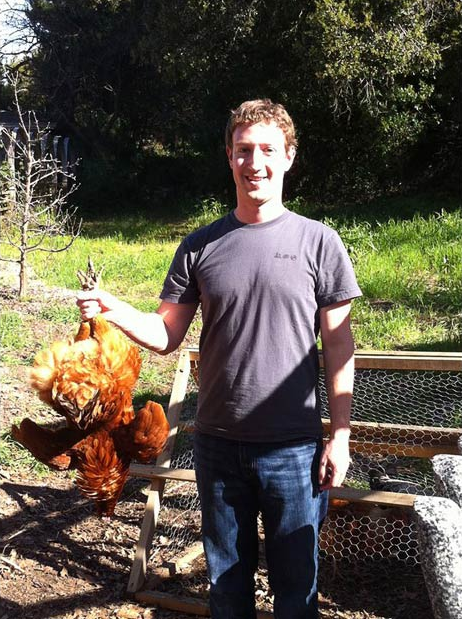
    Mark Zuckerberg said somewhere, because everyone is pretending that his aspirations and thoughts are now public, that he was going to try to eat only meat from animals he himself had killed. Suddenly, I have the thought in my head of one of the world’s richest men chasing and choking a chicken. Or, confronting a cow with its ultimate sunset clause. And, then, a series of other thoughts… Of course this idea that one should only eat what one is prepared to kill comes somewhere from the desire to live a healthier life and to live in a way that reduces the effects of animal cultivation and destruction on the environment, and hence on the planet. I am about to agree this seems like a very good idea. (Peter Singer has remarked that this answer to the problem of unnecessary violence only affects a tiny fraction of the slaughtered animals.)

    Zuckerberg choked the chicken.
    Zuckerberg choked the chicken.

    Then, I wonder about the practicality of this resolution. Chickens, yes, I can imagine most people coping with the consequences of the resolution. There are problems with some of the other animals. Cows are, plainly, rather huge. You would have to share. Actually, you would have to get help to move the poor thing, especially when dead. There is the difficulty of learning the butchering techniques, safety issues, storage issues, and so on. Other animals, smaller ones, present difficulties of scavenging and hunting, not least that you need a lot of time.

    Somehow, I don’t believe Mr Zuckerberg’s idea is as easy or as noble as it sounds. I think there are going to be a lot of compromises. Compromises that involve hunting, plucking, gutting, butchering. He only claimed he was going to try to do the killing himself, so perhaps this is all going to be achieved with a Taser and a team of assistants.

    I wish him well in his efforts to save the planet and his soul.

    Which takes me to my point: the disturbing and great film, «Le Sang des Bȇtes», by George Franju. Made in 1949, and now dubbed in English and available to be viewed on YouTube, it shows butchery of horses, cows, calves and sheep with poetic and dispassionate realism, emphasising the professionalism and expertise of the butchers.

    Charles Trenet's La Mer
    Charles Trenet’s La Mer

    In the final minutes, as the blood of the beasts is being washed away from the streets around the abattoir, we hear one of the workers singing ‘La Mer’, by Charles Trenet, a song that would have been only recently released in France at the time Blood of the Beasts was made. (Was it the first time ‘La Mer’ had appeared on the soundtrack of a movie?)

    Blood of the Beasts is as disturbing as it was in 1949. Many people are not used to seeing animals killed, and would be wrong to think that modern movies and games had inured us to the sight of it. 

    Working at the cusp of realism and surrealism,  Blood of the Beasts is a kind of homage to butchers and, simultaneously, a commentary on the need to do ugly things to survive and perhaps even to fight just wars.

    More information about Blood of the Beasts: http://en.wikipedia.org/wiki/Blood_of_the_Beasts

  • ‘The lesson in filing stories about love’

    I have entered a seminar or tutorial about some subject I am not very interested in, and a strange teacher—well, let’s be generous and say that he’s more like a salesman—makes a few remarks in his odd-looking check trousers and then arranges everyone in a great circle, men forming one half of the circle and women forming the other half of the circle. He tells everyone to start picking off participants they don’t like. I have adopted the strategy of positioning myself at the cusp of the male and female semi-circles. It doesn’t seem to be working, until I realise that I am being ignored—so, in this particular case, it is working. I do not get chosen to be excluded. Understand? I don’t really understand what happened, but it’s too late and the next part of the lesson has started. The horrible man in the strange trousers has written something on the blackboard: a long sentence about sexism against women. It ends up being a very stupid question. I do not want to write about it. However, everyone else has already started, so I am behind. I go up to the blackboard to get a closer look. The writing is tiny and I do not have my glasses on. The teacher tells me to sit down. While I am up I get some nice yellow paper to write on. When I get back to my desk I realise the paper I have chosen is deep red and very difficult to write on. I write on it anyway, completing something that is pretty good, I think. I have been writing in pencil. I search through a satchel for a fountain pen that I think will enable me to write on the red paper in a way that is easier to read. While I am doing this a young version of my mother enters the room and starts talking to me in a loud voice so that everyone can hear the conversation. We exchange remarks about the subject and the man in the check pants, even though he is getting quite annoyed with us. When I have found my pen I have to find the couple of paragraphs of writing that I have done on the seminar’s stupid subject. Where are they? I look through all the files, satchels, bags, boxes and even filing cabinets that are nearby but cannot, despite my increasing frustration, seem to find them anywhere. Jeff Klooger, who appears from nowhere, tells me that I never was very good at filing. Yes, he’s right. But I don’t need to be good at filing now they’ve invented ‘tags’: I just put everything in Evernote.