Category: Prose
-
Welcome to sex education
The controversy over a book and its purpose
“What do you suppose is the use of a child without any meaning?”
—Lewis Caroll, ‘Queen Alice’ in Through the Looking GlassI hear myself speak, and the proximity of the sound appears to guarantee the contiguity of the words to thought.… It is pure auto-affection, and we therefore tend to treat it, our voice, as our most intimate version of ourselves — or as ourselves completely.
—Peter Salmon, An Event, PerhapsIn 2023, in Australia, Hardie Grant Children’s Publishing released Welcome to Sex by Dr Melissa Kang and Yumi Stynes, part of a series of books aimed at young teens dealing with issues like consent, ‘your period’ and ‘your boobs’. There was controversy, of course, because the book is explicit and covers a lot of territory, including issues that many parents (and pundits) think should not be mentioned to minors. The supermarket chain Woolworths, a major distributor of magazines and books, withdrew Welcome to Sex from its shelves but continued to sell the book online. In interviews, Yumi Stynes revealed she had received death threats, and she offered the opinion that Woolworths’ compromise was a vote of confidence in the book and a reaction to its duty to keep its employees safe. “Police have arrested a man who allegedly threatened author Yumi Stynes, the co-author of an educational book aimed at helping teenagers understand sex and sexuality that was recently removed from shelves at Big W after staff members were abused,” The Guardian reported.
Welcome to Sex stakes a claim, which Stynes asserts in public very forcefully, about its usefulness, citing the delay in sexual activity of young people, and reduction of possible harms, as proof. Note, though, as only one indicator among many, that adolescent birth rates have been declining between 2000 and 2024, almost everywhere in the world—and it is not because sex education books for 11–15-year-olds are required reading.
The controversy was widely reported, often focussing on one aspect of the content: the book contains information and advice about anal sex. This may have been the easiest, most easily understood complaint about the content that journalists could find. Pointing their attention and cameras at a page containing the word ‘anal’, surely there could be no need for further verification that the Hardie Grant people were asking for trouble, maybe even hoping for it, since bad publicity can be great for the sales of books that are good, bad, and mediocre. Anal sex is the poster child of transgression.
There’s a section of the book on myths, and a section on “more myths,” as well as pregnancy, feelings, flirting, fingering, scissoring, awkward moments, and “expanding your vocabulary”—something no young person, and every parent, should be afraid of. Reports of the outrage about the book focus on the reaction of adults. I did not find any complaints from children of any age; the book is written for 11–15-year-olds. It’s possible that no one looked for such complaints, or bothered to ask. News framed the complaints as parental concern, usually without verification of the parental status of the complainants.
Then, late in 2024, to make matters worse or better, depending on from which side of the controversy you are looking at it, Creative Australia (a quasi-autonomous government authority) announced that Welcome to Sex had been shortlisted for the Australian prime minister’s literary award in the category of young adult literature. It didn’t win. In the public relations and reputations game, though, it is enough to be shortlisted to claim a new dot point in one’s résumé. The unnamed judges’ report for the award said of Welcome to Sex …
A fearless, frank and important resource for young people, Welcome to Sex is meticulously researched and comprehensive in its representation of sex and sexual experience. The text is very inclusive in its language and the content can be read by all young adults regardless of sexual orientation, identity, gender or culture.
Kang and Stynes’s combined voice is warm, friendly and approachable—brooking no awkward silences in what can be a difficult conversation between young people and adults. Young people are themselves represented in the text, through letters and other contributions, alongside adults and sexual educators, adding extra layers and thoroughness to the book.
High production values from publisher Hardie Grant and wonderful illustrations from Jenny Latham complete an informative, entertaining, and potentially life-saving book that should find a place in every home (even ones that don’t contain a teenager).Is this judgement or boosterism? There is no published evidence the judges read the book at all, or read it closely, or actually considered the accuracy and comprehensiveness of the text.
Googling for reviews of Welcome to Sex earlier in 2024 it was very noticeable that almost all of the internet ‘reviews’ of the book were not reviews at all, but merely regurgitations of Hardie Grant promotional material. —Of course. That is how the internet works. You throw stuff in, and you get stuff out.
“What became clear to my research team, which included professors Alan McKee and Kath Albury, was that the main thing young people wanted to know more about was not ‘plumbing and diseases’ but how to communicate,” said Catherine Lumby, who “is a professor of media and communications at the University of Sydney, [and] was interviewed about her research for Melissa Kang and Yumi Styne’s book …. ” Lumby’s opinion of the book—it’s “brilliant and accessible”—is quoted by Hardie Grant on its website, without mentioning she provided research for it, according to her own report. I do not suppose, nor should anyone, it can be just by chance that McKee and Albury are also professors of communication and media studies. Professor McKee makes an appearance in Welcome to Sex early on, on the page that attempts to define ‘sex’, possibly signalling that the book will emphasise language more than biology.
Does Welcome to Sex succeed in presenting all the relevant information a child (by which I mean a person below the age of puberty or below the legal age of majority) may need to have about what sex means, or what it may come to mean for them? How could anyone begin to talk about such meanings to children, when we hardly know what the answers are ourselves?
What do we need ‘sex education’ books for, anyway? In the form of a small sculpture of female fertility or in the making of a bone phallus, people have transmitted their knowledge and feelings about sex since humans began to make and learn. For the ancients it was enough to put up raunchy pictures in bathhouses. Children survive childhood and puberty to understand the impulses of their own bodies without the help of books. ‘Yes, but unharmed?’ I imagine Stynes reply, and she would be right to ask.
The appearance of ‘sex education’, sometime in the nineteenth century, was not a response to a need for information about what sex is, how it is done, or how to make baby humans. Sex education is, has always been, surplus to minimum requirements of the thing it purports to teach. Sex education might be a kindness to children. When children stopped being ‘little adults’ that could be exploited, it became necessary to imagine them as vessels of future adults that would make a future world. And then, in the last century, sex education developed its second dimension as social engineering to prevent disease and the burden, personal and social, of unwanted pregnancies. Sex education now does all that, and a whole lot more in the realm of violence, consent, and social relations. Almost everywhere in the last century and a half there have been debates, fights, and changing policies, about what and how to teach children about sex. Neither Catholics (in France) nor communists (in the USSR) could settle amongst themselves what sex education should do or say. In wartime, most pundits agreed, soldiers need to be warned against syphilis. Later, everyone needed information about how to have sex without exposing themselves to HIV-AIDS, even though there was no agreement about what constituted ‘sex’, and who needed protection from whom, or what.
Sex education now does all that, and a whole lot more in the realm of violence, consent, and social relations. Almost everywhere in the last century and a half there have been debates, fights, and changing policies, about what and how to teach children about sex.
Just how little do we think children know? Are they not, normally, mentally, super-absorbent creatures? Don’t they, by the time they are adolescents, reach some conclusion about the hypocrisy of their adult minders? A child growing up in Pompeii was no more or less enveloped in a sexualised and gender-stereotyped society than a child today. Every child grows up learning by heart its guardians’ clichés.
❦
‘Sex education’ requires us to ask, among many questions: Who are the teachers, and by what authority do they teach? These are such slippery questions, most journalists did not bother to ask Dr Kang and Ms Stynes who they were, by what authority they wrote, what qualifications they have or what qualifications are necessary or desirable. Instead, the current of outrage flowed freely from the idea the authors had presumed to supplant the educational bond between parent and child. —Though some parents, we all know, would have been happy to slyly leave on a reachable bookshelf a book with some colorful drawings, or else leave a little person to randomly soak up reality by cultural osmosis.
Hardie Grant, and the authors themselves, have therefore crafted a presentation highlighting authority and trust. Dr Kang is a doctor, a real general practitioner, with actual patients. Ms Stynes is an award-winning truth-teller and podcaster (with the Australian Broadcasting Corporation). They are women. (—It feels dangerous to make such a claim, considering what is about the be revealed.) And they have children of their own. Briefly: they are the kind of experts you should feel happy to leave your children with, while you make a cuppa and check email. Their expertise is their experience, and their practice: they have been at it for years, and so must know what they are talking about. Dr Kang said, in an ABC News video published on Facebook:
‘Dolly Doctor’ [an advice column in Dolly magazine] finished at the end of 2016. It was pretty abrupt. We know that teenagers now turn to the internet when they have those kinds of questions. I guess what I think might have been lost is that sense of a personal relationship. It was a way to hear the voices of young girls that was absolutely unique and now I really, really, really do miss it.
What I love about working with adolescents as an adult is even though it’s filled with angst, conflict and arguments with parents, for example, it’s such a gorgeous stage of life. I don’t know that I’d go back to it myself if I had the opportunity, but it’s still something that, you know, we’ve all gone through and learnt about ourselves from, and I just love witnessing that over and over again.
Kang’s palpable concern and care for young people is moving. I have much the same ‘read’ on Stynes.
But there is the question of what we do not know, deemed private, not explicitly deemed irrelevant, but placed by the publishers and authors in the ‘none of your business’ column. Some of the questions might be whoppers (in hard-hitting, journalistic terms), and very rude: Are your children ‘yours’ or adopted? Are you lesbian? Are you married? To men? Readers of ‘entertainment news’ might have gathered Stynes was one party to a dispute over separation from an ex-husband. I include the questions here because Welcome to Sex hints at this kind of challenge to, or question about, its authority. Stynes says, of herself …

“It’s not uncommon for people’s sexual identity to change over time. Even though I write these books, I don’t feel any need to announce my sexual identity to the world. It’s my business. Yumi” [Welcome to Sex, p.74] This sexual identity disclaimer is juxtaposed (Could it really be by chance? —And if it is, it is very careless!) with the image of the non-binary pride flag. In the following pages Kang and Stynes make clear what surely cannot be clear: that ‘sexual identity’ and ‘sexual orientation’ are so close to being the same thing, there can be no point trying to distinguish between them.
Sexual identity labels
Your sexual identity is about how you define yourself sexually. It’s usually about the gender of the people you feel sexually or romantically attracted to. Those attractions can change over time, or they might stay constant. There’s no right or wrong — you’re you! … GAY: I’m sexually and/or romantically attracted to people of the same gender as me. This label is used more commonly by males who are attracted to other males, but it is sometimes used by people of all genders.… LESBIAN: I’m female and sexually and/or romantically attracted to other females.[Welcome to Sex, pp. 75–76]The authors and the legion of communications professors appear not to have come to an agreement about the relevance of ‘sexual orientation’, or maybe consider that language passé. It is at this point the text’s inaccuracies and fudgings begin to pile up. The definition of ‘gay’ emphasises it is a term applying commonly to “males” attracted to other “males”, but calls this an attraction between people “of the same gender”. The definition of ‘lesbian’ does not mention gender at all.
The linguistic enigma of the verbal phrase “identify as” is everywhere, placing (our poor, helpless) adolescents always at one remove from the reality of ‘is’. A boy is not a young male person. No: a boy is a young person who identifies as male, who ‘thinks’ or ‘feels’ he is male.
Is it honest to suppress the fundamental importance of ‘sexual orientation’? Or is that the way you might talk about sexual orientation (about being heterosexual, gay, lesbian or bisexual) if you wanted to give it status not greater than ‘asexual’ and ‘aromantic’? In a section on aromantic versus asexual, children are told that “Being asexual means a person doesn’t experience sexual attraction towards any people. An asexual person might, or might not, feel romantic love towards others. Some people are aromantic AND asexual while others might be one or the other.” [Welcome to Sex, p. 78]
This misemphasis is at work and play throughout Welcome to Sex. Sex is, Welcome to Sex tells us, “doing anything with your body that feels sexy. […] The most useful definition of sex is what sex means to you.”
Defining sex is beautifully complicated. Sex is anything as long as the people taking part in it think it is sex. It excludes violence, and it includes pleasure. Professor Alan Mckee [Welcome to Sex, p. 8]
The professor omits the complicated and nuanced part. Welcome to Sex does not leave biology out of the text, but it carefully strategises diminishing its importance in the calculations children will be asked to make. The unspoken and not-totally-bad rule of the book is: first, check your feelings.
“Gender is how we define ourselves as being female, male, neither, both or something else.” That is one way to think about gender; but can it be correct? Being female is not an act of definition. It is not, in any sense, about language. ‘Being female’ is not something adolescents do to themselves or find ‘in’ themselves. In the list of sexual identity labels ‘female’ is not defined at all, but there is a definition of “cis-female.”
The linguistic enigma of the verbal phrase “identify as” is everywhere, placing (our poor, helpless) adolescents always at one remove from the reality of ‘is’. A boy is not a young male person. No: a boy is a young person who identifies as male, who ‘thinks’ or ‘feels’ he is male.
Transhub—let’s call it the ‘official’ definer of things trans in Australia—says gender is:
- Who you know yourself to be. This may be called gender identity, or simply gender. (e.g. Man/woman/non-binary/male/female),
- A role or set of roles a person has or is expected to perform in their society or culture. (e.g. mother, father, sibling, parent, spouse, wife, husband),
- The way a person expresses their gender to themselves or to others. (e.g. through masculinity, femininity and/or androgyny, wearing hair longer or shorter, facial hair, the clothes you choose, the pronouns you have),
- How their identity relates to what was presumed at birth. (e.g. cis if they have the same gender as presumed at birth, trans if it is different).
The emphasis here shifts away from ‘feelings’ to the much more assertive, and confident, ‘knowledge’ of self; but this definition leads to the same problem. The principle is: Who is going to contradict you when it comes to your knowledge of yourself? The answer to that question, children will need to understand, eventually, could be very embarrassing.
❦
Welcome to Sex is subtitled “Your No Silly Questions Guide to Pleasure, Sexuality and Figuring It Out.” The cover contains graphics of eggplants, a peach and two cherries, which may be amusing to children and render the content relatively harmless at the supermarket checkout. The book starts with a prologue. “[W]e’ve crammed as much realness into this book as possible so that you’ve got a rock-solid resource on sex that you can trust.” [Welcome to Sex, p.2] This prologue ends with a note about words and labels used in the book.

The argumentative parent, p. 25 of Welcome to Sex. When we talk about sex and pleasure we’re not just talking about body parts and feelings, but also about people and relationships. We’ll use words like ‘person’, ‘teen’, ‘penis-owner’ or ‘vulva/vagina-owner’ a lot of the time. On occasion we might use ‘girl/woman’ or ‘boy/man’ when we’re talking about cisgender people and referring to a specific question or story or research: for example, ‘research shows that heterosexual women don’t care that much about penis size.’ [Welcome to Sex, p. 4]
The list of contents spreads over three pages, with very big type and prominent pictures of people kissing. These pages very clearly establish an equivalence between gay and heterosexual relationships. The first page of the contents section shows what appear to be two boys, the second page two girls, and the third page a ‘straight’ couple, a boy and a girl. The images neatly reference the speech of Aristophanes in Plato’s Symposium.
Welcome to Sex soon confronts older readers with an age barrier: while the questions are framed from the perspective of 11–15-year-olds, the great majority of ‘answers’, in the form of quotes, come from people who are just out of adolescence and in early adulthood, in either their late teens or twenties: ‘Megan’ is 21; ‘Casper’ is 20; Lisa is 23; ‘Holly’ is 24; someone called ‘Christian’, who’s age is not offered, is the father of two teens; ‘Dominique’ is 17; ‘Grace’ is 18. In this way the text links trust and credibility to a certain narrow range of ages and roles. The first illustration associated with text about a parent shows an angry ‘man’.
The illustrations, by Jenny Latham, are computer-constructed stereotypes of people, groups, races, and cultures. They are tediously predictable mashups of facial features, hair, and color, from an imaginary world where there is only one kind of nose and eyes do not have irises. Problems with the illustrations may be the consequence of artwork being managed by an editorial committee that feels an urgent need to remind us that dicks come in all sizes, shapes, and colors, thus …
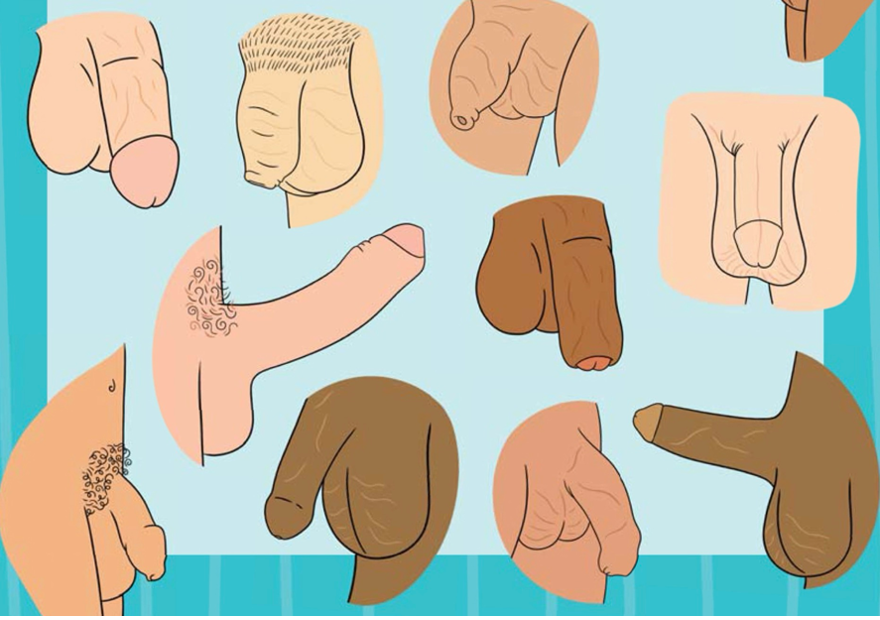
A ‘bag of dicks.’ [Welcome to Sex, p. 113] … but is very coy about depicting girls or women wearing hijab and kissing boys. There’s definitely no interracial, same-sex antics going on in that ethno-religious sex category. This is the raunchiest it gets:

Wearing hijab protects you from interracial lesbian kissing. [Welcome to Sex, p. 150] Hijab-less girls get it on with boys, and other girls, in all kinds of sexy ways. The authors and publishers have considered very carefully which minorities, religions, and ethnic groups they are prepared to offend or encourage. And when there is something mildly censorious to say about other cultures, quoting ‘the help’ puts the blame somewhere else:
I met up with ‘Mo’ when I was 16, he was 17. We didn’t have sex, we just talked. He said, ‘Men like [you and me] will get married and cheat on our wives with men.’ I didn’t want that, I would never want that. I think that reflects attitudes towards women that are prevalent in Arabic culture; I think it denigrates women. Bee. from the podcast One Foot In. [Welcome to Sex, p.89]
… Suggesting, as well, that orientation should not be so ‘fluid’ after marriage, for Arabs, anyway.
In the imaginary pleasure dome of Welcome to Sex you can be a black lesbian amputee with hairy (or is it tattooed?) butt-cheeks and be down for some satisfying scissoring, but if you have had your breasts removed in a fit of gender-affirmation you will find yourself sexually unrepresented and invisible.

Amputee-friendly scissoring. [Welcome to Sex, p. 166] A sex education book that bravely expounds on anal sex and the importance of soap [p. 167], premature ejaculation in the bald, black, cartoon-character community [p. 183], and has a full-page spread on vulvas and pubic hairdos [pp. 114–115], cannot find even one corner of about 300 pages to depict a woman (young or old) who has had her breasts removed. Other books for young people have introduced their readers to the brave new world of breast elimination. This feels like a missed opportunity to satisfy the urge for completeness, and honesty. The authors know there is a point where culture meets the control of sexual pleasure, and comment on it briefly …
FEMALE GENITAL MUTILATION
Female genital mutilation (FGM, sometimes called female genital cutting) is when some parts of the genitals are removed, usually when the child is young. It can involve removing some or all of the clitoris tip and hood, and inner and outer labia. This has been practised in some cultures for many centuries but is illegal now in Australia and most other countries, because of its inherent violence and because it causes long-term health effects. [Welcome to Sex, p. 40]With so much attention paid to a great variety of subjects, much more could—and should—have been said about body modification, surgery, and the effect of drugs on pubertal, sexual, and psychological development. Such subjects are much more difficult to navigate and the authors of Welcome to Sex have decided it is more important to focus on the positive, enjoying sex, than on the negative, the infertility and unhappiness that might follow on decisions made in adolescence that a girl or boy was born in the ‘wrong body’. These subjects are part of every young person’s future as an adult sexual being, and Welcome to Sex is highly focussed on the feelings of the present.
Authors and publishers have made difficult and revealing choices about how far to go in exploring issues that adolescents might be interested in, and the limit appears to have been determined by factors other than ‘need to know’. There is no heading on the contents page for ‘Pronouns’, though this is the way everyone, including young people, refer to each other. ‘Xe/Xer’, ‘Ze/Zer’, ‘Ey/Em’, ‘Hir/Hir’, ‘Fae/Faer’, and ‘Hu/Hu’ are not discussed as options, though they are in use in some circles. There is a section on expanding one’s vocabulary, by which the authors mean they provide a list of pre-approved words with unhelpful or wrong definitions. ‘Omnifutuant’ does not get a guernsey. ‘Endosex’ gets two mentions [p.79]: “We tend to learn about bodies being ‘female’ or ‘male’, and have standard ideas about what their body parts (both inside and out) look like. The label ‘endosex’ describes people whose sex characteristics align with these ideas.” Actually, it means ‘the opposite of intersex’ and is a word that has been in very limited use only since about 2000.
Welcome to Sex sometimes reads like a manual of sexual comedy …

[Welcome to Sex, p.276] I try to imagine what it is like to be a girl categorised in this way. Would I be wrong to think myself cheapened by the idea parts of my body were spoken of like kitchen appliances that came with tips for proper use? Is this the language parents should be using to talk to their children? My own biography will give readers an insight into my shortage of qualifications to answer these questions. But, I assure you, I was an adolescent once.
❦
A fog descends on the minds of young and old alike:
Sex and gender—what’s the difference? Sex is to do with the genitals, chromosomes and hormones we have, usually ‘female’, ‘male’ and ‘intersex.’ Gender is how we define ourselves as being female, male, neither, both or something else. [Welcome to Sex, p.77]
In a book that intends to tell everything about ‘sex’ we are introduced to a world where there are three sexes, ‘intersex’ is counted as “usual”, ‘gender’ concerns only self-definitions rather than behaviors and stereotypes, we can be “both” male and female, or “neither” or “something else”. The perfect liberty to label oneself extends now to the possibility of being a “trans male” (instead of ‘man’) or “trans female” (instead of ‘woman’), and suppressing the meaning of all words we use to distinguish between sexes.
If to be gay is to be sexually “attracted to people of the same gender,” are penis-owners having sex gay if one of them ‘identifies as’ non-binary? To put it another way: if one cis-gendered penis-owner still identifying as a man has sex with a penis-owner who identifies as non-binary, could we say these penis-owners are occasionally heterosexual? How crucially important is it, from an epidemiological or statistical or medical point of view, to have a meaningful answer to that question?
Dr Kang and the publisher’s fact-checkers, if there were any, should have known better than to triumphally present ‘intersex’ as a third sex, smashing the binary duopoly of Nature’s norms. Note the emotional exclamation point …
It’s estimated that about 1.7 per cent of people have an intersex variation—that’s almost two in a hundred! Many intersex people are given hormones or have surgery done to change their genitals […] [Welcome to Sex, p.35]
This forgets to mention people with intersex conditions who object to being roped into the confusion of ‘sex’ and the many clinicians without ideological objectives who have argued (for decades) that the numbers are very wrong. (To be clear: the 1.7% figure is a statistical sleight-of-hand and clinical absurdity.)
Opening the book for the first time, I did not doubt Kang and Stynes have a strong protective impulse that they hope will empower young people to make sensible decisions. I believe that’s a correct assessment. So, why the blather and nonsense about ‘gender’? Why do the objectives and methods not seem to fit together?
Sex education in the 1980s and 1990s focussed on ‘safe sex’ to prevent disease. Sex education now combines practical information about safety with an unstated attempt to dismantle the damaging effects of prejudice against people who simply want to live and love differently. To achieve this, the power of insult and prejudice to inflict pain and to damage ‘identity’ (the sense of oneself) has to be dismantled: if everyone is to be included, no one must be held apart.
Kang and Stynes bring to sex education a Rouseauist attitude to children and politics in which the unblemished subjectivity of a maturing child needs to be both protected and guided. The terms of a new gender-sensitive language have double meanings. ‘Non-binary’ pretends to assert something real about the nature of sex, but in fact it is only the standard, pseudo-technical way of saying ‘Mind your own business’ or ‘I’m omnifutuant’ or ‘I’m still thinking about it, or might change my mind.’ Permitting male persons to demand and expect inclusion in lesbian groups can be reduced to an endless back and forth over the meaning of ‘woman’, or to a legal fiction intended to show compassion to a vanishingly small portion of the intersex population; but it is promoted, in practice, by disinformation about basic facts of biology.
Kang and Stynes think they are creating the conditions for freedom of subjectivity and identity. Instead, they prioritise gender over sex, feelings over judgement, present (pleasure) over future (consequences), sexual identity (feeling you were meant to be a woman) over sexual orientation (being a lesbian).
The practical consequences of this strategy are all around us now: male boxers put in the ring with women; male rapists sent to women’s prisons; young girls required to undress in front of adult men; women’s crisis centres run by men who seek to send those they are sheltering for gender ‘re-education’; the creation of an industry for modifying female bodies to look more like men, and male bodies to look more like women.
Disinformation about sex or gender is not a kindness to women, or to the many homosexuals who think that body modification to achieve stereotypical gender presentation is a new form of conversion therapy. In a book stuffed to bursting with foggy language about gender and sex, I found only one remark, within a couple of sentences about medically assisted pregnancies, on the effects of “gender-affirming hormones”. The other consequences of ‘puberty blockers’ are not mentioned at all:
Young people who have medical treatments that might affect their ability to conceive later in life can also receive information and advice about medical assistance. This might include children and teens having cancer treatment, or teens having gender-affirming hormones. [Welcome to Sex, p.251]
The ‘warning’ is much too little, much too late.
❦
The most significant assumption at play in Welcome to Sex is that the inner voice, with which we simultaneously talk and listen to our thoughts and report our feelings, is a source of certain knowledge about ourselves. The book is an extended mash-up of sexual liberation and gender solipsism. The effort to dismantle social barriers to acceptance has come to depend entirely on a foundation that is unreliable. If the sources of our truth are entirely private, the character of our social intercourse is certain to be conflicted.
About the writer
Stephen J. Williams is a childless and unmarried writer and artist whose opinions on the subject of this essay may, and probably will, be easily dismissed; but he was young once, and that should count for something.
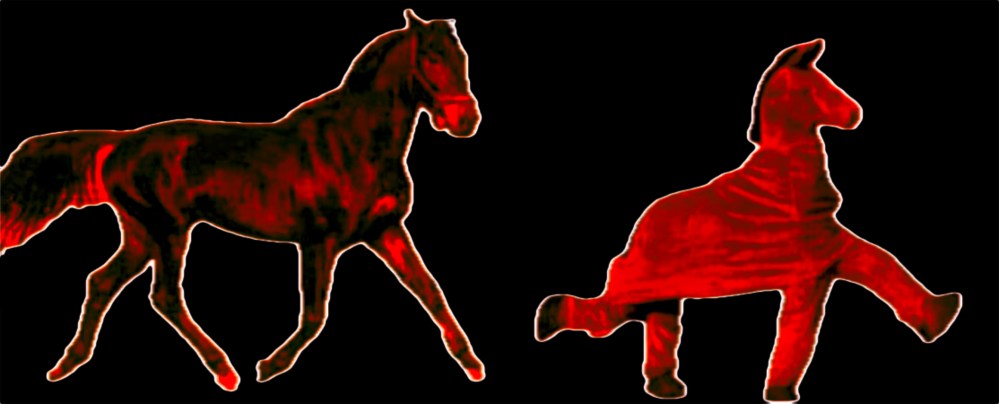
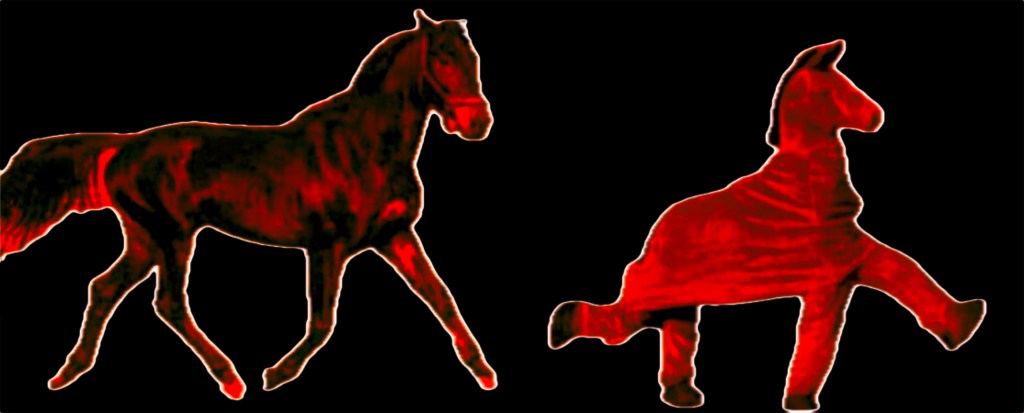
Horses, or mare and nightmare (digital collage based on an internet meme, 2024) Stephen J. Williams Supporting and additional information
- Welcome to Sex by Dr Melissa Kang and Yumi Stynes. ISBN: 9781760509538; Pages, including folds: 304; Publisher: Hardie Grant Children’s Publishing; Published: 17 May 2023.
- Yumi Stynes in the media »» ‹https://bit.ly/3vrXISK›.
- The media (television) reporting of the book »» ‹https://bit.ly/3ShAbNh›.
- The clinical perspective on intersex statistics »» ‹https://www.leonardsax.com/how-common-is-intersex-a-response-to-anne-fausto-sterling/›.
- The Prime Minister’s Literary Awards »» ‹https://creative.gov.au/advocacy-and-research/events/prime-ministers-literary-awards›. Archived at ‹https://archive.md/vhZxx›. Accessed 8 October 2024.
- Dr Melissa Kang speaking on the Australian Broadcasting Commission »» ‹https://www.facebook.com/watch/?v=310211996230038›.
- Transhub »» ‹https://www.transhub.org.au/101/sex›. Accessed 9 October 2024. [Where ‘gender’ is defined in relation to ‘gender’; and ‘sex’ does not appear anywhere in the definition of ‘gender.’]
- Subjectivity and identity »» Didier Eribon, Insult and the making of the gay self (Duke University Press, 2004).
- History »» Jonathan Zimmerman, Too Hot To Handle: A Global History of Sex Education (Princeton University Press, 2015).
- Jean Jacques Rousseau »» ‹https://plato.stanford.edu/entries/rousseau/›.
- Jacques Derrida’s philosophy and the interior voice »» Paul Salmon, An Event, Perhaps: A Biography of Jacques Derrida (Verso, 2020).
-
Letter to the Australian Human Rights Commission
… in support of the Lesbian Action Group
→ Restore the impartiality of the AHRC (open letter and list of signatories, archived)
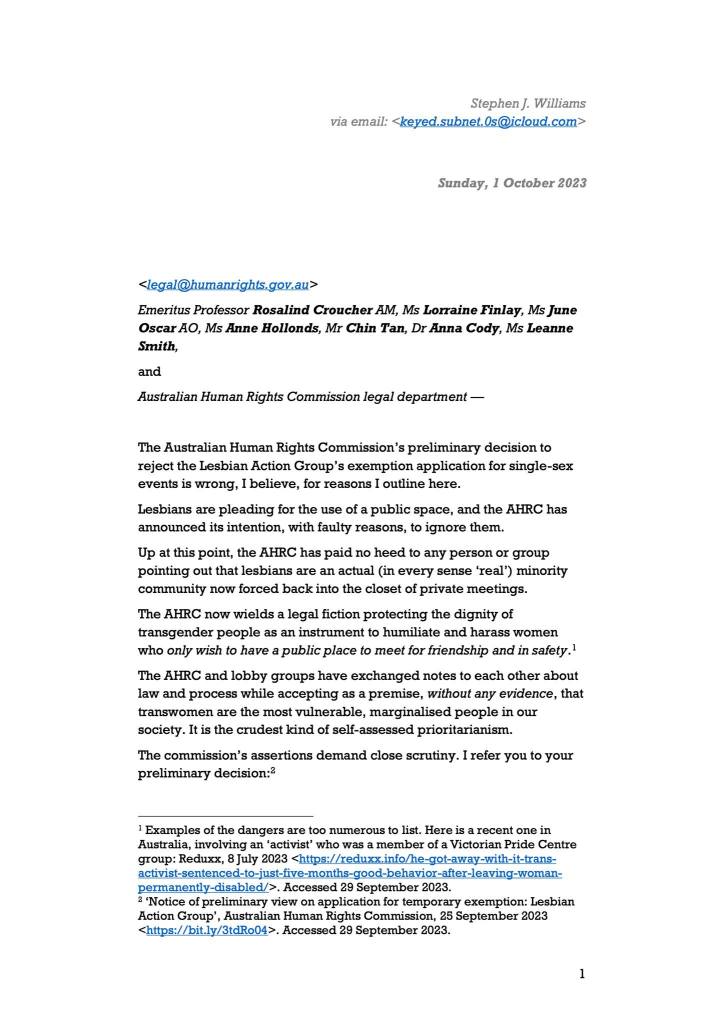
page 1 
page 2 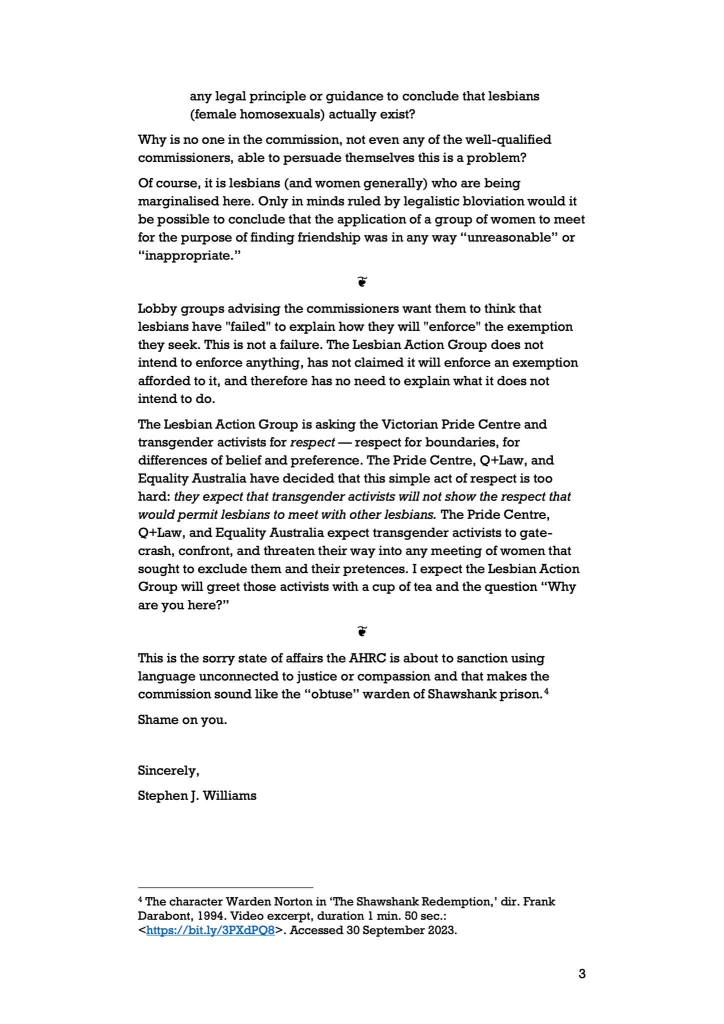
page 3 -

This happened …
Late in 2019, the Australian prime minister (marketing guru and shitty-pants Scott Morrison, ‘Sco-Mo’ to you) and his theatre assistants removed the federal administration’s arts appendix. One moment the word ‘Arts’ appeared somewhere in the names of government departments, and the next it had gone. Snip! And he chucked it in the bin.
Well, not exactly… ‘Arts’ was removed from a department’s name. To compensate, the yarts (as they are called in Australia) got an office. The Office of the Arts: <https://www.arts.gov.au/>. Never have the arts and government been so closely aligned than in this uniform resource locator.
There were articles in newspapers, outrage on the arts websites, and a long rash of angry emojis at the end of comments on Facebook.
The conservative government in Australia, returned at the May 2019 election by a slender margin, had decided a feature of the victory after-party would be to show the country’s angry, artistic child the door. “Your mother and I are tired of you! Always with your hand out, and never a word of thanks! Get a job!” And then, the ‘clap’ of the fly-screen door and a barely audible ‘clack’ of its tiny snib that seemed to say, “And don’t come back.”
Making art is a patient, lonely business. Making any progress seems to require years of practice and a bit of luck. Guidebooks and internet articles about being an artist, full of advice and clichés, pile up very quickly. Be yourself. Tell your truth. Talent is important, endurance essential. In the age of Instagram, sexy drawings and a bubble-butt are handy, but not essential (or so they say). Governments are not needed, but academic sinecures, supervising doctorates in novel-writing or discussions of queer theory, good if you can get them. When universities are financially sous vide, as they will be emerging from the 2020–forever pandemic, place bets at long odds that the arts will be favored for rehabilitation.
Governments, truth be told, don’t want to help. The governing classes are too busy ‘governing,’ which might as well mean lying, or fudging, or crying crocodile tears, or making a killing on the stock market, or taking a holiday in Hawai’i. To be the governor is to be the winner, the one who calls the shots, to be ‘the decider.’ From their high station in life these decider-governors have a role in narrating our social experience. They have a role we give them in legislating to tell us what is and is not important. (Have you noticed how very often our prime minister tells us what is important, and how very important is the very thing he is now saying?) It’s been a long time since governors of any stripe have shown us how the arts and sciences are important. Business, the economy, the stock market, and jobs are important. Wages growth, arts, and science, women, not so much.
UNFURL, my arts publishing project, was a reaction to artists’ reactions to government biases against the arts. Who needs government money anyway? I thought. It turns out, lots of people working in the arts need audiences, and it’s not easy to find and maintain audiences without government assistance. And, even within my narrow range of interests—writing and visual arts—the connections between arts activity and funding are deep. Poetry is not the malnourished tenant of the attic it was in Australia in the mid-1980s. The long lists of books for review and the number of official insignia on web pages are two possible measures of this.

At the same time, long-established literary magazines have had their funding cut. There is money for the arts, so long as it is going to places where the expenditure can be seen to be spent. Government wants the internet to sing “Hey, big spender!” while it cuts funding to Meanjin and others. It may be partly Meanjin’s fault: it has had nearly thirty years to figure out how to get its great store of content online for prospective subscribers to access, while the failure to do so begins to look like obstinacy.
UNFURL asked writers and artists to promote their own work to their own social media contacts while doing the same for other artists and writers: it’s a tool for artists to find new audiences and readers. UNFURL /1 started with a couple of writers I knew, Davide Angelo and James Walton, and a writer whom Angelo recommended, Anne Casey. Susan Wald, also published in the first UNFURL, was a painter whose work I liked and who had an exhibition planned for early 2020. I wanted to establish a process that could lead to unexpected choices. I would try not to make selections. I wanted artists to select or recommend other artists; and I wanted those artists to choose for themselves what they wanted to show with as little mediation as possible, encouraging people to show and to publish work they liked, and that might not have been selected (or grouped together) by an editor or curator.
Government wants the internet to sing “Hey, big spender!” while it cuts funding to Meanjin and others. It may be partly Meanjin’s fault: it has had nearly thirty years to figure out how to get its great store of content online for prospective subscribers to access, while the failure to do so begins to look like obstinacy.
It is more efficient to work on all one’s secret agendas simultaneously, so I should also admit my concern that belle-lettrist aesthetics (including the idea that poetry is language’s semantics incubator) and faux-modernist experimentation have combined to make poetry mostly irrelevant and a branch of marketing. —One only has to look at the writing being selected by the selectors to see that something is wrong with the practice of selection. As much as possible, I think, best to leave artists to make their own choices; and if there are mistakes, then, we’ll know who to blame.
And then, in March 2020 … then was the actual end of the world-as-we-knew-it. Those crazy ‘preppers’ I’ve made fun of started to look like visionaries. “Where the fuck is my bolthole, goddammit!?” and “How big is your bolthole, my friend!?” could have been common questions in some circles. People who could afford it, and had somewhere to go, did leave town. Gen-Xers lost their hospitality jobs, decided that they couldn’t afford their share house rent, and moved back ‘home.’ Artistes no longer had audiences. Artiste-enablers, stagehands, administrators and carpenters, were also out of work. COVID-19 put the arts and sciences back in the news.
The intersectional tragedy of pandemic and conservative political hostility to the lefty arts seemed to many like another opportunity to turn indifference into punishment. It was hard to disagree with pundits who have been cataloging this punishment.
UNFURL, possibly because of all this, has done quite well. By the time UNFURL /5 was released, writers and artists could expect to reach about two thousand readers within a couple of weeks of publication. (Each new UNFURL number provided a little boost to the previous issues, so that all the issues now clock up numbers in the thousands.) Eighty per cent of readers were in Australia, and most of the rest in the USA, Canada, UK and Ireland. The male:female ratio of readers was almost 50:50. The largest age group of readers was 18–35 years. (Though if everyone is ten years younger on the internet, maybe that’s 28–45.)
It’s difficult to read poetry on small-screen devices, so I did not expect UNFURL to be read on phones. The visual arts component of UNFURL is quite effective on phones and tablets, however. It seems likely that readers interested in the writing in UNFURL resorted to their desktops and printers. Sixty to seventy percent of downloads of UNFURL were to mobile and tablet devices.
I learned that women writers (poets) had a ‘stronger’ following among women readers than men had among readers of any kind. It was very apparent, with Gina Mercer, for example, that a very significant number of readers returned more often, subscribed more often, and were women.
I learned that women writers (poets) had a ‘stronger’ following among women readers than men had among readers of any kind. It was very apparent, with Gina Mercer, for example, that a very significant number of readers returned more often, subscribed more often, and were women.
I learned that social media isn’t the be-all and end-all of connecting with an audience. Old-fashioned email also works really well. Some artists and writers had no significant social media presence but used email effectively to communicate with friends and contacts.
I also learned that visual artists were, generally speaking, more enthusiastic and positive about using social media, and even better at basic stuff like answering messages. Visual artists be like Molly Bloom; writers be like Prince of Denmark.
I found that both writers and artists did things in UNFURL other publications might not permit (requiring, as they mostly do, first publication rights). Philip Salom published groupings of new and old poems. Alex Skovron published poems, prose, paintings, and drawings. Steven Warburton published a series of pictures about how one canvas evolved over several years. Robyn Rowland published poems and their translations into Turkish for her readers in Turkey. Ron Miller published a brief survey of his life’s work in space art.
All that and more to come.
-
Double in ourselves
We are, I know not how, double in ourselves, so that what we believe we disbelieve, and cannot rid ourselves of what we condemn.
—attributed to Michel de MontaigneOur hotel would have accommodated the more sinister sequences of some cloak-and-dagger ‘B’ film. During the night, a French letter in the lavatory bowl refused to be flushed by either of us. Then in the morning we had our first glimpse of Olympus through the haze above the curving bay. Any true Grecophile will understand when I say that the unsinkable condom and the smell of shit which precede the moment of illumination make it more rewarding when it happens.
—Patrick White, Flaws in the GlassAs a child in the 1960s, in the then newish Melbourne suburb of Forest Hill, I attended Saint Timothy’s Primary School. The little church in which I was confirmed and where I confessed my drab sins was a wooden fire hazard. I went to a service there every Sunday with my father’s mother—my own parents having separated. On one side of it were the school’s classrooms, and on the other a nunnery, both buildings made in what looked like, then, to be a modern style. The school was established in 1962 by the Sisters of the Infant Jesus. I had no idea who they were. To the seven- or eight-year-old me they were the handsome, unthreatening mystics of education who never said an unkind word.

St Timothy’s Primary School now I do not recall having religion forced on me. We said a prayer now and then before running out to play. Occasionally there was a bit of unruly, awful squealing of hymns in the church. And the nuns chose me to appear in ‘dramatic’ reënactments of the nativity story. Even at nine or ten years of age I knew that painted cotton wool beards were not a good look, so I pulled mine off just before walking on stage and tried to look wise without it. This kind of disruptive behavior should have permanently blotted my curriculum vitae: ‘Not a team player.’

St Timothy’s church in 1962. I wanted to know what the deal was with these nuns. During an afternoon nap, while lying on the floor near Sister Henry’s workbench, I determined to look up her chalk-covered tunic to see if there was anything there that would provide an answer to the mystery of her manly face. There was nothing. Just layers of perplexing, impenetrable, black underskirts. Anyway, I was ten. Someone was walking on the moon. I ran home to watch it on tv.
The Sisters of the Infant Jesus handed me over to the Christian Brothers to complete my befuddlement.
When I was twelve and in the first year of high school I helped fellow classmates cheat at Latin, allowing them to steal my answers in order to escape the sarcasm, and strap, of the unchristian maniac who ruled our Latin and math classes. I didn’t think I could help with the math; I felt hopeless at that. This was the year that maniac was hit by a car while riding his bike. For a couple of weeks this chastening episode turned the rancorous sadist into the mild and kind teacher he should have been all along. And then, without warning, ‘Mr Hyde’ returned.
Family circumstances required me to sample the educational services of four different Christian Brothers Colleges. After Thomas More’s Boys College (now called Emmaus College), I attended Cathedral College in East Melbourne for two weeks, and then St Mary’s in West Melbourne.
A middle-aged man who was a customer of my mother’s business began to use puns in his brief conversations with me that were intended to suggest he knew of my interest in sex. I had not heard them before but, after checking my Chambers Dictionary, instantly recognised them as verbal concussion grenades. One morning, at St Mary’s in West Melbourne, I armed these grenades and chucked them in a history class without bothering to take cover. The lay teacher looked at me for what seemed like a long time while the meaning of what I had said sunk in and he tried to figure out if I had actually meant to use the anatomical pronunciation of ‘aboriginal’. Something about my face must have suggested I had. He sent me down to the principal’s office, where the whole story of my new interest in punography had to be revealed.
St Mary’s principal was a severe-looking bald man who demonstrated his eccentricity and his modernism through the medium of Vespas. He rode his scooter everywhere. He travelled even the short distance from St Joseph’s, where the brothers lived and which was to be my next college, to St Mary’s by scooter. It was one block away. He put his helmet on, started the scooter, turned one corner, and he was at work. When I told him how I had become so expert at upsetting adults, he immediately sat down so as to bring himself on the same level with me. He spoke to me with an unfeigned concern about how important it was for me to avoid the man in my mother’s restaurant. I knew the nameless thing he was warning me against. I had sensed it, but not felt in any danger.
On sports days many of the St Mary’s students would walk along Victoria Street to the Melbourne City Baths to go swimming. One of the younger religious brothers at the school inexplicably decided to go swimming with us, which required him to be naked in the changerooms. When this happened, I suspected he was secretly trying to announce that the brothers were, after all, ordinary men. We thought his arse was too hairy and were distressed we had to look at it.
In the first years of the 1970s, boys of my age could see the chaos in Vietnam had been worsening, even as news of Australia’s decreasing involvement in the war there made no impression on me at all. No adult ever mentioned or tried to justify to me why Australia was involved in the fighting. It seemed to have escaped the notice of the adult world that there were children waiting in the wings of its drama and we had no idea what we were going to say or do when it was time for us to be pushed into the spotlight. The matter was urgent because we sensed our bodies were changing even as the threat of conscription increased. The election of a Labor government was a relief.
When we were fifteen a classmate and I experimented with the social effects of our own precocious hairiness by going to an R-rated double-bill at the Forum Theatre on the corner of Russell and Flinders Streets in Melbourne. It was the 1973 version of The Wicker Man, followed by something in the vampire-sexploitation genre. The first movie seemed to be about burning Christians. We were disappointed there was not more sex, naked actresses notwithstanding. During the intermission we discovered that our hairy-arsed teacher had also been in the audience with us. He asked us if we liked the movie and we answered in a way that avoided telling him what we really thought, while still pretending to be three years older than we were. I do not think it worked, but he did not seem to mind.
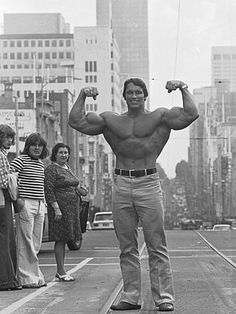
1974: Arnold Schwarzenegger in Melbourne, Australia. At St Joseph’s College, in 1974, a beautiful student whose parents came from Sri Lanka started calling me “Stevie Wonder” and tickled my palm flirtatiously when he shook my hand. Was I being mocked or flattered? Gough Whitlam was prime minister and anything seemed possible. I listened to Motown, and liked it. Arnold Schwarzenegger came to Melbourne. (There is a photograph of him flexing his muscles as he stands on the tram tracks in Bourke Street. The long-haired boy in the striped shirt and bell-bottom trousers standing behind him is not me— but the claim of resemblance to my former self is credible, and several times I used the photograph to ‘prove’ I once had a chance to push Conan, the barbarian, under a moving vehicle.)
It was the golden age of religious educational indifference. The Christian Brother who taught me nothing about Australian history before 1788 stood one day behind a not-quite-closed door and spied on the ‘Year 11 agnostic society’ pooh-poohing transubstantiation and putting the resurrection of Jesus down to a bad case of food poisoning. When we noticed him we expected our religious auditor to establish an inquisition. Instead, he took his nose out of the crack in the doorway and walked away. In retrospect, this now seems like the mature response.
One hundred years after the death of Winwood Reade I got around to reading his book The Martyrdom of Man. The initial excitement wore off after a while and I entered a long period of theological apathy.
Young boys and girls everywhere, before they reach what we have come to refer to as adulthood, trip over the idea that adult convictions are a charade. We stand up, mud on our faces, feeling that we are at the same time cynics and anarchists; we want to preserve what is in our interests and to agitate against the failures of the world we have found ourselves in. Some people manage to maintain an expectation of revolutionary possibility about their own selves and about the world.
By the start of 1976 no psycho-social jamming was strong enough to block my ‘gaydar’. Of course, I was unsure about how to meet people. I was not old enough to go to bars; and the internet was still in the hands of the military-industrial complex; so, I found friends and education as a flâneur. I met men at night, but I was better at conversation than at sex. The first man who spoke to me was three times my age. He invited me to his flat—a tiny bedsit in the ‘CAIRO’ apartments across the road from the Carlton Gardens. He made tea. We talked, and he gave me a tatty copy of Voltaire’s Candide that I have treasured for nearly fifty years. Life, it says, is one episode after another of misfortune and suffering; and the only antidote is work.
In the second half of 1977, construction of the World Trade Centre was completed. Airliner ‘terrorism’ was in its first flowering. Voyager 2 was being launched. There was a uranium export debate in Australia. In August, a ‘docudrama’, The War Game, was shown at the Longford Cinema in Toorak Road, South Yarra. This BBC production by Peter Watkins was a critical event in the life of the high school friend sitting next to me. When the movie ended most of the audience decided not to leave and, instead, started the conversation right there in the theatre about what could be done. It took me a few more years to find the failure I would agitate against.

Still from Peter Watkins’ 1965 BBC docudrama ‘The War Game’ »» https://goo.gl/W0U5Mf I left home in the late 1970s. My mother thought gay people were “disgusting.” My first nights of freedom I slept on the banks of the Yarra River in Melbourne, at a bend near where there is now a skate park. The first home of my own was a couple of rooms in North Fitzroy that were more like corrugated iron lean-tos than rooms. These rooms were air-conditioned but not waterproof; the windows were broken, glass louvres, and the entrance door had a large hole in it. By 1980 I had moved into digs, at the rear of 777 Park Street in Brunswick, that are still standing and look like a granny flat. Worries about finding and keeping a home were often on my mind.
In retrospect, the educational mystery of my childhood is how I could have been treated so gently by most of my teachers, spent so long in the care and company of outwardly religious people, and ended up sharing so few of their beliefs. The same is true about sexuality: growing up surrounded by intolerant, know-all heterosexuals clearly does not lead one to become an intolerant, know-all heterosexual. Why do people believe what they believe, and why do others’ prejudices always seem more urgently troubling than our own? Attacking and shaming people for their opinions, beliefs, choices and preferences has become a blood-sport, usually played while crouching behind an anonymising avatar.
In the 1980s the appearance of the AIDS virus turned my theological apathy into disgusted atheism, not because I thought an omnipotent god could have avoided such misery but because there were suddenly a lot of angry people claiming to be concerned with morals. At this time, my humanistic, progressively-oriented opinionatedness was in full flower, until I saw the world in its proper scale. I had a ‘Hubble moment’. It dawned on me that all the stars of the night sky I had been looking at all my life were just the lights of my local galaxy and altogether less than a hundred-billionth part of the universe. This universe was, if properly imagined, too large for spiritual and ethical systems focussed on what people did with their genital systems.
It is oddly disorienting now to remember that the cause of “GRID” was not known, though its effect was immediately obvious: “Nothing is more punitive than to give a disease a meaning,” Susan Sontag told me.
For a while I did volunteer work writing advertisements and pamphlets about sex. It was a subject I never claimed to know very well, but there were a lot of experts willing to talk, and there was a lot of ‘literature’. I made careful note of the interesting bits and tried to pass on the best intelligence. Patrick White had just published Flaws in the Glass, which contained the only example I needed that condoms were a good idea; the advertisements I helped to write, with a committee of volunteers at the local AIDS council, were less inspiring than Patrick White, but more appropriate for the toilet doors of gay clubs.
Then, I had a day job as a writer for a union. I knew even less about Leon Trotsky than I knew about sex and, therefore, resorted to the same creative process. And at night I joined hundreds of people at telephone counselling services to answer questions from people panicked by the Australian government’s ‘public service’ announcements about AIDS. The telephone banks were in training rooms of the Fairfield Infectious Diseases Hospital.

When you say yes… say yes to safe sex. Information flyer of the Victorian AIDS Council. There was a very long period, years that seemed depressingly long, when every diagnosis was a death-sentence. Like scores of others in Melbourne, I did the required training and joined care teams for people who were dying. I wrote stories and poems and hoped, like Voltaire’s Professor Pangloss, that everything would turn out well in the end.
My next writing job was explaining science to journalists: I tried to make laboratory fractionation dramatic, and offered to fact-check their articles; they wrote articles about three-eyed fish and called me a fascist. I learned that a good many, if not most, scientists are, in their hearts, engineers who want to know how things work, to make things work better, and to apply knowledge to practical problems or unproven theses.
In his early middle age, the conservative and combative Premier of Victoria, Jeff Kennett, had a thick mop of brushed-back hair. When he visited the city campus of RMIT, a rabble of students turned out to protest. A young man, dressed in flannel pajamas and an old-fashioned dressing gown, yelled at Kennett as he got out of his limousine, “Get a haircut!” We became good friends, listened to Bach and Nina Simone, and drank a great deal of champagne. Twenty years later he saved my life.
In the late 1980s and through the 1990s reports began to appear in the media about abuse of children by Catholic priests. The institutional failure of Catholicism to protect children from abuse, to admit the wrongs done, and to offer reparations, is evidence of a general failure of religious people to face reality. I used to imagine religious fanatics and authorities could be cowed with public lashings of pure reason. But the faith at the centre of religious belief is password-protected, unassailable and shameless.
What can a former Catholic do with a feeling of loss that is also the hope of loss? Any man or woman who is honest with themselves must get used to abandoning prejudices and wrong beliefs. The judge “standeth before the door,” and that judge is the world.
For years I tried hard to maintain a small part of trust in the wisdom of the religion that educated me and tried to protect me. But that church does not understand what wrong it did and is still pretending that gay priests are the problem, when the worse sin is betrayal.
In 2012, after many months of tiredness and a feeling of disorientation, I spoke to a friend about how I was feeling. He used to wear pajamas while he was painting in the artists’ studios at university. He spoke to a nurse about what he had heard me say and they were concerned I might have had a stroke. My friend called an ambulance. He knocked on the door of my flat and, when I answered the door, two paramedics were standing behind him. All three of them insisted that I would have to step into the vehicle that had been manoeuvred into position so I could step into it directly from the rear door of my apartment in St Kilda. One of the paramedics asked me a couple of questions designed to ascertain whether my mind was still in one piece. The ambulance moved onto the street and toward the nearest hospital. Sometime in the next minute I was unconscious, and then in an induced coma for several weeks. There were no distant, mysterious lights. There was, unfortunately, no music.
It was a long while before the wound on the back of my left leg, caused by a bacterial infection, had healed sufficiently for me to be able to stand again. I was confined to a hospital bed and drugged for months, and the demarcation between my dreams and the real world became very unclear. In the days between Christmas and New Year, 2013, I imagined, and for a while actually believed, the surgeons of The Alfred hospital had grafted a reproduction of a painting by Canaletto to my thigh using a new technique to disguise the scarring of surgery. By mid-January 2013 I was at war, somewhere in rural Italy, in sets made by Cinecitta designers and photographed by Pasolini. The electrical substation that was the locale of my small part in the war had a touch of HR Giger about it—and, yes, there were well-dressed Nazis who looked like they had just stepped off the set of a Mel Brooks video. When the body is in ruins, the mind works on, regardless. Among the beliefs most difficult to abandon is that we have a firm grip on reality. Seen in retrospect, what we believed is as substantial and changeable as a dream. Certainty is in the here and now, where we are sure we know what is real, and where we are almost always in some way wrong.
Fifty years too late, perhaps, I reached an age where The Epic of Gilgamesh made sense as a fiction about life—something it is difficult to see when you are young. Like the probably gay Gilgamesh, the king of Uruk, we are all the bad rulers of our own domains. In the end, we look to the places we called home, forced to accept we will not survive; but our work, the city, its culture and even its empty fields, will outlive us.… Candide was right.
-
A typographer’s eye
Anyway, the word from the poor author, who’s writing this because he doesn’t have a ‘real’ job, is that he wants to know what’s going on behind those eyes, why we behave as though we still believe in fairy tales when it’s obvious that the world’s fucked. I’m thirty-something, so you’d think I’d have figured it out already; but that’s just the way it is. I’ve got plenty of time, though, if my heart holds out.
I met an author at a book launch recently and we talked about the painter Francis Bacon. An interview with Bacon called ‘The Brutality of Fact’ begins with the admission that Bacon harboured a sexual desire for his father. The author I was talking to thought this was shocking, impressively honest, very promising; but he was sure that Bacon was concealing something else with this honesty. Well, I’m not so sure about that. I’m mentioning this because I remember now what I was thinking while we were talking about Francis Bacon.
I was thinking that when I was a young boy I was fascinated by my father’s sexuality. I loved his body, his big dick and his hairy chest. For years, for most of my adult life, I have maintained the conviction, and touted it publicly, that I hated my father. At my twenty-first birthday party I called him an “elephant’s arsehole”. (Not very nice; but, then, we hated each other secretly: he ‘hated’ me for leaving him; and I ‘hated’ him for treating me so badly when I left.) When I come to think of it, these were almost the last words he ever heard come out of my mouth. Everybody laughed.
Kids are supposed to hate their fathers because they’re the competition in a boy’s love for his mother. Did you ever hear such a stinking lie? This conviction I have maintained, stylishly elaborating it for my small part of the world to hear, is, of course, a load of crap—a load of crap straight out of the elephant’s arsehole, so to speak. The truth is, I loved my father. When I remember him now, in the moments that he touched me, when, for any reason, his arms wrapped around me, I was in heaven. But, even when I was just eleven years old, I knew the boundaries of this feeling, without knowing how I knew them, knew that there were things that could not be done or said, and knew this prohibition was real without ever having heard it spoken.
The point is—to answer the question before it is asked—that Francis Bacon was not concealing something else with his honesty. No, that’s not it. I know what Francis was trying to conceal. In a little while (when I’ve worked out how to say it) I’ll tell you what it was.
It’s hard to say what the truth of ‘style’ is, or with what ‘style’ the truth can be written. I know that I am impatient. I know that poets cannot be trusted. And you know you cannot trust me. You do not know whether I am lying or telling the truth. If those bastards in their ivory towers have their way, no one will know whether this pronoun I am tossing around is the thing that stands for me or is something else. I’ll tell you honestly: it is something else, something that even people who are writers do not know, and people who are readers know even less.
All the most personal writing I have reserved for poems; an idea, a feeling, a gripe with the world, some angry moment or pleasant surprise hunches in a cool, dark place for years, confident that, because it belongs to a writer, no one will arrive with a ‘Use by’ stamp. In a poem, and in some kinds of prose, these moments can be gathered irrationally, bunched like flowers and achieve, without too much thought—apart from concentrating now and then on ‘music’, the need to avoid cliché, and the necessary test of truth—an aesthetic effect. My first poems were not, in any way, personal, except in the safest and most abstract way; they expressed my feelings, but in a way that safely detached these feelings from my person. Perhaps this is the reason, years later, when I read these poems, I’m surprised and grudgingly recognise myself as their author. A few weeks ago, when a Sydney fiction editor wrote to ask if I had any prose suitable for publication in a gay magazine, I was surprised, again, to discover I responded, apologetically, that I write on gay themes only by accident, as though two aspects of my self might collide at an intersection. There are several stories, I explained in my letter, on appropriate themes, but they are all too long and none of them is finished. But, even as I wrote my excuse, I knew that it was not quite true and that I might, some time in the future, have to recant. There are, indeed, long, unfinished stories. It is no accident that they are unfinished. Something has obstructed their completion. There is the story of a man of letters and his boyhood relationship with one of Australia’s greatest painters; a ‘true story’ of which so little detail is available to me that it must be reconstructed from almost nothing: it is like trying to imagine a body from a pile of bones. There is the story of a relationship between a middle-aged man with HIV and a young, straight, drug-addicted prostitute. This is the story from which my last book takes its name: ‘The Ninth Satire’. It is strange, isn’t it, that a book built on the foundation of a particular story should have been published without the very story that prompted it? I like the irony of it. For hundreds of years Decimus Junius Juvenalis’s ‘Satire IX’ was excluded from collections of his satires because it dealt with subject matter which many editors thought unprintable. The relationship of Juvenal to the interlocutor of his ninth satire, Naevolus, has always disturbed me. I cannot fathom Juvenal’s cruelty. And Naevolus is both crudely attractive and repulsive. It is difficult to write about what you do not understand. There is another story, also unfinished, about a young girl who becomes pregnant when she is fucked by a man she later discovers is bi-sexual. This story is about disillusionment, abortion, and feelings of revulsion. These stories have something in common apart from being unfinished. They are all, in some way, stories about my unfinished self, ideas that are waiting for the completion of the person who could be their author.
People like a story that moves forward briskly, sweeps them up in a whirlwind of plausibility and delivers them, not more than a little bruised, to unexpected, credible conclusions: something with a beginning, middle and end. —But life is not like that; at least, none of the lives I know are like that. A story may be composed entirely of things left unsaid, where one thing is not properly related to anything else; and it may move forward only by changing direction. This is a story of that kind. Its author is a character a little like myself; that is, only in the sense that he is also an author.
You see, that’s the problem—Francis Bacon’s problem, one of them—you start out trying to tell the truth and, as soon as you open your mouth, your relationship to it has changed: it is no longer the truth, but something that obstructs something else.

What does it mean when someone writes ‘I’? Geofroy Tory, the typographer and student of Albrecht Dürer and Leonardo da Vinci, once wrote, “I cannot pass here without pointing out that our said letters were devised through divine inspiration. Homer, King of the Greek poets, states at the beginning of Book VIII of his Iliad that Jupiter once said he could, if he so wished, draw to himself by means of a golden chain all the other gods, and even the earth and the sea as well.” Tory imagines this chain, hanging from heaven to where we stand, “well proportioned in length and breadth, suited to the symmetry of our proportional letter ‘I’.”1 Victor Hugo, on the other hand, believed that “ ‘I’ is a war machine launching its projectile…”2 Can you imagine two more divergent explanations of the same thing? The upright letter. Tory draws his letter over the figure of a naked man. Anything could hide behind such a monument of typography, an ‘I’ that stretches from its author to the supreme god. Hugo’s letter is a cannon. It shoots its meaning into the heart of a reader, and it does not even have to be aimed very carefully to tear him apart.3
Now we understand each other. Now, as the story of this unfinished self goes on, you’ll understand this ‘I’ is both a monument of fiction (the obstruction itself) and the means by which the obstruction is removed. A typographer’s eye is another matter.
Mistake leads to interpretation. A proof-reader’s eye can unleash reverberations in a reader’s mind. Hans Gabler’s ‘definitive’ edition of Ulysses repeated the minor error of Clive Driver’s ‘definitive’ edition of Ulysses by deciding that Joyce had meant to write “lumps of coral and copper snow” at the beginning of chapter 15.4 The French translation of Ulysses5 says the phrase is “des couches d’une neige de charbon et de cuivre”—that is, “coal”, not “coral”. Joyce is preparing us for a descent into the underworld, not a sightseeing cruise to a coral reef. While we can imagine that Joyce would have cared greatly to give the correct impression here, the same cannot be said of all writers. It is Proust who interests me; the thousands of pages of digression, one tied to the other, so that a reader becomes lost in purely sensuous wandering, through a garden, along a path, the taste of a little cake dipped in lime-flower tea, the eye stopping for a moment on a young girl’s face. Proust did not seem to care about errors of typesetting. What he cared about was creating yet another digression, and when he received his proofs he added more writing to the galleys instead of reading them.6
“I gazed at her, at first with that gaze which is not merely a messenger from the eyes, in whose window all the senses assemble and lean out, petrified and anxious, that gaze which would fain reach, touch, capture, bear off in triumph the body at which it is aimed, and the soul with the body”, Proust writes, with a typographer’s eye, in the ‘Combray’ chapter of Swann’s Way, “then (so frightened was I lest at any moment my grandfather and father, catching sight of the girl, might tear me away from her, by making me run on in front of them) with another, an unconsciously appealing look, whose object was to force her to pay attention to me, to see, to know me.”7
The eyes are, perhaps, more important than anything—at least, to a person who has the use of them—and there is as much about them in our languages, poetry and morality, as any other part of the body, including the heart. Gray’s Anatomy describes the heart in less than ten pages (leaving aside all the things connected to it) and provides only two illustrations. The eye, however, has at least fourteen pages and five illustrations (not counting the Meibomian glands or the Lachrymal apparatus). The eye is in every aspect of our personality. While we keep the heart and mind separate, all minds have an eye—‘the mind’s eye’—to see things our other eyes cannot. This eye may be green, if we are jealous. And, as we know from the Psalms, having eyes is no guarantee that we will be able to see.8 Understanding is not only a matter for the eyes—‘an eye-opener’—but the speed with which it happens is measured in the eyes: “In a moment, in the twinkling of an eye, at the last trump: for the trumpet shall sound, and the dead shall be raised incorruptible, and we shall be changed.”9 There is an “inward eye”, according to Wordsworth, “Which is the bliss of solitude.” And, as we wander lonely as a cloud, like William, who knows, we might see Mr Dodgson through the looking-glass with our “dreaming eyes of wonder”. But it is all in the eye of the beholder. Some eyes have apples in them; some are jaundiced, some lacklustre; others have bags underneath. Many eyes are found in months—“men’s eyes in April / are quicker than their brains”10 —and there are a thousand, at least, in every night. Are there more eyes in Shakespeare than in the sky, than in the night sky, plus one, “the great eye of heaven”? “Alas, how is’t with you / That you do bend your eye on vacancy / And with the incorporal air do hold discourse?” Why are there so many eyes in Hamlet? “In my mind’s eye, Horatio.” “… Foul deeds will rise, / Though all the earth o’erwhelm them, to men’s eyes.” “The courtier’s, soldier’s, scholar’s, eye, tongue, sword.” “… Make thy two eyes, like stars, start from their spheres …” The eyes are the site of our most intractable prejudices. Black and white. “Appearances contribute to reality”, John F. Kennedy said. We know that there is something else, but our eyes tell us what we believe will be the truth. Our eyes connect us, by their immediate reaction, to what we know is viscerally, instinctively beautiful or horrible. Magnetic. Attractive. Insatiable. Repulsive. Ugly. An eye is a key that unlocks pornography. And while it is true that they can be closed, unlike our ears, which are always open (and, so to speak, ‘watchful’), even when closed the imagination keeps them alight. Memories stoke the fire. When we are asleep our eyes follow our dreams. The eyes hardly ever sleep. All of our desire is in them, and all desire’s sadness. The eyes are full of themselves and with everything else. It is with our eyes that we measure the world and first recognise ourselves in it. Sight, as Plato wrote in The Republic, stating the obvious, is the eyes’ “proper excellence”.11 —If only it were true. It is through them that we measure the visible world, and imagine the extent of everything that is hidden. First in the catalogue of human fear is the ‘unknown’, whose most compelling sign is darkness. The eyes are a list of suffering and joy. All of a person’s character may be in their eyes, as Gustave Flaubert knew.12 —And none of it. The eyes of the paranoiac imagine there is more in the eyes that follow him than there actually is. Why? It is because the content of eyes is very often ambiguous. We hope for love and fear rejection, and never know everything that is behind another’s eyes. A ‘visionary’ is one who saw things we did not, and so is a madman. Visionary and madman are measured by what our own eyes see, or don’t see, as the case may be. (Madness, as the mad will tell you, if you ask them, is mostly in the ears. Thoughts are ‘heard’. The mind is a noisy place. But, after the ears, the eyes are the next to go. Light and dark angels appear where voices were.) And, as Michel Foucault has shown, modern medicine was born in the eyes: “The gaze will be fulfilled in its own truth and will have access to the truth of things if it rests on them in silence, if everything keeps silent around what it sees.”13 Two eyes are needed to appreciate perspectives. A mystic is helpless without the third. A banker may not have a heart but he keeps at least one eye on the bottom line. Some people “only have eyes for you”, which is a somewhat unlikely compliment. To have eyes like these is, in short, to be human. Even Jews have them! “I am a Jew. Hath not a Jew eyes?”14 And niggers, queers, perverts, socialists, women, Liberals and child-molesters have them, too.

Are you following me? Good. Then let’s go to New York—city of many niggers, Jews, Koreans in self-serve salad bars, and millions of eyes. The contrasts are surprising. Times Square is said to have more ‘language’ hanging in the air than any other place on earth; a vortex of signs and speech, a typographer’s dream. Wall Street, on the other hand, where language has been replaced by ‘data’, is a cold, almost signless, windy canyon that, I was surprised to find, has a dark and eerily beautiful graveyard, beside Trinity Church, at its entrance. I walked back from Wall Street to my room on West 48th Street by wandering up West Broadway through Soho and Tribeca (in Spring Street there is an old building now dubbed ‘Poet’s House’—it’s in the NY phone book—where a monthly calendar of literary events and readings is published), the Village and, on the other side of Washington Square, Chelsea, up Eighth Avenue past the General Post Office (“NEITHER SNOW NOR RAIN NOR HEAT NOR GLOOM OF NIGHT STAYS THESE COURIERS FROM THE SWIFT COMPLETION OF THEIR APPOINTED ROUNDS”); a walk that, with occasional stops and small detours, can take a couple of hours. The 40s streets on Eighth could be avoided at night, if you are so inclined: they are full of visionaries, madmen, typographers and tourists. A typographer, I kept my eyes open, of course. There is so much to see. I walked into a salad bar where you can fill a small plastic container with whatever you like and pay, according to the weight of what you’ve chosen, only a couple of dollars for dinner. A tall, white red-neck in the queue in front of me was having an argument with the small Korean woman who weighed the meals. I had seen her here several times before, at all times of day, and concluded that she never slept. The red-neck had had enough of something. Maybe there are just too many people with yellow-brown skin in Manhattan these days. He exploded angrily, made some offensive remark, threw coins on the counter, and exited with his plastic container. The Korean woman said something to me that I didn’t understand, and then she laughed. I smiled quizzically. I was becoming accustomed to having conversations in which less than half of what was said could be understood. The previous night a cab driver had stuck his head out of his car and asked a black woman on the street, “Where is two-thoity-sex?” “Two-forty-what?” the black woman had replied in a well-educated tone of voice. I imagined these two people had spent most of their lives growing up together, one from Brooklyn, the other from the Lower East Side and, with only the East River between them, at this one, chance meeting, effective communication seemed impossible. I picked up my plastic container, which the tireless Korean woman had put in a little bag for me, and continued on my way. My eyes were still open. “Hey! Baldy!” I turned around. I realise, now, that this was a mistake. I should have kept my ears closed but, as I’ve already warned you, the ears are ever watchful and cannot be closed. A little Jewish man with long, messy hair, and dressed in a long, dirty, black coat, was hobbling behind me. He looked, in the moment that I saw him, like a mad and visionary Rabbi—not someone to be messed with. “Wha’do you want, baldy?!” Under no circumstances was I going to stop for this man. He had seen something, I don’t know what, leaning out of my eye as I walked along Eighth Avenue toward my room. Desire, perhaps. Whatever it was, he didn’t like it, and he was going to get me. “Hey, baldy! Wha’do you want, eh, baldy? Bald man!! Stop! Wha’da ya looking here for, bald boy?” he cried angrily. This guy was getting on my nerves. I walked a little faster, consoled myself that West 48th Street was only around the next corner and this nightmare would soon be over. But I was also angry. I was, after all, innocent of everything, except having eyes; and in New York there are millions of those. A moment later I realised that this caustic Jew and I had become a spectacle: ‘AVENGING RABBI CHASES GENTILE FROM PIT OF INIQUITY’. —This is what the German tourists have come to New York to see. What business was it of his where I looked, what my eyes saw? And this ‘baldy’ thing—it was very embarrassing. Had my corner not arrived just in time to save me, I would have turned on him and given him the slanging match he so richly deserved. My trump card was 2 Kings 2: 23-24. A Jewish nightmare, I thought, is a Gentile who knows the Old Testament. “And he went up from thence to Bethel: and as he was going up by the way, there came forth little children out of the city, and mocked him, and said unto him, Go up, thou bald head; go up, thou bald head. And he turned back, and looked on them, and cursed them in the name of the LORD. And there came forth two she bears out of the wood, and tare forty and two children of them.” I was shocked to look with my ‘inner eye’, in what should have been the “bliss of solitude”, on great reserves of hatred. Visionaries and bigots—the only way to cure them is to pluck their eyes out. This place, I thought, must be Hell in summer.
It is the same everywhere… In Melbourne, at a friendly Fourth of July gathering of expatriate family and lesbian acquaintances, a woman makes the remark, about a young girl who has just left, “She’s a very pretty young woman. And she’ll go far, if she fixes up her teeth.” The discussion bubbles for half an hour and then erupts. What kind of desire, mingled with business-like cruelty, had looked out of those eyes? In the 1930s, in Queensland, a young boy was receiving advice about life from his father. He recalls, nearly sixty years later, “My father told me there is no God. He was a sensible man. He told me I should not waste my time yearning for the Absolute, that I should be careful with money and that I should never feel guilty about sex. But the most important thing of all for a young man, he said, was to be careful not to get a young girl pregnant. If this happened I would be responsible for the baby before that responsibility was wanted, and it would ruin my life.” Between advice and recollection was a remarkable life, guiltless sex and, I assume, no babies. Once or twice, at the moment when stories haltingly begin, he refers to a self-imposed restraint on how his eyes might wander longingly over a beautiful face because, if it were noticed, some danger that is probably only recognition might present itself. Walk along a busy street, anywhere, behind a beautiful girl or boy, and you can see, in the faces of men and women alike who pass you going the opposite way, how their eyes suck light into an abysmal prison of need, with “that gaze which would fain reach, touch, capture, bear off in triumph the body at which it is aimed, and the soul with the body”. “He stared at the snake, and the snake at him”, just at the moment before his painful transformation, one body sucked into the other, and both of them transformed.15 It begins with a stare. Young girls are tarted up so effectively before their images are glued to billboards, you’d think they were old enough to consent. We are in Hell, and all this is perfectly natural here.

My own characters stare out at me like they would stare at the snake. Something prevents me from finishing them off. I slide around them, hissing, for months or, sometimes, years. —An unwillingness to change. That, you see, is how Dante finishes Canto XXV of Inferno: with the change and transmutation of creatures in the eighth circle of Hell, where fraudulent thieves are kept. (So, poets are among them, of course.) Dante’s eyes, he says, are “somewhat confused”, and his mind bewildered.
The eyes have always been the most sexual of organs. Legislators, moral guardians and civil libertarians argue more about what we may and may not see than anything else. The freedom to speak is, just as often as not, the freedom to write and, by implication, the freedom to read; and we live with elaborate administrative systems regulating what may be seen and, every now and then, the rules change. But some things never change and cannot be regulated. At the very beginning of (the first) Francis Bacon’s Advancement of Learning, the author was careful to note that in his own mind he represented the King “not with an inquisitive eye of presumption … but with the observant eye of duty and admiration”.16 The seventeenth century version of “you were always on my mind”, this was, of course, a lie, and it is clear he was attempting to cover up his ‘original sin’. Eyes are not like that. For both God and man, creation, knowledge and everything begins in the eyes: “God saw the light, that it was good … the woman saw that the tree was good for food, and that it was pleasant to the eyes … and the eyes of them both were opened, and they knew that they were naked …”17
So, when Francis Bacon—the painter—said he harboured a sexual desire for his father, was he concealing something else with this giant truth?
The National Gallery of Victoria has an early Bacon painting, Study from the Human Body (1949). Many of Bacon’s paintings depict bodies of this type. The naked male figure moves through a veil or curtain, steps into a dark space behind the painting, from the visible world into the invisible world, from consciousness into the unconscious, from life into death. His right leg and right arm quietly push the veil aside. His head bends forward into the dark. Two falls of curtain divide the painting—left and right—and the figure is in the centre. The man’s calves have been chopped off at the bottom edge of the frame. We cannot see his feet. The left fall of curtain hangs straight. The more central folds of the right fall of curtain slope gently toward the right. Above the man’s head, between the falls of curtain, is solid grey. The whole picture is composed of sandy-yellows, greys and white paint. The back, right shoulder and right arm of the figure are mostly bare, white paint. We cannot see his eyes, which must be looking down to where a little yellow-grey light is slipping along the floor from where we are to where he is going. Unlike many of Francis Bacon’s paintings, the figure is not distorted or deformed. He is a lover leaving the bedroom. A father disappearing into the past. You can stare into the painting a long time without noticing something else, a small detail that may not be very important: there is a safety pin fastened to the right fall of curtain, helping to hold the veil open. If the figure were absent, if no one had decided to pass through here, or if he had already gone, the gap in the veil would remain open, the safety pin holding it there so we could peer into the dark. In a moment he will be gone. The figure in this painting looks like my father. We want to call him back, tell him not to go in there. We would only need to say something, anything. We would only need to say something else. We do not know what this something else is. No one knows.
Study for Nude (1949), by Francis Bacon This story comes to you courtesy of the Great World between Fact and Fiction, Inc., the eighth circle of Hell, pit of thieves and poets; where everything is changed into everything else; where, Dante reports, thank God for small mercies, smoking is not only permitted but absolutely essential; where poor Mr Bacon and I stare at the snake and wait, with terror, to be changed. Later, in the eighth circle, you will meet fraudulent counsellors and all kinds of falsifiers (generally speaking, the post-modernists). —Have a nice day.
This short story was originally published in Going Down Swinging Number 15, 1995.
- Champ-Fleury, 1529. View at http://www.rarebookroom.org/Control/trychf/index.html ↩
- Travel Notebooks, 1839. ↩
- Tory and Hugo do not always disagree. To Tory, for example, ‘H’ is “the body of a house” and to Hugo it is “the façade of a building with its two towers”. ↩
- The 1960 Bodley Head edition of Ulysses prints it correctly as “They grab wafers between which are wedged lumps of coal and copper snow”, p. 562. ↩
- By Auguste Morel and Stuart Gilbert, in collaboration with James Joyce, 1929. ↩
- Guy Davenport discusses the examples in this paragraph at length in his book Every Force Evolves a Form, Secker and Warburg, London, 1989. ↩
- Marcel Proust, Remembrance of Things Past, Volume 1, Swann’s Way Part One [1913], trans. by C. K. Scott Moncrieff, Chatto & Windus, London, 1976, pp. 192-193. ↩
- Psalms, 115:5. ↩
- 1 Corinthians 15:52. ↩
- John Drinkwater (1882-1937), the playwright (Abraham Lincoln and Bird in the Hand), biographer and poet. ↩
- The Republic, Book I, 353. ↩
- Julian Barnes has written much about Emma Bovary’s eyes in Flaubert’s Parrot, Picador, London, 1985, pp. 74–81. ↩
- Michel Foucault, The Birth of the Clinic: An Archaeology of Medical Perception, Vintage Books, New York, 1975, p. 108. ↩
- William Shakespeare, The Merchant of Venice III, i, 62. ↩
- Dante, Inferno Canto XXV. ↩
- Francis Bacon, Of the Proficience and Advancement of Learning, Divine and Humane (1605), First Book, ‘To the King’, paragraph 2. ↩
- Genesis 1:4, 3:6 and 3:7 (King James Version, 1611). ↩
-

Since Jerusalem
… for those who have died but live again.
The first thing I want to say is that everything I’m going to write down here is true. Obviously I’m going to lie a little here and there because you can’t tell everything you know about someone unless you’re trying to hurt them and I don’t want to do that. But as far as all the things that matter are concerned I’m going to tell the truth.
The notebook’s first page is a collection of titles. Most of them are crossed out lightly, or struck through; some have been obliterated by several layers of ink. Two of the titles are written in an unusually neat hand. They were the first and last choices. One of these two has been rejected because of its coincidental reference to a novel by Patrick White. Throughout the notebook the titles are repeated above versions of the same story or different parts of the same story. Everything in the notebook is unfinished.
There are two versions of the beginning: the first is a half-hearted claim to write nothing but the truth, and the second, in the middle of the notebook, is an attempt to begin at the beginning. He has decided this second attempt to open the story was too important to take the place it would naturally have in the record of a person’s life, and therefore adds the note, End—explanation?
The story is there, in the notebook, but, as it stands, it is little more than a record of the author’s failure to write it. “Story”, though, doesn’t describe it properly: some parts are like a diary, some actually a diary, some nothing more than notes on conversations. How much of it is true, how much fiction, doesn’t seem to matter.
I’ve been reading bits and pieces of The Norton Anthology of Modern Poetry. —For years. I have to admit I don’t like Ezra Pound. There are others I don’t like, which is only natural, but with Pound I feel like I should apologise, like it’s a sin.
Father, forgive me my sins. It has been years since my last confession, father, and these are my sins:I don’t like Ezra Pound. It’s nothing about the writing. I think it’s something personal. Something to do with the ‘hieratic head’, the arrogance of it. Something about the way his poems are treated like holy relics. But now I’m not so sure, because there’s this ‘Portrait d’une Femme’, and it makes me cry. I slobber over it. It’s not a terribly sad poem — at least, I don’t think it’s supposed to be.“Your mind and you are our Sargasso Sea.” No need to look at the note to understand what it means. My aunt is my family’s sea, beautiful and dangerous. So much depends on her.
Her life stinks and, unlike Job, she hates god for it. There’s no point in thinking that god might not exist—someone has to be responsible. Her bravery in cursing him during thunderstorms frightens friends who happen to be visiting.All references to religion have been deleted, except a kind of prayer which I will show later.
In the next passage, not really part of the story, there is the reason for the writing.
More than a year ago my aunt left her home and moved into a flat to live by herself. She left her husband and son. Everyone in my family was shocked by this and couldn’t understand it at all. I include myself, of course. I heard about it second hand, from my mother when she visited me one day, hunting for clues. She didn’t tell me the whole story because she didn’t know it all herself. She didn’t say, for example, that some people in my family had been saying my aunt was a lesbian. “That’s the reason she’s done it. It couldn’t be anything else.” All I knew was my own disbelief.
When mum kicked me out of her house because she wanted to get on with her life, I left quite happily because I wanted to get on with mine. Kids run away just because they’re growing up, or because they think they’re growing up, which is the same thing. It’s about independence. A year ago independence was the only reason I could find for my aunt’s flight. I’d forgotten—not even thought, because it had never been necessary for me—it could also be about survival. Women know this other explanation deeply. Men don’t seem able to think it.
After the titles are four photographs, one to a page, pasted to the lined paper with art cement. The aunt is first. She is cutting a cake (a birthday cake?) and there is a Christmas tree in the background. The uncle is second. He is holding up a glass of beer in the gesture of ‘Skoal!’ and grinning broadly. Grandparents are third. It is a portrait taken with a diffusing lens-filter. A window off to the left of the couple throws light into a dark room. The tan on the face of the sun-loving husband and the flowers on the wife’s dress look painted. I am the fourth. My appearance, as a photograph in the notebook, is puzzling: the only other reference to me I can find is the letter “M” underneath the picture. It would have been more appropriate to include a photograph of the cousin, Robby.
Then there are two pages of scribbling. Two addresses, doodles, and a figuring of dates which arrives at the answer “1953?” The best, but still inadequate, version of this year is written like a report; the rest are only notes.

When she was thirteen everyone called her a tomboy. She used to box with a boy who lived down the street where she lived in Richmond. His name was Johnny Famechon and he went on to make a living beating young men to a pulp in the ring. When he was a kid, though, he used to come out second best against my aunt. In the same year, 1953 I think, there was a hot December night and nothing very important was happening. Anyone who was moving was moving slowly. Maybe half the women in the street were sitting out on their patios drinking beer. One of my aunt’s cousins, older than her but not by much, started talking about sex. It was a subject my aunt had not given much thought to. What was said—something crude and, in fact, a lie about my aunt’s mother—doesn’t matter in the long run. I’ve no intention of bringing it to life by repeating it here. It’s more important to tell how I was told of it.
My aunt was trying to remember how she felt. She said very clearly, very directly, “I hated her.” As she said this I remember seeing this hate as though all the years which separated her present self from that former one were suddenly transparent and irrelevant, and I could see the core of what she was that night her cousin told her the lie. Now I don’t know whether she was referring to her cousin, her mother, or both of them.
That hate lasted eleven years, from the night in December, 1953, to the day she gave birth to her baby. What happened during these eleven years is difficult to explain, and I don’t pretend to understand it at all. She says that this hateful “thing” which had formed inside her was alive, but also silent, like a place where light and sound could enter but not leave, a listening, lizardy thing, cold-blooded, not human. She became ill, and refused to carry on conversations even with people she had known for years. There was going to be a place no one else would know about, where she could be alone; and since there was no place in the real world she could make that happen, she created a place inside herself for that purpose. This place could be infinitely large, insatiably hungry.
There are more lies in here than are necessary to protect the people the writing refers to.
That first rule, Write about what you know, is not very helpful tonight. What I know tonight is that I have forgotten a great deal it would be useful to remember. There are only threads of conversations and stories left, which I pick up, trying to put them together. So, they’re together. How many lies will make a pattern visible?
My aunt used to listen to doctors, friends, and family talking to her, asking her what was wrong, and it would seem she wasn’t listening at all. Nothing seemed to get through. That was a mistake. In fact, she heard everything and let everything in. In her secret place she would be listening and speaking all the time, saying things like, “You’re all idiots! You’re never going to get in here!” Doctors can be idiots, too, of course. “It’s stupid to claim you know something when you don’t”, is her explanation of the work of psychiatrists. She does admit that one of her doctors came close to her.
He gave her paints and clean, white paper to work with. She liked painting, and still does, though she never paints people because she believes there is too much in people which can’t be seen. She paints only landscapes and houses. In Mont Park, the mental hospital, she painted what she saw and used only two of the colors in her set of paints, black and red. The whole surface of the white paper she’d been given would be covered with black, except for a thin, rectangular sliver of white right in the middle. At the end of this white sliver she put a red dot.
It was a cigarette. My aunt was certain that no one “in the whole world” would understand what it meant, but the doctor who’d given her the paints looked at it and said, “Well, there’s some hope for you yet. I’m glad you think there’s still some white to look at. It’s a window, yes?”
Less subtle, not-so-clever psychiatrists had already tried electric shocks to relieve her depression. The idea is that, if you shoot a certain number of volts through someone’s brain, the poor bugger’s going to feel as though he’s died, first, and then feel like he’s been born again, which gives him a new start in life. It certainly gives him a start. It wasn’t electricity which shocked my aunt out of her private place but the desire for light and the surprise of a real birth.
The notebook, its leaning toward an always incomplete story, seems to skirt the issue of a scandal in the family, providing the motive to write, but surfacing only in phrases delaying its appearance—“until recently … ”.
By 1959 my aunt had already married. I don’t have the foggiest idea how this happened. The details of this part of her life have never interested me very much, but now that I get around to this part they seem important and I’m pissed off that I can’t record it properly. I do know that her husband is a good man and loves her. I know that most of the time they sleep in separate beds. I know that until recently her marriage was the happiest in my whole family. I know there was a baby, my cousin.
After a few years she was still not considered to be really well or, at least, “normal”, and there was a lot of talk about whether she would be able to cope with a baby. For a while into the pregnancy her doctors continued to ask questions, mainly about sex. Neither my aunt nor her husband seemed to be very comfortable with it, but then you could say that about a lot of people, including most of the doctors, I suppose. She got fat. It was the first time in her life she looked like her bulging, robust sisters, and she thought it was wonderful. It was wonderful being fat; she wasn’t yet sure about the baby. If you could see her grand, muscular son now when he stands beside his tiny mother you’d probably laugh at the miracle of it. At some point she discovered the baby was protecting her. The doctors stopped asking questions. Occasionally she heard people say things like “It could go either way”, which she supposed was a comment on her mental state. She got fatter. She became two people. And then one afternoon, after complaining to the nurses of the women’s hospital for more than an hour, her son’s leg “popped out.”
I think it was a leg but it might have been his arm. She remembers travelling in an elevator with one or other of the baby’s limbs sticking out from between her legs and a nurse saying “You’re not being very helpful” as she wheeled my aunt’s bed into the delivery room.
After that there was nothing real, only a dream.
There are two dreams in the notebook: one recording a birth and the other a death.
Over the next few days the same dream kept coming back. She was being beaten cruelly by people who wanted to get inside her, and the baby wasn’t safe. Every night she had to fight these people off until her baby emerged with bruises on its face. The staff at the hospital and all the visitors recited a prepared speech when my aunt asked them why she could not see her baby. “Everything is all right. You must rest a few more days.” Robby did have bruises on his head, caused by the large clamp which had been used to assist his appearance in the world.
He has tried to assess Ezra Pound’s poem against his aunt’s life. There are lines in the poem which made him think of her, but others apparently did not sit comfortably with his ideas about her. Two pages of the notebook are devoted to this strange assessment, most of it unintelligible, referring to things and events not appearing elsewhere.
“Oddments of all things”
Pillow — Cigarettes — Huge jigsaw puzzle — Watches — Body
— Toasters — Radios — Matches
“Fact that leads nowhere”
Doctors
“No! there is nothing! In the whole world and all, nothing
that’s quite yr own.”
Anyone? What rubbish!
These are the only three parts of the poem clearly connected with parts of the notebook text.
It’s now about thirty years since the first time my aunt died. I’ve promised her the next time she dies, which will probably be from lung cancer at the rate she smokes, I will arrange for her favorite pillow, cigarettes and a box of matches to be buried with her. She says these are the only things she couldn’t bear to live without—or die without, depending on how you look at it.
After Robby was born my aunt started pulling things apart to find out what was wrong with them. Wherever she’s lived she’s become famous (locally) for being able to pull broken things apart and put them back together again fixed. Neighbors bring toasters, radios, tape-recorders, hair-dryers and children’s toys and puzzles for my aunt to work her magic. This is the way my aunt set about trying to repair the world and understand it, one thing at a time. Watches and clocks are her speciality.
One afternoon I went to visit her there were tiny pieces of metal scattered in what might have been an orderly fashion all over the kitchen table. She asked me whether I thought time was inside or outside a clock and I had to admit I didn’t have the faintest idea; so we just had another cup of tea while she put the clock back together again.
The meaning of the word ‘Body’ in the group “Oddments of all things” is not clear. The implication may be that the aunt’s peculiar mechanical abilities, her desire to “pull things apart”, were a substitute for a deeper interest in the workings of human bodies.
How can only three people be afflicted with so many unpronounceable names? ‘Von Recklinghausen.’ ‘Dupuytren.’ And so on. I imagine there are many like her, who live among the rest of us without ever telling us their special knowledge because they do not understand themselves it is something worth knowing. I imagine they have special powers given to them by their experience. And I imagine their numbers are growing.
I wish I were one of those know all authors who write stories where everything just falls into place, who make their characters do things like it was obvious what was going to happen all along.
In all the years I have known him I can only remember my uncle saying about a dozen things to me. Sometimes a few will come in combination: “Hi, how are you?” “It’s been a long time.” “What have you been doing?” I have a photo of him, glass of beer in his left hand and his mouth stretched to form an astonishing smile. It is really a picture of the mouth.And then, the same thing over again …
Another Christmas has been accomplished. My aunt, her husband and son were absent this year. If they had said nothing, which would not be unusual, the rest of the family could easily have thought the three of them were staging a protest. It was not a protest. They went to meet Ken’s father halfway between the present and the past.
My aunt’s family seems to spend a lot of time not speaking. That’s not quite right: they speak, but do not tell. In all the years I have known him, before the last year, I can remember Ken saying only about a dozen things to me. Sometimes a few would come in combination: “Hi, how are you?” “It’s been a long time”, and, “What have you been doing?” I have a photo of him, glass of beer in his left hand, and his mouth stretched to form an astonishing smile. It is really a picture of a mouth. The mouth that doesn’t talk, at least not to me. It’s no less a friendly mouth just because few words come out of it.
I called her today to find out what had been going on. She didn’t come to Christmas lunch this year because she, Ken and Robby went up to the mountains to see Ken’s father. It’s been forty-four years. Father and son sat on the grass up there for hours, crying and talking, talking and crying, while the others, eating cold chicken, watched from a distance. My aunt couldn’t hear what was going on because her hearing aid was pointing into the wind. All she got was a roaring hiss. On the phone she kept calling the whole thing “pathetic”—“It was so sad, pathetic.”
He is relieved, at last, of the burden of having no past. Now, he looks there, seeing something solid, a grey face, old, not very impressive as far as faces go—but a face, life in its contours, a real death and loss in its future, something to know, touch, and kiss, or to hate and to blame. With this relief there will also be change. That must happen.
But, as for me, I am unchanged. The photographs prove it. I stare into the lens, my lips closed tight, not in the pose of a man who will not tell, but like one who has nothing to say. The one photograph which is most telling shows me clothed in black, in a solidly dark room. A light to one side of my face half lights me, and appears to freeze me in a world without its own features. The other half is completely black, and this is the place where I dream, and where, I suppose, my aunt lived. Who knows if there is any change or life there, or whether it is just a slow accumulation of junk and memory, where we might, if we were brave enough, go to find all our other selves, and write.
O God, who made us, who knows us, who knows our future
Who causes all our pain, and leaves us bewildered and helpless,
And free to die, and without hope, I know you are the God
Who is not God, who is our unfeeling, unthinking emptiness—
I know you are the God my aunt married, the dull, cold-blooded,
Blue-blooded lizard, and the dark, sticky resin where memory
Is planted, and where our feet stick. I know that I must fear You
As I fear the grave, and fear madness, because that is what you are.
I know that I must have you in my house and in everything I do
Because you are the living God who is dead in everyone,
Who sleeps and dreams with us, who arrives at breakfast
Stoney-faced, formal, in a black suit, like forgetting, and
Whose cruel, unbroken years of silence waits to break us.
Last night I dreamt I had fallen to the ground. I could see faces coming toward me, the familiar faces of the people I work with coming toward me. Arms reach out to touch me. Just at this moment I realise I am about to die. There is nothing these people can do to help. Someone calls for an ambulance. Since there is nothing I can do I watch my self dissolve; the faces looking at me disappear as I might seem to be disappearing to them. Then I am in a deep darkness. There is no sound and I can feel nothing. My mind is alive inside a black box. At this point—it has only taken a few seconds—I understand I have dreamt my own death, or I have actually died and that I understand nothing. What do I do now?

“What is there left for me to do? My first death left me with a choice I could not avoid, to live forever in that black cave I made, with my own voice, or … I remember the moment Robby was born, as though he were punching his way free of the place where he had been confined with me. I knew then that I was not alone, and never had been. This small thing had been with me all along, even from before I was married. He had been with me for as long as I have been here. I emerged, too, along with my boy, and found the other place outside not much worth living in. Every now and then I discover some thing, or a small area to live in, flooded with light, things or places where nothing is hidden from anyone who cares to look. —A clock or a watch, for example, inside which nothing can be secret, and where, because of that, there can be no real darkness or misunderstanding. The closed box of a jigsaw puzzle, too, is a place always containing some perfect picture; it only needs opening and patience. On the other hand, people are completely mysterious, and hopelessly dark. It is impossible to paint them. They are all odd numbers. My husband, whom I love, I have lived with all these years and I still do not understand him. I cannot explain the bad time we went through. The bruises, the drink, everything obvious about that time … I know I have not been the easiest person to get along with. He saved me once. I think it must have been he who saved me. At some point I can no longer remember I must have willingly come out of my madness and loved him. This must be true. I am here, after all. And we have survived all this. We are no longer alone together, but together. Something deeper has saved us all, and continues to save us. When I was young, very young, my parents already knew I was to be the odd one out, and odd even among all the odd in the world. I was the last of four sisters. My father was going to the War, taking a ship to the Middle East. It would be a struggle with four kids at home. The wartime censors pretended to keep secret where the men had gone. I still have a letter which dad sent home that has a square in the top right hand corner neatly removed. But there is also a yellow-brown postcard with the word JERUSALEM boldly printed at the bottom. On the docks, before he left, mum told me later, was where I was conceived, in the last ten minutes before all those years of silence. I can’t imagine where they found a quiet place to make me, or if they were worried about that. It was a quick job, but one well done, mum says. They never loved each other more than in that moment just before leaving, which was a kind of death, and never hoped more for the life that was promised after death. That is the reason I am here, and the meaning of everything that has happened to me …”
Originally published in Meanjin, 1990. (Reader’s report by Gerald Murnane.)
 Stephen J. Williams
You must be logged in to post a comment.