-
It’s not about the clothes, dummy
“It’s about plastic surgery,” Walter van Beirendonck told me. I knew it wasn’t about fashion, or clothes, which is what I had a right to expect it would be about. After all, Van Beirendonck is a fashion designer, and he had just spent an hour or so with an enthusiastic young crowd at the RMIT Storey Hall auditorium, saying several times during the discussion on stage that he was not an artist.
To be an artist, if you are a fashion designer, I began to think, must be something like being branded impractical or noncommercial or incapable of designing wearable clothing.
Van Beirendonck’s recent designs, clothes that are much less commercial than the street wear and jeans for which he became well-known, can still be bought from his shop in Antwerp. Just the place to go if you want an haute couture, plastic, cherry-colored suit—available in all sizes.

Spring 2012 collection The problem is that van Beirendonck is an artist, or is behaving like one. At a Paris show a few years ago he put his models on stilts (the kind that plasterers use to reach ceilings), covered their faces, turned on the spooky music and waited for a reaction. The resulting ‘performance’—it’s difficult to continue calling it a ‘fashion parade’ or anything else that implies display of goods—was tremendously affecting, presenting the audience with the unexpected vision of models who had distorted their bodies to achieve a sort of perfection and had, at the same time, erased their identities. It’s no wonder that van Beirendonck’s shows are popular.
Transplanted to a theatrical stage, cut loose from the delimiting response of an industry audience, some moments he devises could easily be mistaken for ones by Pina Bausch, the German dancer, choreographer and champion of modern dance.
These effects on the catwalk have not come easily or suddenly to van Beirendonck. It’s clear from the videos of him, when he began teaching fashion in Belgium in the mid-1980s, that he used to look and behave more like we imagine a fashion designer should.
These days, fortyish, he admits that a gradual change has overcome him, the result of a desire to be more himself. He’s gone through many changes, in fact.
Fashion is the commodification of change, n’est-ce-pas?
He used to say, “Fuck the past! (Kiss the future).” One of the audience at Storey Hall wanted to know why he hated history. He is adamant that he does not; it’s just that he does not want to be tied to it.
Now he says, “You are not alone.” In the last few seasons he has stripped his designs of all ornamentation and shown us a bland future; dressed his models in hokey cowboy street wear and made them boot-scoot; then presented them all in pale-colored, knitted, clingy frocks.

Walter van Beirendonck In a way, it’s interesting: fashion as a vehicle for thought… Do you think it’s going to work? Van Beirendonck certainly gives it a go, but the problems are too obvious. One of his recent shows sported the title ‘Gender?’ It was not about gender at all. It wasn’t even about sex (which is what most people think ‘gender’ is). It was a display of androgynous models. There weren’t any women.
“It was a male collection!” van Beirendonck explains. Exactly. Why pretend to be thinking about gender at all?
The reason, I suppose, is that fashion is not about the clothes, and not about being an artist, and not about thinking, or performance, or even business and money. It’s about expressing yourself. So there.
Originally published in RMIT’s Openline in 2000.
-
[cathedrals in their middle age]
cathedrals in their middle age
          sourly contemplate

the platitudes of worship
          (what longing made

the history of their long struggle
          and what prayers like smoke

stain the minds and hands
          of old men

): their structure is a torsion—
          pleasure and silence

twisted
          at invisible altitudes—

below, the dark
          icon of betrayal

above, a whispered light
          revealing nothing.

without ceremony
          no voice to read

a lesson
          or to preach

and no believers (especially
          if there are no believers)

at the end of worship
          silence is their business.

if I was such a man
          —my eyes removed

for safe-keeping
          through the wars

my memory buried
          in a field—

how could I then say
          what my body meant to say?
Originally published in Out of the Box: Contemporary Gay and Lesbian Poets, edited by Michael Farrell and Jill Jones, Puncher & Wattmann Poetry, 2009
-
the dear departed [lovers that have gone]
the dear departed
                 lovers that have gone

angels that once terrified us
                 threatening to bring death

so near as love
                 sometimes return.

these lost loves,
                 whose provenance and history

is harder than a coin
                 passing hand to hand

through all the dull business
                 of the commonwealth,

arrive at our aching arms
                 unexpected.

the strange gifts of a stranger,
                 a once familiar mind.

thoughts that tasted like water,
                 answering an ancient need.

we may go down to the shore
                 and take a boat to be more

completely under a sky we knew
                 at a happier time,

remember love
                 like one who is newly blind remembers color,

listen to our bodies sing
                 their old pain.

our untasted souls,
                 we hoped would feed another life

to propagate our own,
                 make, at any spot we stop to feel,

the feast of questions
                 loving is.
Originally published in Out of the Box: Contemporary Gay and Lesbian Poets, edited by Michael Farrell and Jill Jones, Puncher & Wattmann Poetry, 2009
-
In museums of beautiful art
In each great hall an exhausted tourist or a lover of art
whose life has come to this fine point, standing still as a sign,
is troubled to learn the truth of his companion’s mind, and
cannot calculate how far he’s come to know so little.He knows the museums of beautiful art are full,
as much with pain as love; and all the masters, old and new,
knew just what we go to them to do… At every other corner
a blood-soaked scene, vengeful, pitiable, famous or obscure,is excessive proof—with martyrs, slaughtered innocents, rapes,
betrayals—the world was shaved by a drunken barber; and,
at the next corner, the beautiful starvation of youth, which, like a theory
facts have not yet spoiled, reminds us of all longing unfulfilled.It’s true, as we’ve been told, every dreadful martyrdom
must run its course. Paris, if he is not in love, is just a city
full of old stuff, unhelpful, jaded waiters, and dog shit.
Fall flat on your face in Rue Saint Denis, and Parisians laugh.On such a day—beyond where Veronese’s butcher-cook hacks
away just above Christ’s head; and, following the signs, in the hall
past the spot where Leonardo’s Mona Lisa woodenly endures
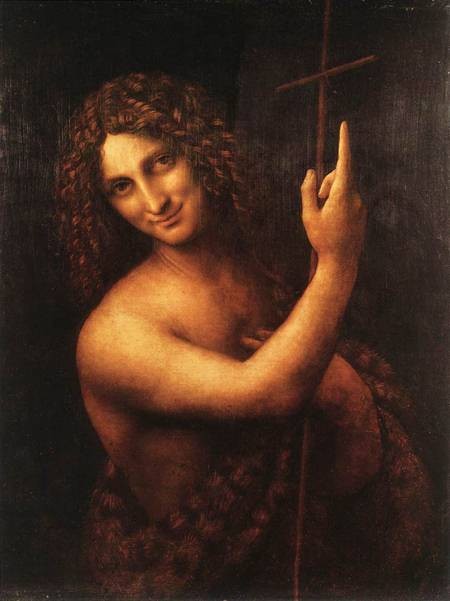
the tourist crush—one more painting waits for him…Saint John, the Baptist. From within the black world where nature
and hope have disappeared, the saint’s left hand rests upon his heart;
and his right arm, pointedly, shows the way to another world.
He steps into the traveller’s light and, with a kind word and gestureto offer, smiling, says, “I know that you, too, suffer.”
Meanings that will not bring words to a traveller’s mouth,
the wounds he spoke of to himself at night, are recognised,
fixed forever, in the master’s art and the smiles of artless saints.Originally published in Out of the Box: Contemporary Gay and Lesbian Poets, edited by Michael Farrell and Jill Jones, Puncher & Wattmann Poetry, 2009.
-
Dinner at Whistler’s
The interior, like a fresh, young face,
is a masterpiece of simplicity.Traffic moves along straight lines
between what is said and what is done.At the dinner table, even the menus
are painted to illustrate the feast.Desire is a red plate.
Love is a black bowl.It is ironic that his mother,
now an exhibit in Paris,is surrounded by impressionists
and looks very sad.Aesthetes imagine a blue square
is the most beautiful space.Peacocks and all other flightless birds
no longer lay claim to parts of the sky.The quarrel of art and money is over.
Needing each other, they kiss and make up.The rooms we lived in, the meals we made,
the words we spoke, themselves all masterworks,numbered, rotting, forgotten,
will no longer be the cause of any emotion.A regret, like a tremor, wakes us.
He goes to piss against the wall.I am the stranger here, in the room
made for blue and white porcelain.This poem appeared first in Out of the Box: Contemporary Gay and Lesbian Poets, edited by Michael Farrell and Jill Jones, Puncher & Wattmann Poetry, 2009.
-
‘How do you know if someone loves you?’
An older man is fucking a younger man. Several people are sitting around a table, talking about a matter that it seems cannot be answered, and someone says, “You’d might as well ask, How many angels are on the head of a pin?” And someone else, “Or how do you know if someone loves you?” The older man is standing behind a younger man, who is bent over a table, taking it in the arse. The older man says, “That’s a good question. How do you know when someone loves you?” The younger man turns his head around, still bending over the table, to say, “Give me a matchbox.” He begins writing on a piece of paper the names of everyday objects and places: ‘rice’, ‘pen’, ‘book’, ‘chair’, ‘carpet’, ‘spoon’, ‘candle’, ‘plate’, ‘shirt’, ‘photos’, ‘glass’, ‘bathroom’, ‘shoe’, and so on. He puts the paper in the matchbox and hands the box to the older man, saying, “In a year, give this box back to me.” A year passes. The older man gives the matchbox to the younger man who opens it, takes out the piece of paper. “You see,” he says, as he reads through the names of things, “love changes everything.”
-
Subscribe
Subscribed
Already have a WordPress.com account? Log in now.
 Stephen J. Williams
You must be logged in to post a comment.