Category: Humor

  • Turkish delights of the 1970s: movies of Metin Erksan

    First ghost scene from Grigori Kozintsev’s Hamlet.

    Metin Erksan (1929–2012) was no slouch. His movies were entered into major international competitions and sometimes won them. When Turkish cinema was having its heyday, in the 1950s and 1960s, Erksan was there. In the 1970s, though, he started making movies aimed at commercial success—or so the story goes—and on a couple of occasions at least, this seemed to involve taking well-known masterpieces of cinema and giving them a Turkish (and possibly Islamist) makeover for Turkish-speaking audiences.

    Metin Erksan's 'Şeytan'
    Metin Erksan’s ‘Şeytan’

    The Yeşilçam (‘green pine’) period of Turkish cinema had entered its decline as Erksan was hitting his stride in the mid- to late 1960s. Making almost a shot-for-shot remake of ‘The Exorcist’ for Turkish cinema audiences must have seemed like a good idea. Erksan did it on a small budget and without much in the way of special effects. The makeover attempts to reproduce many effects of art direction, set design and music, but not very successfully. He gives it his best shot. In fact, he just steals the music. Erksan’s version, called ‘Şeytan’, was in Turkish cinemas at nearly the same time as Friedkin’s original. What was the point?

    Though the video is marked ‘Private’, you may be able to watch it on YouTube.

    ‘Şeytan’ (1974) removes all visual and narrative trace of Catholic heresy from William P. Blatty’s story. There are no Catholic priests in ‘Şeytan’, no cassocks, no seminaries and no desecrated statues of the Virgin Mary. When the possessed teenage girl is hovering above her own bed it is not “the power of Christ” that compels her to get back between the sheets, but an all-powerful Allah. So, at one level, Erksan was presenting Turks with a ‘Halal version’ of Blatty’s screenplay.

    In the years following ‘Şeytan’, Erksan made five Turkish short stories into television features. Then, in 1977, he made a Turkish version of Shakespeare’s Hamlet, and he based it on the great, Soviet, cinema version of the play made by Grigori Kozintsev in 1964. This Soviet version was itself built upon a translation by Boris Pasternak and featured original music by Dimitri Shostakovich.

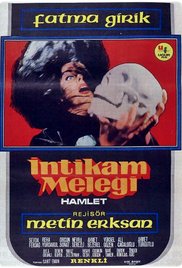
    This time Erksan went further than making a Turkish Hamlet on the cheap. He added an unexpected extra element to the mix: he made Hamlet a woman. Highly-regarded Turkish actress, Fatma Girik, played the “Avenging Angel” of the title. “Hamlet” was the subtitle used on the posters, though the movie is usually listed as “Kadin Hamlet” or ‘Woman Hamlet’. Again, Erksan stole whatever was useful, chopping up Shostakovich’s score ruthlessly to make it fit his scenes, and echoing elements of the set and art direction. The effects fall short of Erksan’s aspirations: the ghost in ‘Kadin Hamlet’ looks less like King Hamlet than a somnambulant Bela Lugosi.

    ‘Kadin Hamlet’ was shown at the Filmex movie festival and was accepted into competition at the 10th Moscow International Film Festival (1977). At Filmex it was shown during the festival’s 50-hour movie marathon and greeted with hilarity. There’s no record of whether the jury was laughing in Moscow where, I imagine, there may have been serious discussion about the nature of cinematic homage, the political turmoil in Turkey, and the credit given to Shostakovich but not to Kozintsev.

    Should we be laughing? I did. I’m not ashamed. But I wondered, also, whether there was something missing from this reaction, and if a cult of incompetence has grown up around certain movies—and ways of making movies—that makes it easier to laugh at them than to see what they were trying to show us. Erksan’s Hamlet stays in the background of her mother’s wedding, and she is dressed in a modern 1970s white suit. There is disco music in the background as the film’s first exchange takes place. Erksan appears to be making serious claims on behalf of his audience, including that Turkey’s decades-long reforms in favor of modernity, and equality for women, were not going away. Erksan smartly turns the duel between Hamlet and Laertes into a shooting-match with rifles in a forest.

    Within a few years, the political situation in Turkey even more chaotic, other film-makers began cobbling together less respectful and less competent rip-offs of Hollywood hits. ‘Dünyayı Kurtaran Adam’ (1982), known as the Turkish Star Wars, is the most notorious example. It’s awful, and awfully funny.

    Turkey was not the only country performing this kind of cultural appropriation. There is a Japanese version of Star Wars, called ‘Message from Space’ (1978) and an Italian Star Wars called ‘Star Odyssey’ (1979).

    See also:

    How Iran’s ‘filmfarsi’ remains the biggest secret in cinema history (Guardian)

  • Shakespeare

    By the time Shakespeare was my age he had been dead for six years.

    »» New York Times article.

  • Couch-based activism 101

    You want to make the world a better place. The intractable difficulties and complications of reality are stacked against any chance you might succeed.

    This is a quick introduction to strategies and tools for protest, sharing and action in the Internet age—most of which can be done sitting down.

    Emailed protests

    When thousands of outrage-laden emails start pouring into the inbox of the incompetent government minister, a simple filter redirects the electrons onto an information technology compost heap. If your protest must consist of sending someone something, put down the iPad and stick a stamp to an actual package, which you can then get someone else to mail for you.When protesters wanted to have their say about anti-gay laws in Russia they sent Vladimir Putin dildos in the post. Does anyone know what he did with them? (—The dildos, I mean, not the protesters.)

    Facebook

    Judge your friends and acquaintances by how enthusiastically, often and mindlessly they click the ‘Like’ button underneath your posts.The name ‘Facebook’ carries within it the judgmentalism of the software program that was its precursor, ‘Facemash’, a computer game that sorted Harvard women into ‘Hot or Not’. Users turn Facebook into whichever kind of game is most important to themselves: like me or don’t like me; approve or disapprove; with or against me; agree or disagree; and so on.The non-threatening and non-judgemental uses of Facebook—keeping in touch with friends and family, arranging invitations to parties, etc.—are the outer and upper circles of a deep, cold hell where people can easily convince themselves that ‘sharing’ a news item is actually sharing.

    Twitter 

    … Apparently able to tear down corrupt governments with a single tweet retweeted until your despised oppressors simply pack it in. The 140-character messages on your fancy phone are powerless unless someone—a million someones—actually decides to turn up. Turning up is what topples governments; turning up in sufficient numbers and refusing to leave until something happens.

    Occupiers

    … Which leads me to occupiers, not strictly part of the couch-based activism movement.You’ve got to love the commitment and outrage of the occupiers of the Occupy movement but, the moment the news starts showing them sitting in a circle, on cushions, and passing the talking-stick, you know something has gone wrong.

    Poetry

    No. (Yes, it can be done sitting down but, as a strategy for social change, it doesn’t work.)

    Satire

    You can do this lying down or standing up. It is difficult to do well but it can be effective. Modern trends seem to favor non-verbal, graphical forms of mockery (except ‘street theatre’, which is now only acceptable at Earthcore events).

    Unions with Facebook accounts

    Without doubt the most accurate sign your union has abandoned hope that your job and conditions can be protected is the appearance of the union’s Facebook page. Not as concrete as a poster or letter, not as personal as an email, not as rousing (or as dangerous) as a good old-fashioned meeting or speech, the union Facebook account turns all news, good and bad, into ‘timelines’ of blue-hued inevitability. The union organisers who post news to Facebook are most likely at home on the couch right now with a bowl of popcorn.Unions should own more megaphones than smartphones.

    YouTube 

    Meat including Pork (73%), Water, Premix [Potato Starch, Tapioca Starch, Salt, Modified Starch (1442), Soy Protein, Mineral Salts (451, 341, 450, 452), Dextrose, Spices, Antioxidant (316), Sodium Nitrite (250), Fermented Red Rice], Food Acid (325), Sucrose, Smoke Flavors, Vegetable Gum (412), Anticaking Agent (551) … YouTube is the manufactured meat product of the Internet.While it is one of the great, supine protest activities, YouTube’s effectiveness is greatly enhanced when done outdoors and in the kinds of places where human rights are being abused, decency trampled on, and innocents being shot. No editing or music is required. Just set your camera-phone to upload videos automatically and start recording.

  • Ironising the ironisers: Edwards does Britney from behind

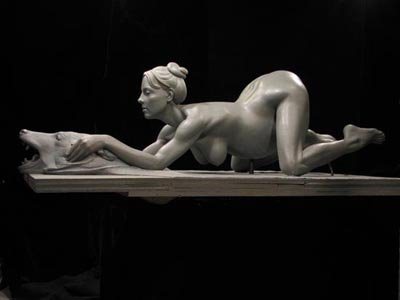
    Daniel Edwards’ take on the pro-life debate is so outrageously perverse the pro-lifers are beside themselves, not knowing if they should be thankful or horrified. Edwards plants Britney Spears on all fours on a bear skin rug, arse in the air, the head of her baby crowning between her spread legs while her milk-laden breasts hang underneath her. The media release, reproduced below (from Capla Kesting Fine Art), is a finely tuned comedy sketch, from which no-one gets out alive.

    Daniel Edward's sculpture of Britney Spears.

    The three photographs of the work on the web site are all taken from the side or front. There are no ‘posterior’ shots, so to speak. This leaves some drama for the collectors’ vernissage, I suppose, and saves unsuspecting under-age art lovers from throwing up on their computer screens. This little fit of modesty also serves to emphasise the main beguiling feature of the sculpture: Britney has such a calm, sexy (if you like that kind of thing), knowing expression on her face, not at all the kind of look you would expect to find on a woman pushing a baby through her pelvis. Indeed, as little Sean Preston is about to squeeze out the other end, Britney seems to be concentrating on showing the bear a good time. The bear, actually, appears to be enjoying himself, in the middle of a sort of bear-ecstasy and letting out a little growl.


    Dedication honors nude Britney Spears giving birth

    Pop-Star’s Pregnancy Idealized In Brooklyn Monument to Pro-Life’

    Daniel Edwards
    Monument to Pro-Life: The Birth of Sean Preston
    Capla Kesting Fine Art […]

    BROOKLYN (March 22, 2006)——A nude Britney Spears on a bearskin rug while giving birth to her firstborn marks a ‘first’ for Pro-Life. Pop-star Britney Spears is the ‘ideal’ model for Pro-Life and the subject of a dedication at Capla Kesting Fine Art in Brooklyn’s Williamsburg gallery district, in what is proclaimed the first Pro-Life monument to birth, in April.

    Dedication of the life-sized statue celebrates the recent birth of Spears’ baby boy, Sean, and applauds her decision of placing family before career. ‘A superstar at Britney’s young age having a child is rare in today’s celebrity culture. This dedication honors Britney for the rarity of her choice and bravery of her decision,’ said gallery co-director, Lincoln Capla. The dedication includes materials provided by Manhattan Right To Life Committee.

    ‘Monument to Pro-Life: The Birth of Sean Preston’, believed Pro-Life’s first monument to the ‘act of giving birth,’ is purportedly an idealized depiction of Britney in delivery. Natural aspects of Spears’ pregnancy, like lactiferous breasts and protruding naval, compliment a posterior view that depicts widened hips for birthing and reveals the crowning of baby Sean’s head.

    The monument also acknowledges the pop-diva’s pin-up past by showing Spears seductively posed on all fours atop a bearskin rug with back arched, pelvis thrust upward, as she clutches the bear’s ears with ‘water-retentive’ hands.

    Britney provides inspiration for those struggling with the ‘right choice’, said artist Daniel Edwards, recipient of a 2005 Bartlebooth award from London”s The Art Newspaper. ‘She was number one with Google last year, with good reason—people are inspired by the beauty of a pregnant woman,’ said Edwards.

    Capla Kesting denies the statue was developed from a rumored bootleg Britney Spears birth video. The artist admits to using references that include the wax figure of a pole-dancing Britney at Las Vegas’ Madame Tussauds and ‘Britney wigs’ characterizing various hairstyles of the pop-princess from a Los Angeles hairstylist. And according to gallery co-director, David Kesting, the artist studied a bearskin rug from Canada to convey the commemoration of the traditional bearskin rug baby picture.”

    An appropriate location for permanent installation of ‘Monument to Pro-Life’ by Mother’s Day is being sought by the gallery.

  • Thingward ho!

    Humor is not a mood but a way of looking at the world. 

    — Ludwig Wittgenstein

    You admire and envy, don’t you, those people who can wear any crumpled, disorganised, unplanned mess, and still manage to appear attractive? You are at a party, say, and two male figures, in unpressed, unmatching formal attire, Bollé sun-glasses and designer stubble, let themselves in. It is not clear they have been invited, since no one appears to know their names, but they add to the still small crowd that touch of studied desuetude and are allowed to stay, for decorative purposes.

    Or perhaps it is a club or bar …

    Little constellations of self-proclaiming stars gather in every nook and corner, competing for the attention of any earthling with a telescope. There are a few dresses sewn together with things sparkling at the blue end of the spectrum; a few others announcing their social awareness with autumnal and earth-motherly oranges and browns. (I am referring mainly, of course, to places reserved, by unspoken agreement and the certainty of embarrassment, for people over thirty, since, being too ugly, too old, and too well-heeled, I would not be welcome anywhere else.)

    Go any Friday or Saturday night to the streets of any major city and see how sartorial decisions follow occupation or preoccupation.

    Young women in creations with fluffy shoulders and considerable padding can be seen accepting invitations to study at the School of Hard Cash. They are not prostitutes. Like many young women these days they have been confused by feminism. If one, by chance, happens to sit at your table in a café, obviously because there is nowhere else to sit, and you get to talking, you might eventually ask what it is she looks for in a relationship. She will begin by telling you she wants someone to support her, rich, tall, strong, handsome, as well as sensitive—not a ‘yobbo’—and end by saying she would like to have a career. You might think, as I did, of objecting to this contradictory selfishness; but at least Simone and Germaine have taught her one good thing.

    Recent survivors of Grammar School, now, perhaps, settled into a job somewhere close to the stock market, declare their aspirations to achieve the karma of serious money in tuxedos with satinised lapels.

    During the day these same new recruits can be seen dressing down in Country Road and Sportscraft, or up, if they are regular readers of Arena, in something that convincingly imitates Jean Paul Gaultier (when at work, minus the designedly torn jeans) or Hugo Boss. The shoes will have been bought (that is to say, in the future perfect, on credit) at a shop frequented by people with less important things to worry about than money.

    They need a face and body to go with all this, of course, because without those the effect is rather like cooking porridge up as soufflé. Though having both the face and body which make Gaultier look at home, there is no need to wear him for the purpose of attraction.

    The new recruits know it is not at all fashionable to be too fastidious. For $300 anyone can get an adequately tasteful double-breasted suit with more buttons than NASA; and if you do this you had better have plans to live on the moon. Seriously and ambitiously fashionable people know the immoderate effort and expense which must be endured to achieve the effect of relaxation.

    … And that is the nub of the modern fashion problem, the veritable crotch of sartorial philosophy. For the sufficiently well-to-do, a shirt, jacket, pair of pants, shoes, and a few accessories, visible and invisible, are asked to carry the weight of a terrible cultural and personal problem—to be visual proof that the wearer is, in just the right degree, ‘thingwardly aspirational’, but also, down deep, where it really counts, a spiritually and psychologically balanced ordinary guy. Clothes do not make the man: they turn man into art.

    An artfully clothed body is popular culture’s version of a mystery novel with the last page torn out. So long as the body keeps its mouth shut, and has no distinguishing marks, the dénouement of its promised satisfactions can be delayed while the reading goes on. Perfect fashion imagines undressing and, when it is lucky, or irresistible, carries its plot with it into the bedroom.

    The thing is to keep the mouth shut, if it is likely that what is going to come out of it does not precisely match, or exactly compensate for, the artifice of one’s clothes. There can be no reason, surely, for the expense of even an attainably cost-moderate Country Road image if the shortest conversation convincingly demonstrates the model is in a state of permanent emotional anaesthesia. If you have created the impression of being management material you must not natter like an intellectual twinkie. To be an unemployed Shakespearian actor with matching wardrobe is a socially acceptable misfortune, but you must not talk about it endlessly. Dressing for sex is, by definition, attractive. Verbal bonking is not.

    So, beyond all the things which hang on the surface, much deeper and more important, there is the ultimate fashion accessory, which must be tailored and worn most carefully. —Not art-print boxers. I am thinking of speech, the sound a body should make a short while after thinking, the physiological antonym of wind.

    You cannot imagine how pleased I am to make this discovery. It is only a personal discovery, though. There is nothing here I can patent or bottle. It is true that I am ugly; no one has been cruel enough, yet, to tell me this outright, but facts of this sort are known inwardly and should be admitted. Also true is I can, with some concentration and planning, turn out a phrase to make Arctic hearts melt, delivering it with conviction.

    The more expensive fabrics of chatter are not necessary to achieve good effects and, in fact, these days, they can be a hindrance. In the fashions of speaking, as in everything else, quality and originality are important. (A little cribbing is OK, to gain momentum, but steal from the best.)

    If you are, like me, one of the unfortunate multitudes for whom wit and charm must compensate for a paucity of attractiveness, you will be pleased to discover, if you haven’t already, that skill in their fashions can be learned, and memorising a few, simple rules of thumb will set you along the right path. Practice and more practice will enable you to play any part, to be, at a moment’s notice, the common bird admiring peacocks and the one they all want to take home with them, or Oscar making yet another American debut.

    Keep these points in mind as you set out to develop your verbal wardrobe …

    As with suits, so with words: you will be assessed by clarity of cut and shape of line. The speakers at the cutting edge of verbal fashion are always cutting out when too many others have cut themselves in.

    Stream of consciousness is the Hawaiian shirt of conversational arts. Make sure your partner has one packed before you don yours.

    Satire is proper and fair only among people capable of comprehending it, otherwise you’d might as well be wearing art-print boxers.

    Sarcasm is verbal pugilism: it is best to let other people do it, while you take bets.

    It is important to avoid clichés and any terms you have learned from newspapers, television, or in the workplace. For example, at very boring parties someone is bound to start talking about the economy and they will use words like ‘trickle-down effect.’ This is really the most insulting concept in economics. To most people it sounds rather like being pissed on from a great height.

    Avoid truth and morality at almost all costs. These are the two most destructive forces in human relations. Besides which, they are a little like reigning monarchs: no one planning to have a really good time ever invites them to parties.

    Self-deprecation is in most cases a more effective strategy of endearment than egotism, but you must try not to be too convincing.

    Prepare and memorise about half a dozen casual and witty remarks which can be easily transposed for use in different situations and among people of different political (and even sexual) persuasions. For example, in the wealthier suburbs of our major cities, it is quite proper to begin a conversation with a remark that, “The New Right’s idea of entertainment is sneering at breadlines”, but if you have any ideas of laying your pre-eminently fashionable interlocutors it may be necessary to add, “—The Government’s idea of entertainment is making them.” Don’t be embarrassed about wanting to bet both ways: in the bedroom everyone pays lip service to Glasnost.

    And as you reach for your Nautilus Vocab Expander, remember that it is only fashionable to be blonde by will if you have the audacity to show the roots. Words are the clothes, but the way you wear them on the tongue will show you either as a work of art or a bread pudding.

    Then it is only necessary to color co-ordinate mouth with wardrobe. In many cases this is easy. Dressing in Country Road or Sportscraft you only need murmur nostalgically about life on the farm and express vague alarm at any harsh turn in the conversation. In Gaultier you are expected to be more aggressive and darkly witty, and the effect of such clothes is completely lost without some sullen and misanthropic complaint about the complexities of life. Wearing Yves St Laurent is an overture to talk which is mostly serious and always sensitive.

    Matching inward and outward appearances, word with deed, mouth with wardrobe, you are fit for any conquest and thingward ho! But one more thing …

    If you are ever cornered and asked to explain exactly what it was you meant by what you said, and suspect yourself of saying nothing and meaning less, remember Dr Seuss— “I meant what I said, and I said what I meant. My clothes say a mouthful, one hundred per cent!”

  • On the uncertainty of finding a place to call home

    [Note on this story.]
    The beginning of the end

    When not giving demonstrations of black boxes to new salesmen in country towns, I sell the boxes door-to-door in the city. Black boxes provide relief from all the 156 boring chores associated with day-to-day living. There are 156 different boxes to do 156 different jobs. Visitors to my house cannot understand why it hums. All the boxes are at work. My house must be the only one in Australia with all 156 boxes installed and working. A showcase of modern technology it hums, contented, and I hum with it. When the children were younger, in the days when Marjorie could still remember my name, we all used to sit in the living room together and listen to the house hum its merry work-a-day melody, and we used to hum along with it. The novelty of my new job was still fresh then, and it was a time for humming and singing and being happy.

    If Marjorie is home when I return to Melbourne, she will say that she has been waiting for me.
    —Peter (she will say), I’ve been waiting for you.
    —You shouldn’t have (I will reply. Then 1 will give Marjorie a kiss).
    —Are you tired from driving, Simon, darling? (she will ask).
    —No, I’m fine (I will answer, not at all surprised that she cannot remember my name).
    —John, the children will be home from school soon. They’ve missed you terribly.
    —Yes. Marjorie. I’ll have to spend more time with them, I know. Perhaps this weekend we could all go to the beach?
    —David, I think that’s a wonderful idea. I’d like that a lot.

    Only one thing puzzles me—why Marjorie forgot my name in the first place. Apart from the tension this causes between us sometimes, our marriage is perfectly normal, and I am happy.

    The children may be home of course. If they are sick today, they will be home lying in front of the television set, which is the only medicine Marjorie knows to relieve their hyperactivity.

    The color of the dust has changed noticeably during the past hour’s driving, from pale and red to grey.

    I don’t believe country people when they say living in the city is unhealthy, that it causes cancer. The sky is still blue, and the grass green. Though I must admit the sky looks a little frayed around the edges sometimes, maybe from overuse.

    Not one car has passed me coming out of the city in nearly two hours. This is strange, even for January. There are two huge trucks cruising behind me—loadless, uncovered, semi-trailers. I think that if I stop or slow down they will push me on. I have no choice. But I will have to stop soon, because I am running out of petrol.

    I stop.
    I get out of the car.
    I look at the signs. It is a self-service. It is what I deserve.
    I look at the directions on the pump, then try to operate it.
    I succeed. I have a knack for this sort of thing.
    Replacing the nozzle on its rest, I notice the attendant is watching me.

    The attendant’s head is propped up by the attendant’s hand.
    His elbow is on the desk.
    And the desk is on the floor.
    The floor is a concrete slab lying on the ground.
    The ground has always been there.
    The attendant will not take his head off his hand.
    He doesn’t want to disturb the natural order of things.

    —How much do I owe?
    No answer.
    —How much does the petrol cost?

    His eyes move and look at the meter on the desk. It shows the amount that I owe. I put the exact money on the desk and turn to leave. I get the impression that he doesn’t like me. I have disturbed the natural order of his loneliness. He jumps up, and rushes to the door ahead of me, running around to the side of the station, falling to his knees near the old oil barrels, where he spews up the morning’s breakfast and beer. When he is finished, he looks up at me. He wants me to go away. I go away.

    Closer to Melbourne, driving through the suburbs, I find more semi trailers. They are not alone now. Each semi-trailer is accompanied by a big, red fire-truck. Inside the fire-trucks are men in rubber suits. They get out of the trucks sometimes, looking like frogmen.

    I stop my car to watch them.
    The frogmen get out of the big, red trucks, and hose their rubber suits with a kind of detergent that even from a hundred yards away I can smell is very sweet and flowery. They wait for a semi-trailer to arrive. When one arrives, they start picking up the bodies. Some of the bodies are very stiff and dry from being left in the sun too long.

    The frogmen see me watching them. I don’t try to hide. They seem harmless enough. I notice that they do not talk. I don’t know why.

    Approaching them, they ignore me. They seem intent on ignoring me.

    The middle of the end

    I think maybe the communists have taken over, and everyone is not really sure what to do about it. The shop-owners seem to have caught onto the idea really well. All the stores are left open 24 hours a day. You don’t have to pay for anything. It’s there for the taking. Though I suspect a lot of shop assistants are out of jobs, as self-service seems to be the trend. I don’t know how they will pay their bills if they refuse to take any money from me. Maybe there won’t be bills to pay any more. The communists have taken care of everything very nicely.

    Apathy is still a problem. Marjorie still will not talk to me. Neither will anyone else. Three days after I arrived home, Marjorie is still slumped across the kitchen table, fascinated by her soggy weetbix and milk. I think she is conducting an experiment, and wants to be left alone. She is watching the milk curdle, and waiting for the weet-bix to turn mouldy. But I don’t know how this could have commanded her attention for so long. The children are still lying in front of the television set. And my house still hums. At the very least, my house is contented. I find the behavior of my family most disturbing. They should be grateful for all that I have done for them, and at least talk to me now and then.

    The fourth day after my return, Marjorie is still in the kitchen conducting her experiments.

    I take a seat beside her at the kitchen table, and I insist that she talks to me. She doesn’t. I put my arms around her shoulders, kissing and hugging her, but she is cold and unfeeling.

    —Marjorie?
    Marjorie. please talk to me.
    Please take your head out of the bowl.
    Marjorie.
    Marjorie?
    Marjorie, please.
    Pretty please.
    Pretty please, with sugar on top. Marjorie?
    Marjorie. if you keep on acting this way. our marriage is sure to deteriorate. Think of the children, Marjorie. Marjorie?

    These five days of solitude have made me lose my faith in human nature.

    Finally. It ends.

    Marjorie and I have separated. She is retaining custody of the children.

    Today, I don’t feel like going to work.

    I have gotten into the habit now of actively seeking out and following the frogmen in their big, red trucks.

    The frogmen will not talk to me, but I plead with them to take me.

    —Will you take me with you?
    Please?
    Will you take me, please?
    I’m bored and lonely and if I stay here much longer, I’ll go insane.
    Take me with you,
    pretty please.
    Take me with you,
    pretty please,
    with sugar on top.

    One of the frogmen takes me by the arm, and helps me onto the back of the trailer. It is nearly full. I am lucky to get a place. He points to the spot where the next body should go, and I climb up.

    And in the end,
    among these bodies.
    I sense I am no longer here
    waiting
    but here
    dying.

    I dare not disturb the natural order of things.

    The frogmen spray me with their balmy lotion,
    so I smell of flowers and honey.
    They take me to the mountains,
    and I lie there forever,
    refusing to talk.


    Originally published in Meanjin, number 3, 1980.

    meanjin-3-1980
    Cover of Meanjin, number 3, 1980.