I remember it was a rainy night, and cold
 For our reunion my father took me to his favorite restaurant
 His Chrysler Valiant was painted pearlescent white
 He drove much too fast of course on slippery roads, and parked in a dark street
 When we arrived it was already very late
 In this part of town theatre people, and prostitutes, were everywhere
 A tall man with an ornate beard stood in the restaurant window’s light
 My father was known here so, when we entered, we were seated immediately
 One elderly couple had brought their little tan-and-white dog to dine with them
 It was creating a puddle on the floor underneath their table
 A large party had formed near us, several tables crashed together
 There was laughter and shouting for more wine and bread
 For a while the restaurant was a chaos of yellow light, food and noise
 Tables rearranged themselves like Dodgem cars
 And my father’s table crashed the party forming in the centre of the room
 There were some people we knew—Susan, for example
 She was relating the story of her assault on the base camp of Everest
 And there was Thomas, the tiny but famous author with white stubble
 I tried to listen to everyone, and even to Susan whose story I had heard before
 Thomas tried to speak to me to tell me about something he thought important
 I watched his mouth as it spoke to me
 Then, unfortunately, Susan saw that I was no longer listening to her
 She leaned forward, stared me down, tugging at her ear
 Oh, Susan, I said, no one wants to hear what unrecyclables you left at the feet of the gods
 So, she was hurt of course but I did not see any way of avoiding it
 And Thomas and the secret he was whispering to me were gone
 People had already started to leave before the lights went up
 It was the time of morning bakers go to work
 My father took his coat and headed out before me
 He did not wait for me and crossed the road
 His silhouette marched into a narrow laneway and then it turned a corner
 That was where I also turned to follow after him
 I found only wide, dark pools of water there
 The steep road, winding along the edge of a city park, was empty
 The early morning smelled shiny-wet, and he was nowhere to be seen
 I walked in circles and walked in circles and then came back to where I’d been
 I fell in a gutter and my skirt and shoes were soaked
 The man with the elaborate beard was still standing there
 Even after several hours he was still waiting though I didn’t know for what
 And inside, I could see through the window the dining room being dismantled
 Renovations that could not be started during service had begun
 And workers were already atop of their ladders getting ready to paint
 The old patron said, it’s cold outside come in
 Thank you, if you don’t mind, I will use your restroom, I said to him
 And slipping in, behind me, the strangely bearded man followed me
 Me too, he said, pretending we were together
 Behind a door from the dining room the bakers were on the morning shift
 A beautiful young girl with the tray of sweets swept past me, smiling
 Try, she said, and tilted the display toward me
 I could smell the powdery confection under my nose
 Warm, nutty and sweet, and ready to eat
 And behind me the smell of my new, wet friend
 His arm stretched over my shoulder to grab a treat
 His beard, thin as a tattoo, sculpted into spirals, scratched my cheek
 I could have fucked him then and there
 It was what we wanted, but we threw ourselves into a soft sofa
 In the family rooms there were other diners who also had returned, defeated
 My wet friend wrapped his legs around me
 I looked closely into his eyes, asking for reassurance but finding none
 I kept one hand on his shaven neck and with the other painted his lips with sugar
Tag: poetry
-
I remember it was a rainy night
-
The quiet Australians
In case you were wondering the quiet Australians
Won’t tell you what they are thinking. Their patriotic
Yowl is stifled by a kind of shame, or fear of shame
That in a plastic-colored world of money, generations
Of growth and privilege do not add up to much.
The quiet Australians want someone to wail for them

To sob about unfairness, suffering, their piece of cake
To blame, to tear down, to strategise retaking what
Was taken from the history their forebears vandalised.
The quiet Australians would stand up to be counted
If they had a leg to stand on. They would go to war
If war did not require a sacrifice they shrink from.

Fears aside, the quiet Australians sometimes speak
When martyrdom can be assured, when whistling
At a pitch that dingoes hear their words give voice
To pain they sincerely feel in the salty cracking
Landscape of their lives. There on the dusty plain
The quiet Australians cultivate contempt for strangers.

Not feeling for them, we pretend the strangers cannot
Feel. We, I say, since I am one of you and know that
Silence can be strength; I know what lengths my hate
Can go to. When we quiet Australians learn to speak
We might have something good to say. But, when?
I don’t know. I’m old. One day, I think. One day. -
Auguration
I woke this morning from a dream in which the future
had been laid out before me like mathematics. All the assertions
of economists and other soothsayers about the sickening movements
of markets could be denied; and everything will be denied
everything—except that two plus two equals four.The animal used in this auguration was the self-acting mule, a machine
that has arms and pincers, and can be made to perform
routine tasks tirelessly, without complaint except that it might
give a kick now and then. This animal, this algorithm without feeling
has been shitting in our society for years—and now we have found a use for it.The dream did not turn out at all how I expected it to turn out.
That is how you know dreams have turned into nightmares.
We are all going to find ourselves crouching in a dark space
not together—that is, not acting in unison, as a group—but separately
and individually responsible in the fight that is coming.The rulers, however—the presidents, governors and the rest—
who have always united for the purpose of our repression and
do not like to share any ground with other people
will be onboard their yachts and planes at the crucial moment
when promises are made and broken in the same breath, and things fall apart.It is just then that the failure of truth will be its own punishment
and facts will stand out in stark relief, like someone screaming
on a cold night. It will be fight or die. A survivor will be left standing
covered in blood and it will not seem proper to talk about right or wrong
because some questions have always been answered this way.Note: This poem represents ideas in ‘Chapter Two: The Metaphysics of Political Economy, Part 5’ of Karl Marx’s «The Poverty of Philosophy».
Published in Otoliths, 1 February 2017.

Robert Mapplethorpe (1946-1989), American Flag, 1977. Gelatin silver print, 19 3/4 × 15 15/16 in. (50.2 × 40.5 cm). Whitney Museum of American Art, New York. -
Inhabitants of Celebration Park
There have been reports of a ‘mountain lion’. The danger
that came down from a reserve and waited crouching
in grey grass at the side of the road had eyes
emitting rays to hypnotise hunters and children.
The announcements paralysed us. We did not think
that in our despair we gave everything we owned
to the rich and scientists who perfected lying
for theorems whose only purpose was deceit. The voters
got up to no good at night in parks set aside
for the betterment of us all, dressed up as crazy beasts
as celebrities, symbolists and as fortune-tellers
and let the animals loose. In Celebration Park
there are no super-heroes, and not even any heroes
in this dire plot: we are the wildlife, it is our nature
stripped and bare-ass naked. There is a map for everywhere
except the private places of a few who can afford silence.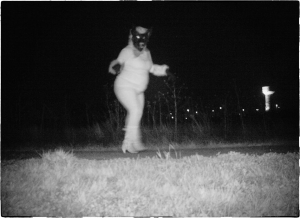
Celebration Park, Kansas USA—Gardner Police Station photograph of mountain lion. -
Transposition in the words of James Baldwin
We have invented the faggot.
I did not invent him.
Straight people invented him.
I have always known, have known since I was seventeen
years old, what you were describing was not me, and
what you were afraid of was not me. It had to be
something else. You had invented it.
So it had to be something you were afraid of
you invested me with. I learned this
because I had to learn it.
But you still think, I gather, that the faggot is necessary.Well, it is not necessary to me.
So it must be necessary to you.
So I give you your problem back.
You are the faggot, baby.
It isn’t me.Note: All words spoken by James Baldwin.
-
People like us
The numbers are important: it has been twenty years,
more than twenty years. Still, he is always home at six, exactly.
I have prepared the table, and the vegetables. Something
has been cooking all afternoon that we will finish togetherlater, but before that he throws his arms around my shoulders
and kisses me on the neck. We have a drink and talk.
Like all companions we have a secret language, and a world
within the outward world where characters, known only theresub-plots, imaginings, laughter, have private lives and meaning.
Then, when it is time to eat, we go to the kitchen and agree
on how to serve. Did you know that in the Bible it says
be subject to each other? It means, I think, he is first, always.It means, he thinks, I am always first. We assess the wine.
He is better at this than I am. At this, and many other things.
I am better at the jokes, I think, but we share a taste for the absurd.
Everything and everyone is discussed. No one has the final word.Then there is a handful of hauntingly beautiful scenes, a girl
in a red coat, a crumbling beach house, the installation
of the finished bell, to be recounted later in a dream, music
and poetry piling up in a great heap of life.For us there is nothing ever new under the sun.
In the place beyond the city where we escape
debates and news—where it is useless to mention
politics because there are no roads or pathwaysand there is no right or wrong—people like us, lie down
in the grass, and for a minute there we lose ourselves
the sky too quiet to talk about, and we can be nothing
actually nothing, nothing at all, if not together, not as one.
 Stephen J. Williams
You must be logged in to post a comment.