Tag: poetry

  • In museums of beautiful art

    In each great hall an exhausted tourist or a lover of art
    whose life has come to this fine point, standing still as a sign,
    is troubled to learn the truth of his companion’s mind, and
    cannot calculate how far he’s come to know so little.

    He knows the museums of beautiful art are full,
    as much with pain as love; and all the masters, old and new,
    knew just what we go to them to do… At every other corner
    a blood-soaked scene, vengeful, pitiable, famous or obscure,

    is excessive proof—with martyrs, slaughtered innocents, rapes,
    betrayals—the world was shaved by a drunken barber; and,
    at the next corner, the beautiful starvation of youth, which, like a theory
    facts have not yet spoiled, reminds us of all longing unfulfilled.

    It’s true, as we’ve been told, every dreadful martyrdom
    must run its course. Paris, if he is not in love, is just a city
    full of old stuff, unhelpful, jaded waiters, and dog shit.
    Fall flat on your face in Rue Saint Denis, and Parisians laugh.

    On such a day—beyond where Veronese’s butcher-cook hacks
    away just above Christ’s head; and, following the signs, in the hall
    past the spot where Leonardo’s Mona Lisa woodenly endures
    the tourist crush—one more painting waits for him…

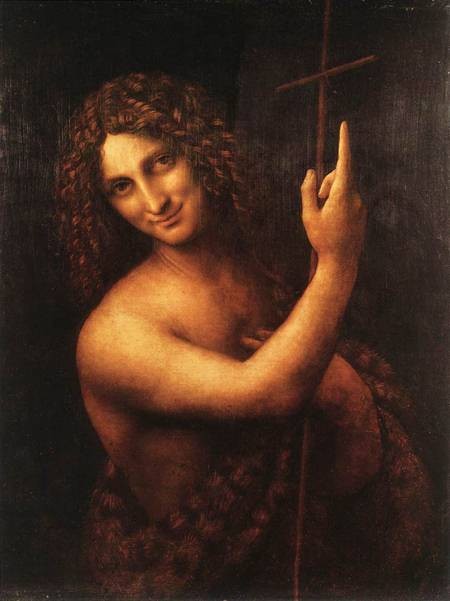
    Saint John, the Baptist. From within the black world where nature
    and hope have disappeared, the saint’s left hand rests upon his heart;
    and his right arm, pointedly, shows the way to another world.
    He steps into the traveller’s light and, with a kind word and gesture

    to offer, smiling, says, “I know that you, too, suffer.”
    Meanings that will not bring words to a traveller’s mouth,
    the wounds he spoke of to himself at night, are recognised,
    fixed forever, in the master’s art and the smiles of artless saints.

    Originally published in Out of the Box: Contemporary Gay and Lesbian Poets, edited by Michael Farrell and Jill Jones, Puncher & Wattmann Poetry, 2009.
    st_john_the_baptist_-_leonardo_da_vinci

  • Dinner at Whistler’s

    The interior, like a fresh, young face,
    is a masterpiece of simplicity.

    Traffic moves along straight lines
    between what is said and what is done.

    At the dinner table, even the menus
    are painted to illustrate the feast.

    Desire is a red plate.
    Love is a black bowl.

    It is ironic that his mother,
    now an exhibit in Paris,

    is surrounded by impressionists
    and looks very sad.

    Aesthetes imagine a blue square
    is the most beautiful space.

    Peacocks and all other flightless birds
    no longer lay claim to parts of the sky.

    The quarrel of art and money is over.
    Needing each other, they kiss and make up.

    The rooms we lived in, the meals we made,
    the words we spoke, themselves all masterworks,

    numbered, rotting, forgotten,
    will no longer be the cause of any emotion.

    A regret, like a tremor, wakes us.
    He goes to piss against the wall.

    I am the stranger here, in the room
    made for blue and white porcelain.

    This poem appeared first in Out of the Box: Contemporary Gay and Lesbian Poets, edited by Michael Farrell and Jill Jones, Puncher & Wattmann Poetry, 2009
  • [At night]

    The only sound


    pencil skating


    across paper.

  • To like most the poems most needed

    Barrett Reid: Making Country (Sydney: Angus & Robertson, in association with Paperbark Press, 1995).

    I had read these poems many times before they were published here. Barrett Reid worked hard on his poems. He polished them, sometimes for years; and many major changes were made to them only months before this book was sent to be set. Many fine poems, I am told—I never read them—were lost in a house fire, years ago. (What is it about poems, even small, apparently easy poems, that no effort of will can make them come back, force them to be reconstructed or remembered, if a writer should lose them?) So, Barrett Reid’s first and last book of poems will be the last we hear of him as a poet, even though there are fragments, some pieces nearly but not quite finished, that might usefully be studied alongside the ones in this book: no future edition could confidently add anything significant to this one.

    Shortly before his death, after the manuscript of this book was settled and he had himself had a little time to assess it, Reid commented to several friends on the surprise of noticing he had been an editor who encouraged experimentation and modernity even though his own poems, seen as a whole, seemed a bit “old fashioned”. Well, yes, maybe. That would be one way of putting it. As much as I would like to give Barrett Reid the last word on this, I think it is truer to say that Reid did not write an ‘old fashioned’ kind of poem but that he failed to overcome his influences. He was in some ways a better reader of poems than a writer of them.

    These influences sometimes announce themselves very loudly, leaving me with the impression that Reid has borrowed another writer’s signature. In ‘Seatime’, Reid’s love of Wallace Stevens competes with the poem’s content for my attention:

    There is a voice that does not reach the shore.
    We do not hear it, walking on the shore.

    [‘Seatime’, p. 3.]

    At other times the influence of reading is more productive when Reid engages with another writer’s ideas. In ‘Go Gently’ his disagreement with Dylan Thomas is as clear, and as deeply felt, as Randall Jarrell’s with Auden:

    I will go gently to the unmanned night
    where good and bad are left behind the light.

    When in life I shared the quiet of nature
    why, dying, should I seek to make a stir?

    I had some joy, I had some pain,
    some sense they may not come again.

    Loved much, but too carefully. Do not rage
    but love madly to furnish your old age.

    [‘Go Gently’, p. 65.]

    But the first couplet is unnecessary; the second (sitting under the same title), in my view, would have been the better, epigrammatic opening.

    As ‘Go Gently’ shows, I believe, Reid’s poems are most potent when he is most sure of his meaning. This sounds like a truism, unless we recall what Reid often said, as an editor and reader of poems: that he liked most those poems which were most needed. The first principle of his reading practice was to keep one ear alert to the part of writing’s energy that signified this need. And, if that urgency or sense of necessity were present in a poem or story, then there was a good reason to take the writing seriously. It’s a liberal urge: to look first for writing’s urgency, rather than judge its content or intent.

    Measuring Reid’s poems in the same way, by his own method, any reasonable estimation would have to conclude they succeed wonderfully. (Examining the poems by a different method might lead me to different conclusions, of course. Why, for example, are there twenty-six references to ‘air’ [twenty-seven, if I count all senses] in only 117 pages of poems? Can it be because this is an important leitmotif, or are there at least a few instances where a too-easy rhyme causes an imprecise image to appear? Close reading of any kind, according to a program or ideology, will have the effect of making a text unwind before your eyes; and at a point somewhere near the reader’s exhaustion—or frustration—it isn’t hard to imagine the author shrugging his shoulders and saying, “But you weren’t meant to read it like that. Does anyone read poems like that?” And this imaginary author is right—so I will not read them that way.) There is a marvellous variety of poems here, humorous, philosophical, satirical, generous, on love and lovers, on friendship, on places, on art, cancer, poets and plants. The mixture seems, because it is, a perfectly natural reflection of Reid’s interests, preoccupations and ethic.

    So, it also seems natural to say that these poems are not about nothing, even when (in at least two poems) that is exactly what they are about. How to make a life, a way of living, of being with others, out of ‘nothing’? The atheist’s problem: there is no god, so, what now? This appears to have been, going on the evidence of the poems themselves, a theme that Reid struggled to work out and to write down. ‘Making Country’ offers no solution, except to note what can be done:

    So take it easy.
    We can do no more
    than map precisely
    and explore the world we make.

    [‘Making Country’, p. 47.]

    ‘Nothing’ is one of the poems in this book that benefited by being severely cut late in its career: there was a whole fifth section, now gone, that added nothing important to the difficult and hopeful conclusion of its final version:

    Such is their nakedness.
    You would say: their love
    has come to nothing after all,
    there is no other here, or anywhere —
    nothing to take the strain, nothing
    between each one. Here
    in distance, in exile, above
    all, shall love grow.
    This is its very air.
    For there is nothing here
    there are no names for you to go by now
    there is no prayer,
    only a heart beating, below
    all, and being human
    free to move
    into that nothing which is love.

    [‘Nothing’, p. 61.]
  • The whole truth

    Clichés tumble out of lovers’ minds
    Like bargains at a jumble sale.
    All the scraps they think are ‘finds’
    Are hand-me-downs whose colors paled.

    New lovers walk around in rags
    No decent mum would have her kids in:
    Straight, or bi, or screaming fag,
    There is no haute couture of loving.

    Unseemly, smelly, dirty things
    No civil person does, or has;
    Turgid, horrid, lumpy limbs;
    Quantities of juice and gas—

    These are what must be endured
    For seconds of a feeble pleasure.
    Lasting joy is not assured
    By love’s insipid, tawdry treasures.

    This poem was originally published in Overland Number 1, 1996.
  • Apology

    Today I sat with coffee and newspaper
    through the lunch hour
    trying to catch up with the whole world’s tragedy.
    Over the weekend was the calmest, coldest Sunday
    for lunatics with guns, and there are six dead.
    Monday all the wounded, the heroes, the neighbours,
    the journalists, the dogs and cats,
    have interviewed each other.
    But today I was not living in a real world
    and I must apologise for this.
    For this one hour, when I was not working and distracted,
    with time to think how life is,
    I remembered Figaro and Susanna, Cherubino’s love songs,
    and hummed Mozart, hummed through blood
    and black banners which came off on my hands.
    Last night one fine lover pushed pain aside
    and held me still—the best duet, the friendliest, and quietest.
    So, I’m sorry, today the world
    was not in the least bit tragic, not even a little sad.
    I could not cry for any pain.
    Happiness has hardened me against all sorrow.

    Originally published as part of War poems: for baritone voice, alto sax, cello, vibraphone and piano, performed by Grant Smith. Composer: Andrée Greenwell. An OzOpera production at the Melbourne Opera Centre, 10 and 11 September 1999, and at the Barossa Music Festival on Sunday 3 October 1999.
  • Mr Thinnegen

    Who once was thin
    And then was fat
    And now is Mr Thinnegen,

    Harangued by news-hounds
    At his door,
    Meringued by brats at
    Pleasure grounds,
    Now is asked
    With almost awe,

    “Oh, tell us, sir, your greatest feat,
    This fat to airy thinness beat …
    Was it something cancerous?
    Have devils come to dance with us?
    Or was it just an act of will
    Which disappeared your grocery bill?”

    Though constantly in quite deep thought
    On questions about Is and Ought,
    And often neverendingly distressed
    For creases that are not quite pressed,
    The asking makes him gird his loins
    And wonder how its clauses joined.

    “Oh, well, you see,
    I’m not as big
    As I have been
    Since all things that
    Are very fat
    Are only fat
    When they’re like that.”

    Perverse and strange, but palpable,
    The reason seems quite wonderful,
    And all who were impressed by that
    Seek his views on other facts.

    “Oh, tell us, sir, how has it been
    We all eat strawberries red, not green?”
    Or, “When will those who know have told us
    Who’s to blame and on whose shoulders
    Rests the weight of all the world? And,
    Does he wear his shirt-sleeves curled?”

    Throwing off the answers quickly,
    Growing thin with each more sickly,
    He answers questions everywhen
    And how or where he comes on them.

    He says:
    “I am he who once was fat,
    Who knew the truth of every fact.
    I am he who now is thin,
    Who knows the waste of questioning.
    And I am he who’s at his end
    To end all Ends, where questions
    Have no fat to spend, where bodies
    Made of skin and bone
    Lie silent in the sick folks’ home,
    And all that’s lovely, wise, and true,
    Sips tea and wastes the afternoons.”