Category: Writing

Writing posts.

  • Ironising the ironisers: Edwards does Britney from behind

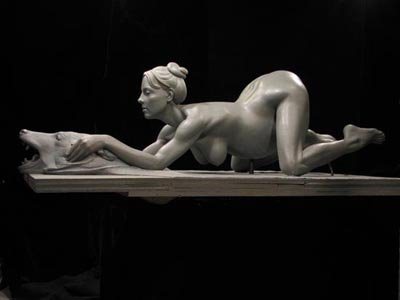
    Daniel Edwards’ take on the pro-life debate is so outrageously perverse the pro-lifers are beside themselves, not knowing if they should be thankful or horrified. Edwards plants Britney Spears on all fours on a bear skin rug, arse in the air, the head of her baby crowning between her spread legs while her milk-laden breasts hang underneath her. The media release, reproduced below (from Capla Kesting Fine Art), is a finely tuned comedy sketch, from which no-one gets out alive.

    Daniel Edward's sculpture of Britney Spears.

    The three photographs of the work on the web site are all taken from the side or front. There are no ‘posterior’ shots, so to speak. This leaves some drama for the collectors’ vernissage, I suppose, and saves unsuspecting under-age art lovers from throwing up on their computer screens. This little fit of modesty also serves to emphasise the main beguiling feature of the sculpture: Britney has such a calm, sexy (if you like that kind of thing), knowing expression on her face, not at all the kind of look you would expect to find on a woman pushing a baby through her pelvis. Indeed, as little Sean Preston is about to squeeze out the other end, Britney seems to be concentrating on showing the bear a good time. The bear, actually, appears to be enjoying himself, in the middle of a sort of bear-ecstasy and letting out a little growl.


    Dedication honors nude Britney Spears giving birth

    Pop-Star’s Pregnancy Idealized In Brooklyn Monument to Pro-Life’

    Daniel Edwards
    Monument to Pro-Life: The Birth of Sean Preston
    Capla Kesting Fine Art […]

    BROOKLYN (March 22, 2006)——A nude Britney Spears on a bearskin rug while giving birth to her firstborn marks a ‘first’ for Pro-Life. Pop-star Britney Spears is the ‘ideal’ model for Pro-Life and the subject of a dedication at Capla Kesting Fine Art in Brooklyn’s Williamsburg gallery district, in what is proclaimed the first Pro-Life monument to birth, in April.

    Dedication of the life-sized statue celebrates the recent birth of Spears’ baby boy, Sean, and applauds her decision of placing family before career. ‘A superstar at Britney’s young age having a child is rare in today’s celebrity culture. This dedication honors Britney for the rarity of her choice and bravery of her decision,’ said gallery co-director, Lincoln Capla. The dedication includes materials provided by Manhattan Right To Life Committee.

    ‘Monument to Pro-Life: The Birth of Sean Preston’, believed Pro-Life’s first monument to the ‘act of giving birth,’ is purportedly an idealized depiction of Britney in delivery. Natural aspects of Spears’ pregnancy, like lactiferous breasts and protruding naval, compliment a posterior view that depicts widened hips for birthing and reveals the crowning of baby Sean’s head.

    The monument also acknowledges the pop-diva’s pin-up past by showing Spears seductively posed on all fours atop a bearskin rug with back arched, pelvis thrust upward, as she clutches the bear’s ears with ‘water-retentive’ hands.

    Britney provides inspiration for those struggling with the ‘right choice’, said artist Daniel Edwards, recipient of a 2005 Bartlebooth award from London”s The Art Newspaper. ‘She was number one with Google last year, with good reason—people are inspired by the beauty of a pregnant woman,’ said Edwards.

    Capla Kesting denies the statue was developed from a rumored bootleg Britney Spears birth video. The artist admits to using references that include the wax figure of a pole-dancing Britney at Las Vegas’ Madame Tussauds and ‘Britney wigs’ characterizing various hairstyles of the pop-princess from a Los Angeles hairstylist. And according to gallery co-director, David Kesting, the artist studied a bearskin rug from Canada to convey the commemoration of the traditional bearskin rug baby picture.”

    An appropriate location for permanent installation of ‘Monument to Pro-Life’ by Mother’s Day is being sought by the gallery.

  • Another Kon job goes belly up

    Another Kon Dimopoulos disaster, this time from NZ, is breaking news: a wealthy New Zealander, Michael Hill, who dreamed of having a sculpture park in his backyard that could be seen from the moon (yes, he said “moon” but I think he meant ‘space’), has packed his AU$120,000 Dimopoulosiana into the shed, thrown up his hands, and his dreams with them. Hill shouldn’t despair: Kon has other sculptures, indistinguishable from Hill’s backyard job, still set up in NZ and Australia. And, besides, I’ve heard the audience for ‘art’ that can be seen from the moon… let’s just say he’s not going to be getting many letters of complaint about the cancellation of the gig.

    Hill removes art after council indecision
    14 March 2006

    Jewellery store king Michael Hill says frustration with Queenstown Lakes District Council led him to remove a giant work of art from his garden.

    He told NZPA if he ran his business the way the council’s resource management division department ran its decision-making process, “we’d just be gone”.

    Mr Hill erected a five-metre-high $120,000 Kon Dimopoulos reed sculpture on his land around a year ago.

    New Zealand artist Dimopoulos is most well-known for a Pacific Grass sculpture located on the roundabout at the northern end of the Wellington Airport runway.
    Mr Hill said the artist took a “great deal of care” with the sculpture’s placement, taking into consideration “the area, the environment and the mountains must not be competed with”.

    He said he had also planted fir trees to eventually hide it from the nearest road.
    Problems started, however, when he asked the council for resource management permission.

    “I really wish I hadn’t,” he said.

    “The Resource Management Act doesn’t have separate clauses for art, so the council had to view the sculpture as a house. In the end, it took so long to hear from them I put it up anyhow.”

    Since then, he said he has been working with the council for consent, but has been left constantly frustrated.

    “People in these positions are frightened to make decisions outside of the square of the Resource Management Act,” he said.

    “It just needed someone to say: put it up, take it down, anything! Any decision is better than no decision,” he said, sighing.

    “And that’s why I pulled it down as you can’t carry on anguishing.”

    The sculpture, which now sits stacked in Mr Hill’s workshop, was just one of many he had planned for the area.

    “I wanted to have a sculpture competition here, but I won’t be able to do that now,” he said.

    “The valley is going to be lacking a significant supporter. These works of art are not cheap. I was going to put up over a million dollars – the council and most of the community can’t afford them, and here was the perfect opportunity.”

    Eventually, Mr Hill said he wanted to emulate amphibious craft entrepreneur Alan Gibbs’ sculpture park in Kaipara, Auckland.

    “Art that you can see from the moon … it’s unbelievable … I would have liked to have done something similar here,” he said.

    from http://www.stuff.co.nz
  • Victoria Contreras Flores | Art~natomist

    Artnatomia is a tremendously clever use of Flash and a great educational tool. It is the inspirational work of art teacher and artist, Victoria Contreras Flores, who, with a contrary view of the demands of the art market, has decided to concentrate on using new tools and media to express herself and teach her students.

    Her web site is at http://www.victoriacontreras.com.

    Victoria Contreras Flores' animation 'Another Day' can be viewed at her web site.
    Victoria Contreras Flores’ animation ‘Another Day’ can be viewed at her web site.
    From Victoria Contreras Flores (in very expressive English) to Stephen J. Williams:

    In fact I begun to project this ARTnatomy tool just by necessity, as a ‘war tool’ for my pupils, by the time I taught at a little University which had not any subject in Anatomy (during a five years career!). In order to provide them the minimum information, and also make my job easier, I begun this work, which finally I have presented as an academic investigation.

    I don’t have any agent or gallery. I broke my relation with last one two years ago.

    By the time I was a fine arts student, abstract expressionism worked as the real academicism at the Universities and the Art Market. In this lineal and scientifist (and mistaken) conception of progress applied to art, figurative art was despised as old. Nevertheless, I have always be interested in the representation of the world and the human being, and my readings, in the tradition of heterodox thought. I have always been an outsider (I don’t like vernissages… [A ‘vernissage’ is a private viewing of paintings before a public exhibition—SJW.]) very critic with the art market: as you see, this is not the best way to become a successful artist.

    By the time I discovered digital tools, I begun to find another way to pay my bills and a powerful medium to experiment and mix all of my other interests (music, narration, movies). Nevertheless, as guarantee of ‘seriousness’, the ‘modern critic’ tends to demand to the author a specialisation, for me narrow and suspicious: it is supposed that if you make oil paintings, you cannot be a good escultor, or work with computers, or vice versa; nevertheless, the incursions of Leonardo or Picasso in any scope are well understood as virtues and richness… Far from trying to compare myself to them, nevertheless, I do not put any limits to me, because I work by passion and curiosity (the rest, concerns nothing to me and I am sent to results). Rather than this, I brush often the most unconscious audacity, putting me in lands where still I am only an apprentice (3d or writing, for example. The section ‘Toxtexts’ in my web is where I put my ‘essais’ and my ‘poems’, sorry just in Spanish).

    As you see, in this way, I have preferred to have my name forgotten by art critics (as I forgot theirs), to work in freedom. I think the Internet is much more alive than the market of the traditional arts and less won by the ‘intermediaries’. Find more interesting artists in the network than in Arco or Basel, and I do not have any doubt that if Leonardo da V. were raised again, he would be hooked to his computer, ‘playing God’ gladly, with tools that include supports, brushes, pencils, music and movement. If to similar playful possibility we add the reproductivity and accessibility advantage to him to be—not only economically—for any bourgeois, the computer opens for the creation a new door of revolutionary consequences: the real possibility of insurgency of ‘I do all by myself because I don’t need anybody else’. As always, another thing is the use that everyone does of the instrument: the new tools raise the challenge to combine with sense creation and technology, to produce an art of quality that assume applications, utility; the objective would have to take care of recover for the creative activity the place and the function in the society (more natural, less sacred) than narrow dichotomies and bad interpretation of history, snatches to him.

    Victoria Contreras Flores
  • Swinging pink flesh drives Indonesian Muslims wild

    The following post is, statistically, the most popular (well, most clicked) post on this site for Indonesian web-surfers. Google link stats suggest this is because many web-surfers located in Indonesia come here hoping to see ‘Anjasmara nude’ (‘Anjasmara bugil’). Could this be true? If you are visiting this site from Indonesia, leave a comment to register your disappointment, or any other feelings you have.


    Here is the photograph and installation that is causing all the fuss in Indonesia. It is neither very offensive nor very interesting. As usual, scale makes up for what imagination fails to provide: apparently it is pretty big—“massive,” the journalists say. The photographs show the wall-height photograph is wrapped around an actual pink swing—like a backyard or playground swing, painted pink—large enough for a child (or small adult) to sit in. And the little, white dots that coyly camouflage the models’ naughty bits are in the original and have not been added to protect you here.

    However, in truth, as everyone in Indonesia seems to realise, the furore about Pink Swing Park is not really about art at all but about the larger national debate in which power-hungry religious ideologues have decided they will mobilise the passions of their followers by attempting to outlaw whatever they say will inflame human desires.

    Tight clothing, erotica and, who knows, maybe even chocolate (!?) are on their way out in Indonesia.

    Women, in any case, should stay at home. That is the simplest way to prevent them inflaming male passions.

    Now, to be perfectly honest, I think this is the correct strategy. I believe we should be encouraging the whole Muslim world to introduce radically repressive laws against all forms of indecency, sexuality and anything that inflames desire. While we are at it, let us encourage them, also, to reject everything tainted by the unfriendly, unclean hand of the West. And I think we should encourage them to keep their women at home, sheltered, uneducated and forbidden to travel without chaperon. The Muslim world should be encouraged to destroy all its great works of art, as the Taliban did in Afghanistan, and to destroy as much history and as many books as they find objectionable. Only in their own countries, of course, and as an example to the rest of us.


    Navel gazing ruled out as Indonesians button up

    Photo: Agus Suwage and Davy Linggar
    By Mark Forbes Herald Correspondent in Jakarta
    February 25, 2006

    ROCKING in a pink swing fashioned from the cab of a pedal-driven rickshaw, Agus Suwage felt at peace. He had just installed his Pinkswing Park exhibit at Jakarta’s international biennale and was surrounded by massive panels with multiple pictures of a near-naked man and woman frolicking in a utopian park—a world away from thoughts of religious furore, public condemnation and possible imprisonment.

    The softly spoken, bespectacled 47-year-old seems an unlikely martyr, his only concession to the battle now enveloping his life is a peaked camouflage hat with a skull and crossbones button pinned to its front.

    Within days of November’s exhibition launch, Islamic fundamentalists had shoved Suwage to the forefront of their struggle to redefine Indonesia by descending on the biennale, forcing its closure and demanding prosecutions. At first police claimed his work blasphemed the story of Adam and Eve, then last week they told Suwage he faced five years in jail for producing pornography.

    The same groups staging violent demonstrations against the West over cartoons of the prophet Muhammad are targeting pornography in their battle to transform Indonesia into a strict Islamic nation. And they are winning: parliament is set to introduce a sweeping anti-pornography law.

    Expected to be passed by June, the law imposes a rigid social template; couples who kiss in public will face up to five years’ jail, as would anyone flaunting a “sensual body part”—including their navel—and tight clothing will be outlawed.

    Most women’s groups are horrified, entertainment industries believe it could destroy them and Bali’s embattled tourism authorities are alarmed at the prospect of sunbathing tourists being arrested.

    Mainstream Islamic organisations are warning of moral decay and backing the bill, while politicians, wary of alienating Indonesia’s Muslim majority, are condoning the growing anti-porn movement.

    Plans to introduce Playboy’s soft porn to the Indonesian market next month have become another focus of rowdy demonstrations, with protesters portraying the magazine as a symbol of the decadent West’s attack on Islam. Playboy’s publishers are proposing a bizarre compromise, no naked women will be featured—Indonesians, at least, will be able to say they only buy it for the articles.

    In Jakarta, police have seized hundreds of thousands of “erotic” magazines—including FHM and Rolling Stone—and DVDs, after an edict from police chief Sutanto to “eradicate pornography”.

    The Islamic Defenders Front spearheads the anti-porn protests. It took two days to track down its leader, Habib Riziek, this week—he was at police headquarters, seeking information about “his men” arrested for allegedly attacking the US embassy in Jakarta last week. Porn, including artworks such as Suwage’s, contributes to moral delinquency, Riziek claims. “We don’t care about the technicality of the picture,” he says. “What we care is that the picture is publicly exhibited and it is pornography and it would damage morals.” Suwage believes his work captured attention because one of the models, Anjasmara, is a popular soapie star. The two models, photographer Davy Linggar and the curator of the biennale, Jim Supangkat, are also facing criminal charges.

    Suwage is increasingly bitter about Supangkat’s reaction to the protest. After hundreds of demonstrators arrived at the exhibition, a panicked Supangkat ordered the offending panels to be covered with white cloth. Other artists draped their own works in solidarity and Supangkat closed the biennale, permanently.

    Suwage believes his prosecution is linked to pressure to pass the anti-porn law and the desire of fundamentalists to impose Islamic rule on Indonesia. Suwage, who is afraid of prison, says he is determined to fight.

    Based at a small cafe gallery in Jakarta’s backpacker precinct, Suwage and a motley collective or artists are mobilising against the new law. “From this case, we make a manifesto for art against the pornography bill. It’s very dangerous for freedom of expression but it also threatens other aspects of society.” Riziek remains emphatic the bill is essential to “guard the nation’s morality” against pornography, which extends past explicit photographs to “anything that could arouse sexual desire”.

    Balkan Kaplale heads the parliamentary committee finalising the pornography bill and is confident it will become law this year.

    It would halt the publication of magazines such as Playboy, he says. “ Playboy would place a time bomb in Indonesia, what guarantee is there it would not arrive in the hands of our children? Playboy is American magazine. Please, don’t play this game with Indonesians, we have dignity.”

    Indonesians also have sensuality, says leading feminist and university professor Gadis Arriva. “Women here have always dressed sexily and in tight clothes, this law is something very alien to us, we have barebreasted women in Bali and Papua, this is part of our culture.”

    In Bali, the head of the government’s tourism authority, Gede Nurjaya, agrees. Traditional Balinese art and dance could become illegal, he believes. He is concerned prohibitions against kissing and revealing bodies could be imposed against foreigners, destroying Bali’s faltering tourism industry.

    Arriva says most women’s groups oppose the bill. “Most of it restricts women, what they wear, how they act. It even creates a board that would go around monitoring women’s behaviour.”

    The new law would also gag a flourishing emergence of young female writers, who write openly about sexuality. “It states it is illegal to express any sexual desire, even imagine sex—how do you prove that?” asks Arriva.

    She sees the anti-porn movement as part of an agenda to reshape Indonesia, with pornography a symbol of Western culture to the many Muslims who believe globalisation aims to destroy their culture. Adrian Vickers, Professor of Asian Studies at the University of Wollongong, agrees the debate is “part of whipping up a moral panic about Western decadence eroding Indonesian culture and morality”, with the potential to push Indonesia towards an Islamic state. “Given anxieties about terrorism, a more Islamic Indonesia could see Australia very much as the enemy,” he warns.

    A closed society looms, says Suwage. “There would be no freedom, it will have a big impact for us, for artists, but it will go everywhere. I don’t believe a picture can change a person’s morality. Morality starts from the individual, from inside, not from dogma.”

    with Karuni Rompies


    Elsewhere, on a similar theme

    and on the changing face of Indonesia

  • Artnatomia: science for artists

    Artnatomia.net is a great site: the best use of Flash on the web I’ve ever seen.


    Have a play! If you’re interested in drawing the human face, you may have found an invaluable resource. Artnatomia is a finalist in an award for the use of Flash on the web.

  • What are galleries for? Artists as indentured servants

    Seems like a simple question, doesn’t it. A gallery is for showing pictures, of course. Let’s be liberal, and say it is a place for displaying works of art, or where people go to view works of art.

    I’m not referring to museums of art, or state galleries. The question is really about commercial galleries. The visual artists I know appear to be, now, in a situation something like the position poets were in twenty-five years ago (not much has changed, everything has changed) when there were, in Australia, literally no major commercial publishers of poetry and a few writers I knew got together and formed a small, private press to publish each other. Over the course of the following fifteen years this small unincorporated association published twenty books and had some success. By the end of it, though, it was still publishing slim volumes—we believed in quality—to deafening silence from reviewers. One of its last books was an anthology of more than a dozen writers that did not get a single review. When we asked the editor of a nationally distributed review magazine why no article was arranged, we were told the anthology was “obviously good”. Well, thank you, we said, and the conversation ended there.

    Perhaps we failed to be interesting or controversial enough. Self-reliance is not newsworthy.

    Visual artists could hardly claim to be in same situation. There are galleries galore. The public listings are full of openings to attend. Opportunities are everywhere. Or, are they?

    It’s not as though writers or poets can claim there is no publishing going on. What we can claim, I think, is that publishers are interested only, exclusively, in their bottom lines, in seeing their accounts written in black ink. You can’t blame them. There is no profit in poetry. And there is no profit in some difficult visual artist whose work cannot quickly establish a market value that buyers are willing to match with dollars. It does not matter if he or she is a genius. Genius doesn’t pay the bills.

    The principal difference between writers and visual artists from a commodity point of view is that writers create a product that is the art world’s version of fast moving consumer goods. Buyers literally take literature off the shelves, in shops that resemble supermarkets. Decisions are made pronto! A book is a standard gift option. Visual artists don’t normally make products of this kind. Purchases are considered. The visual arts are not bought to be consumed, and set aside, in the same way books are bought and shelved. This demeans the relationship readers have with literature, but there is a kernel of truth in it.

    Commercial galleries plot a course between what one must suppose is a genuine interest in art and the mundane worries of their pockets. Welcome to the world as we know it.

    There is nowhere for visual artists to go that is not smell of commercial relationships. Writers, by contrast, are the piece-workers of the art world, huddled in their garrets, earning a pittance for every thousand words: the smell of money rarely reaches their rooms.

    Above all else, it’s disatisfaction that they share; and isolation from the very people who want to make contact with them.

    Commercial galleries, if the system that the galleries describe were to work as perfectly as everyone hopes, offer more than representation. There is supposed to be much else that comes with the relationship: the problem is, really, whether or not this “much else” actually materialises.

    Commercial galleries are supposed to:

    1. Represent artists—that is, speak for them, and about them; negotiate for them; promote them.
    2. Provide exhibitions or shows at least every two years.
    3. Maintain up to date records of works held on consignment and try to sell these works.
    4. Help to build an artist’s reputation by promoting scholarly and other writing about their art.
    5. Generally, manage the relationship between the artist and the market to maximise the artist’s opportunities to profit from his or her work.

    If galleries actually achieved this for more than a handful of the most prominent visual artists, artists would think, no doubt, that the galleries were doing a good job.

    But they are not doing it.

    A mid-range artist in Australia, for example, exhibiting 30 works at a significant commercial gallery once every two years, and selling perhaps 20 of these (a successful show!) for an average price of AU$4,000, brings $80,000 to the cash register. Forty per cent of this goes to the gallery: $32,000. This leaves $48,000 for the artist. A pittance for two year’s work. It’s no wonder they have to have second jobs! (Let’s not even mention the tax situation.)

    No-one attacks the galleries. Why would anyone want to? Even if there were any public discussion of commercial galleries, surely artists would not have anything bad to say about the galleries that are, of course, the very arteries through which the life-blood af art courses…

    Absence of discussion and debate does not mean absence of comment. It is well-known, of course, who the bad apples are. (Who knows, we might even get around to naming them here in future episodes: stay tuned…)

    It’s the relationship between artists and galleries I’m interested in. Now, do you notice anything odd about the following statements quoted, verbatim, from the ACGA website:

    Vision:
    The Australian Commercial Galleries Association seeks to contribute to the visual arts in a way that enhances understanding of and support for the primary market while cultivating sound entrepreneurial ethics and an ever-strengthening national and international market for Australian art.

    Mission:
    The Australian Commercial Galleries Association exists to represent, promote and further the interests of Australian commercial galleries whose core business is the ethical representation of living Australian artists. A dual aspect of the Association’s mission is to develop Australian artists’ livelihood and reputation while contributing to an enhanced public understanding of contemporary Australian art in the primary market.

    ACGA

    I think there are several strange things going on in these quotes, not least of which is that the vision statement does not envision anything (unless it is that the national and international market for Australian art is “ever-strengthening”). I wonder, for example, why this organisation is so obsessed with ethics and ethical bahavior. Has someone accused it or its members of something terrible, or do their consciences need to be salved?

    I mention this obsession with ethics in the vision and mission statements of the ACGA because the point at which the code discusses a gallery’s right to receive a commission on all sales of an artist’s work strikes me as being distinctly unethical.

    The partnership between the gallery and the artist establishes commission as payment by the artist for the gallery’s intensive ongoing work and representation in the development of the artist’s career, reputation and livelihood. As such it should be recognised as an agent’s fee, earned by the gallery in return for the type of ongoing services listed under item 4.

    ACGA

    Item 4 in the code of practice lists a whole heap of things that galleries barely do at all for most artists, and do very badly most of the time. (Read the whole sad catalogue at the ACGA website.) The code is, in fact, a strained attempt to justify a claim that artists, particularly struggling, unknown artists, but also middle-rung artists, have little or no power to deny to galleries.

    Artists, in fact, have to put up and shut up in the face of galleries who do nothing for them between annual or bi-annual shows but still want 40 per cent of sales they haven’t been involved in.

    Wouldn’t it be fairer, more ethical, as a starting point in negotiations between artists and galleries, to say that galleries were entitled to up to 40 per cent commission on any artworks they choose to show, or choose to hold on to between shows?

    You can hear the director-fussbudgets of galleries around Australia huffing, puffing and moaning already, can’t you? Oh, dear, how will they ever earn a living if they only get commission on the works they really want to sell?

    The services these fussbudgets (don’t go off to the dictionary: it means one who is overly particular about unimportant things) offer to artists are described in terms that make their gallery businesses sound like retirement homes for librarians. They promise to be monitoring, archiving, maintaining and pursuing. And when they’re not doing that, they’re cultivating, collaborating and recording. All very important stuff, I don’t doubt. Meanwhile, it is the artist who is doing the real work.

    The list of services that galleries perform to earn their commission is a furphy, a wild rumor, a tall story, and everyone knows it. Artists make their reputations by sticking at their work. It is a hard slog that, even for artists of acknowledged brilliance, goes on for years. To pretend this isn’t the case, and instead put about that the development of an artist’s reputation and career is something that is strategised by whispers and nods between gallery directors and clients with too much money in their pockets, is simply to lie. And there’s nothing ethical about that.

    What is going to change, though? How can the system be changed? Important questions, to be answered by someone else.
  • Pathologies of outrage

    Pathologies of outrage


    The Rent-a-Negro website link flew around the internet a while back, many people linking to it as a humorous site. Initially few people recognised that the site was, as well as being very funny and beautifully written, a ‘serious’ art project.

    More recently, and more controversially, Tanja Ostojic’s poster of a reclining nude in blue briefs with the symbol of the European Union planted over the hidden entrance to an unknown woman’s vagina, caused outrage in Austria.

    Other posters commissioned by 25PEACES were by Carlos Aires, a Spanish photographer, depicting international leaders (including the Queen of England) having sex.

    What are we to make of these web sites and images? The Austrians, currently thinking hard about their relationship with Turkish immigrants and the possibility that Turkey might one day join the EU, were naturally sensitive to Ostojic’s image.

    The 25PEACES commission of over a hundred works contained images that attempted to provoke debate about the relationships of global political leaders.

    From this distance—and it is very difficult to judge reactions and emotions through the news and over the internet—what looks like public outrage may only be a storm in a teacup. In reports about the public outrage over art works, generated for the sake of news or not, there is almost never any real discussion of the ‘art’ in the art. Is it no longer relevant—because only ‘facts’ are reported in the news—what an artist’s other works are like?

    Reporting (in Europe) about the controversy over the Ostojic image blends it seamlessly with reporting about the other posters and of people’s reactions. However, there are two facts it is useful to know…

    1] The Ostojic image exactly reproduces Courbet’s famous painting in the Museé d’Orsay, ‘The Origin of the World’. The title of the reference painting, alone, should be enough to make us stop to think what might be going on here.

    2] Ostojic’s art often focuses on issues where politics and women’s bodies collide. Look at this remarkable image of a woman in a camouflage burka 

    To me, this is a much more powerful work than the 25PEACES commission, but I don’t expect to be bowled over by everything an artist does. Artistic works of this kind set out to dislodge our thinking from fixed positions.

    Beginning with exactly the same methodology and materials, Carlos Aires’s contribution—global leaders fucking—seems thoroughly tame. Why? Possibly because the idea underpinning the images is weaker. Possibly because we sense, as viewers of the works, that Aires has strained too hard and with not enough effect after the outrage the work sought?

    These are more typical Aires photographs. Confronting, in a dull way, but competently photographed and printed (on metallic paper: a trick from the advertising industry).

    Part of the problem with Aires’s contribution to the 25PEACES commission may simply be that he has miscalculated the objects of his scorn. Why is Queen Elizabeth in the group at all?

    The outrage over such art works is a good thing. Artists, old and new, sink or swim in the tidal flow of public perceptions. Commentators on art works behave as though this isn’t the case, and has not always been the case. The pathologies of our outrage, the process by which we become aware of what has moved us or left us cold, need to expand our peripheral vision beyond the images themselves while not losing focus on what it really is we are looking at.