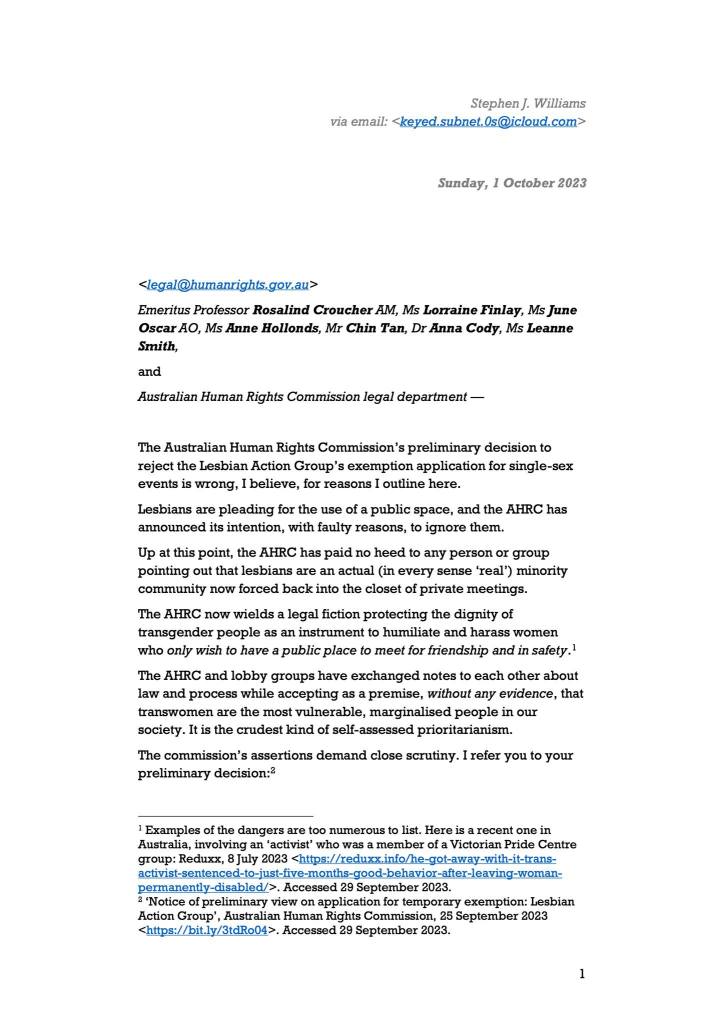
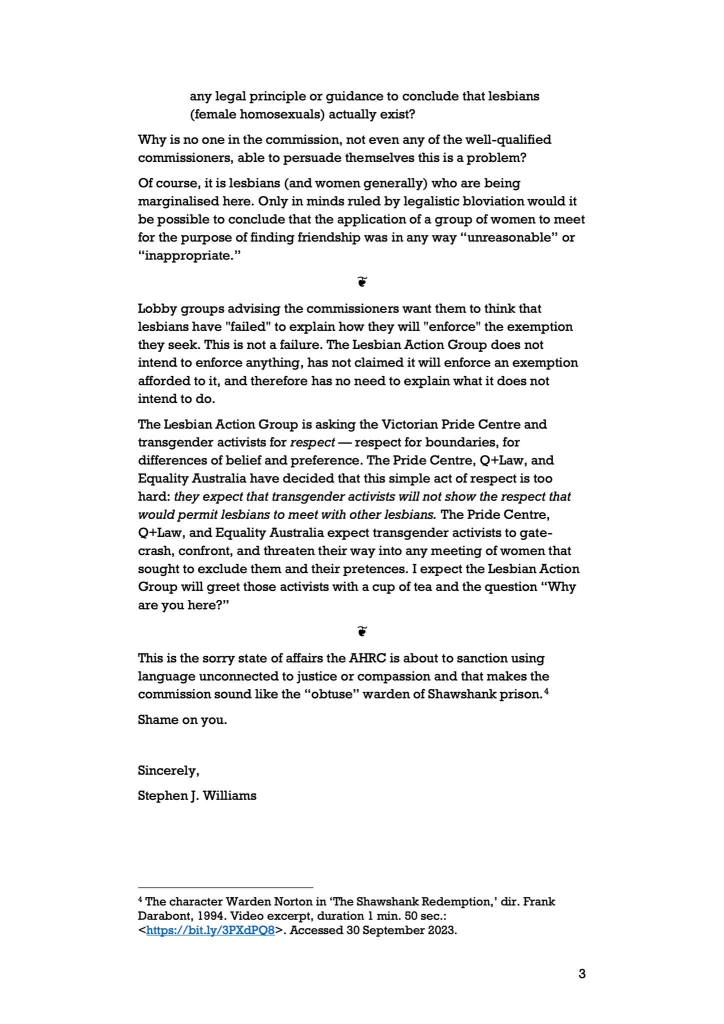
… in support of the Lesbian Action Group
→ Restore the impartiality of the AHRC (open letter and list of signatories, archived)

→ Restore the impartiality of the AHRC (open letter and list of signatories, archived)
Color-changed and juices spent your average tree
abandons hope of saving its riches and begins
a fall that resembles economic collapse. One thing
leads to another. Moisture accumulating in the sky …
A boulder balancing against gravity over
the mountain path … An old gasket no longer
able to hold its own for the safety of a cook …
The moment arrives like a mob in the street. Some
sweet souls just want to kiss the new year in
and others have an urge to kill. The monkey's
grip lets go. Everyone is soaking wet with ‘love.’
Music scores are marked crescendo. A Tolstoyan
force of history relieves us of responsibility
for the deaths of shopkeepers and of friends
before the final peace sets in, the end of ends.
This year is the twentieth anniversary of my publication of Joyce Lee’s It is nearly dark when I come to the Indian Ocean, her collected works 1965–2003. Lee died in 2007.
![Joyce Lee [photograph, 1993]](https://stephenjwilliams.com/wp-content/uploads/2015/08/19930000joycelee-v0-1.jpg?w=1000)
I was and still am proud that this life’s work of another writer continues to be available — with the help of the National Library of Australia’s TROVE.
—Stephen J. Williams
What is the confidence of a girl?
How does she make herself and with what rules?
The women of the late geometric period
Have eyes high up in their minds
And brows always lifted in surprise.
Their ears, pricked up, are tuned to truthfulness.
They do not hear the living clamor.
Where is the pivot of all the sadness?
They open their mouths but no sound comes out.
Blame their frankly strange anatomy
Of legs like spikes for holding firm
Of their arms to search for meanings and
Of their bell-shaped bodies.
Unsurprisingly, their breasts are small
Since there is no use for them
In the other world, where, ironically, kindness
And love are brought from fountains.
Girls know a woman is a series of enclosures
A darkness, and a maze.
They know what wishes are
And that for every girl there are two birds
One dancing and one still
One feathered, one un-winged.
Remember, girls, remember, men:
Those buried without their mouths
Those buried voiceless—
They were shaken but still sing.
And when women sing, all tremble.

Why, when the singing was over, did the young man’s nose look crooked?
Normally, a choir will line up to fill the space in which it sings, but this choir is a circle.
When the game is over and the teams fall back to their rooms, the losing side sits dejectedly along the walls.
The winning side stands in a circle of players, to the exclusion of all others, arms around each other’s shoulders, singing the club song. The words tumble out quickly. There is no effort at all to co-ordinate one voice with another, and no division between tenors, baritones, and basses. And, certainly, no harmony. Heads and shoulders bob up and down excitedly in the rhythm of the song.
Why, when the singing was over, the winning club and fans all happy, was the young man’s nose crooked and his face covered in blood? He was singing with the others. He sang the same lyrics. Players noticed the rover’s grin through a face covered in mud and sweat.
But, just as the singing stopped, and a cheer went up, everyone in the room shouting exaltedly, the smallest man there stepped back from the circle and his face turned away, body bent double, hands cupped underneath his nose as a stream of sticky, vivid red blood poured over his mouth and jaw.
The room was still murmuring with self-congratulation and laughter as arms began to gather around the rover’s shoulders to help him to a bench. While players and team staff fussed around the rover’s head, offering towels, simultaneously barking questions and commands— “What happened?!” and “Put your head back!” —all eyes turned to the bloodied centre of the room.
“No. No. Please don’t. I’ll be all right,” the rover said, adding a hint of uncertainty and pathos with “… I think.” A doctor was called. And the doctor called an ambulance. “I’ll be fine. I think.”
It did seem strange that a nose so irregular should take so long to bleed after coming off the field. Absent testimony or witnesses, the coach and some players scoured video of the game for any record of the final moments of play and of the opposing team’s crestfallen retreat from the field. They found nothing, and their rover was silent, except to apologise for the trouble his nose had caused.
Some secrets escape even a camera’s gaze, and the next day, when club managers viewed a CCTV recording of the circle of men singing, it was still not clear what it showed, or that it showed anything. Arms raised and bodies jumping and hugging obscured the final second when the rover stepped back from the choir. In one moment he stands next to the team’s ruck, the taller player looking down into the rover’s face; and in the next they have both disappeared in the chaos of the team’s rejoicing.
When, the next day, the rover’s face emerged with a bandage on it, a theory also surfaced. And, since rumors abhor a silence, there were many more fictions than facts about what had happened. Neither the plentiful fictions nor the rare facts would go away; and both the rover and the ruck were silent.
The public’s mind is a dark and noisy place, and imagination lights a flame where there is no spark of intelligence—or truth. It was inevitable this imaginary fire would have to be put out, but the coach’s remarks to journalists seemed obtuse, like someone trying over and over to kick goals with a lettuce. The ruck was there, too, thinking he might have one chance to douse the hot mess.
One journalist squeezed her way through to the front of the conference. “Don’t mind me. I’m short. You won’t miss a thing,” she said, excusing herself, as she pointed a recorder up to the ruck’s mouth. “There’s been a suggestion,” she called out in a loud voice with staccato emphasis on her key words, “that you’re going to offer a ‘… gay … panic …’ defence and that …”
“Hold on. Let me stop you right there, so you don’t embarrass yourself. I don’t want anyone to be embarrassed. I … did … not … punch my friend in the nose because he touched me in a … special … way,” the tall man said, repeating the journalist’s staccato. “I punched him because he didn’t ask first.”

Look! From out of history’s darkening skies
A kaleidoscope of amorous, witty butterflies
Comes to save us—from fatuous liars
And deceivers, from ‘fake news’ and perdition’s fires.

Welcome them, friend. Let them land
Their gaudy wings upon your hand,
Or head, or nose, or knee, or bum.
Let them flit and ‘do their thing’ until the job is done!

 Stephen J. Williams
You must be logged in to post a comment.